








Add value to produce and reach new customers
I started farming during university on urban organic farms. After graduating in 2018 with lots of student debt, I looked for jobs that pay well above minimum wage. I realised quickly it wouldn’t be sustainable for me to farm full time physically or financially, but I still wanted to include it in my lifestyle in some way.
My farm-to-table food business, The Conscious Kitchen, started somewhat serendipitously with people on Facebook asking for freshly prepared meals. I started cooking for them, and they told their friends.
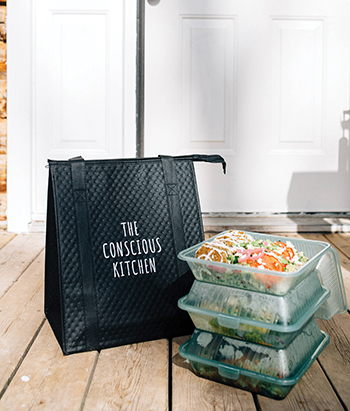 The author has spent about $25,000 over three years on returnable containers that they have not charged customers for. They see this as an ethical investment, and it has not hurt the bottom line. Many customers see this zero-waste aspect as a big reason to order.
When I found a commercial kitchen to rent, the business took off. I sourced organic produce from local farmers, including the farmers from whom I was buying my own CSA. Eventually, I was buying hundreds of pounds of produce from them each week. Early on I did some ‘back of the napkin’ calculations and realised the margins on these meals were great.
As my customer base steadily grew I knew this would be a sustainable enterprise that would allow me to stay connected to the farming community and eventually do small-scale farming myself.
As I grew the business, I talked to my farming friends who were optimistic about the possibility of buying land to run their own farm, but I was seeing a different reality. Minimum wages from farming jobs couldn’t cover the increasing land prices in southern Ontario, Canada. Back in 2020, prices for one acre of farmable land within two hours from Toronto averaged about $500,000. It has only since increased.
In August of 2020 we looked into purchasing land ourselves, and the closest that we could afford to our city of Guelph, Ontario, was $615,000 for 5 acres, of which ¼ acre was actually farmable. We afforded it with a $100,000 gift from our parents, a $60,000 off-farm salary, and a parent co-signing the mortgage. Our $1,800 a month mortgage, along with an additional $1,000 a month in utilities and property taxes, wouldn’t have been feasible with farm income alone.
I also noticed that farmers who already owned their land were working around the clock to afford their basic needs, and many farmers were burning out and leaving the farm. They were using unpaid or low-wage workers just to break even. Even with land, I saw many farmers with business models that weren’t working.
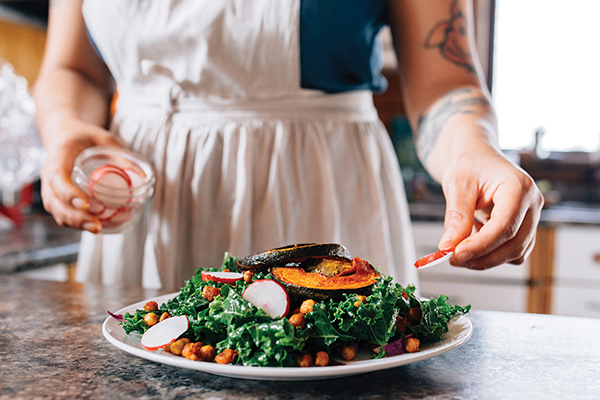 The Concious Kitchen. All images courtesy of the author.
For our society to continue having a local food system, people must be able to farm sustainably, so when you think about these two factors — rising land prices and farmer burnout — it’s not hard to arrive at the conclusion that something has to change in the farming world.
And it is. We are seeing farmers starting to add value-added products and services to their farm enterprises to increase overall profitability. We’ve seen this successfully done with on-farm retail stores, agri-tourism, and farm-to-table prepared meals, like what we are doing.
Our business
Our farm-to-table business is called The Conscious Kitchen. Our commercial kitchen is located on our 5-acre farm property on Saugeen Ojibway Nation Territory in what is known as Grey County, Ontario, Canada. Our weekly, ever-changing menu features local, seasonal ingredients in reusable containers that we take back, sanitise, and redistribute.
We serve three medium-sized cities (average population of 200,000) within an hour and a half drive from our farm. We have about 200 customers in rotation. The average order size is $75 as customers are purchasing a week’s worth of meals to fill their fridges. We have a minimum order size of $45.
My first year, revenue was $80,000, and I paid myself $10,000 from the business. The second year revenue was $150,000, and I paid myself $45,000. In my third year, revenue was $350,000. I paid myself $60,000, and paid two employees $35,000 each ($22/hour, 30 hours/week).
 The author.
I’m not going to kid you into thinking that offering prepared meals is a silver bullet; I still work long days and burnout is very possible. Yet, the profitability of the model allows me to build a business and life that works for me, which includes farming in a smaller capacity. So if you are interested in diversifying your days and revenue streams, let me summarise the benefits that I have found from this type of business.
Benefits
Simply put, it’s profitable. Prepared meals have high margins that allow me to pay myself and employees well above living wage (starting salary is $22/hour) and reinvest in the business, such as a kitchen expansion and a new Ford Transit van. I can purchase high-quality, sustainable produce which supports our local farmer friends.
I can get creative and integrate a wide range of produce in the meals. The meals are never repetitive and I create them based on local and seasonal ingredients. I can use unique vegetables that consumers may not cook with themselves, introducing new ingredients and purchasing produce that is profitable for farmers. Farmers tell me they want to grow cool veggies like kohlrabi, but customers don’t know what to do with them. When we buy kohlrabi to use in our dishes, customers never complain.
My workweek is more flexible and I can preserve my energy. With delivery, I don’t have to be at a farmers market at a certain time. I get to create a delivery schedule that suits my workweek, with flexible start and end times. Plus, in-person markets and events drain my energy. I like interacting with customers over email or briefly at their door, but I wouldn’t do well with long days talking with hundreds of people at a farmers market. This model suits my personality well.
I can still include farming in my day-to-day. I find farming part-time and running my food business the rest of the time a great balance. We farm a quarter of an acre of vegetables, which we use in the business. We get to farm speciality varieties, and only what we want. We can buy the rest in from our neighbours and farming friends.
If the benefits pique your interest and you are interested in trying it out for yourself, consider the following.
Reusable containers
From the start we wanted to operate as zero-waste as possible- which meant using reusable containers. Our reusable container system is mostly simple to manage, although has been expensive. We use containers from a company called G.E.T. Enterprises (bought through webstaurantstore.com) which are ordered in cases of 12-24. The cost of each container is high- about $4-$7- and each order includes about $30-$60 worth of containers.
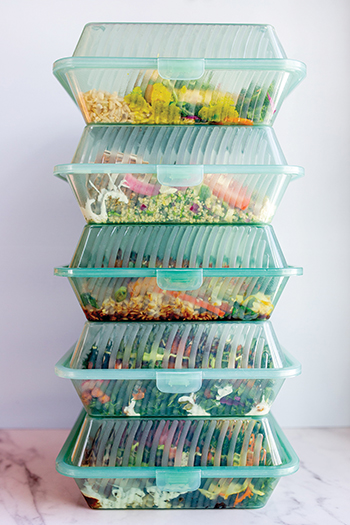 It takes 4-5 hours to sanitize the 500-600 containers that are returned in a given week.
We initially decided not to charge customers a deposit on them, as it would take us too much time to track who returned them each week. Instead, we charged a “membership fee” for customers to use our service, which was about $50-$100 yearly based on family size- about the cost of 2 sets of containers. After six months we decided to stop charging this fee, as we thought it was stopping potential customers from ordering- and we were right.
We now reach out to customers after their first order and if they do not wish to reorder we pick up the bag & containers, and if they continue to order we swap the old containers for new each week. We do lose some, as some new customers never return our email, but overall 90% are returned.
In terms of sanitizing, we use a three sink wash & sanitize method. We wash them briefly, rinse, and sanitize in bleach, then air dry on shelf racks. It takes about 4-5 hours per week to sanitize 500-600 containers.
At this point (year 4 of the business) we have spent about $25,000 on containers that we have not charged customers for. We see this as an ethical investment, and it has not hurt our bottom line. Many of our customers see this zero-waste aspect as a big reason to order from us.
Getting started
You will need a certified commercial kitchen for the food production. Where I live, rural municipalities permit ‘home occupations,’ allowing you to run a certified food business from your home in a separate kitchen. Depending where you are located, this could be the same. Contact your municipality to learn zoning and home business regulations.
If allowed and after you’ve set one up, you’ll need to get it certified by the local public health authority. Alternatively, you can rent a commercial or shared kitchen space, but saving commercial rent costs is a huge bonus. To install our commercial kitchen, we spent $25,000 — $10,000 for the walk-in fridge, the rest for counters, sinks, stoves, electrical, plumbing. We would have easily spent that sum on rent in just one year.
You’ll need culinary skills, but don’t have to be a professional chef. I am not a trained chef; I’m self-taught. If you are a good cook you may be able to do the cooking yourself. Our meals are family friendly and replace what people would likely cook for themselves.
If you don’t have culinary skills, you can hire a chef. But be careful, this type of cooking is different from a chef’s restaurant experience. It’s more similar to catering cooking. Simple but creative menu options and efficient use of seasonal ingredients are all really important skills to have.
You’ll likely need a delivery vehicle. If you already have a vehicle to deliver your produce, you’ve got this covered. You will need a refrigerated unit in the vehicle to keep the food at regulation temperature. If you don’t want to do delivery and would rather sell the meals at your farmers market booth, I would recommend having customers pre-order the meals to pick up at the market to avoid leftovers.
Your existing customers are your best customers. Chances are you could sell these products to your existing customer base. Even if they are buying a week’s worth of veggies from you, they’re likely buying some prepared food or takeout. So think about how you could offer that to them. Maybe you offer prepared meals as main dishes, and they can use a veggie CSA to add as sides.
In case you are thinking that this all sounds too good to be true, or wondering how it works, I’m going to break down the business model and why it’s as profitable and sustainable as it is.
Why it works
Efficient production time is important. We have a new menu of five meals and sides that rotate each week. We’re creating the menu items based on what is seasonal, local, and in abundance. We are making the meals in large batches which is very efficient. When compared to the amount of labour it takes to farm, prepared meals have a very high return on physical labour time. As a business we spend about 100 person hours working per week and generate $7,000 in revenue in that time.
Taking orders ahead of time is efficient. Similar to the concept of a CSA, we receive our orders in advance of preparing them. Unlike setting up a farmers market where you don’t know how much produce you’ll sell and could have leftovers, we only buy and prep the ingredients and create the meals after we know how many orders have been placed. This saves time and waste.
Efficiency of deliveries is created by having large basket sizes (average order size is $75) and delivering $3,000 worth of product in one day’s delivery route. That’s maximising our time, gas, and vehicle space. The economics of delivery might not work if you’re delivering $15 or $30 worth of product to someone’s door, but it likely will at $75 per delivery.
If you are interested in setting up a farm-to-table prepared meal business on your farm, reach out to me at celeste@slowgrowing.ca or visit our website at www.slowgrowing.ca.
Copyright Growing For Market Magazine.
All rights reserved. No portion of this article may be copied
in any manner for use other than by the subscriber without
permission from the publisher.