










Excerpt from The Farmer’s Office, Second Edition
When starting out, many farmers look at what other farmers charge and copy their pricing. It’s quite common. Others want to keep prices in line with the local supermarket. Maybe you did the same? If you’ve done a cost of production analysis or even a bigger picture profitability analysis, you may realize you will need to raise your prices if you want to be financially sustainable.
I don’t need to tell you that increasing your prices is not as simple as it sounds. Will your customers still buy from you if you raise your prices? Does raising your prices misalign with your mission of providing local sustainable food at an affordable price?

Bill and Jean from Soule Lake Farm (not their real names) faced a similar challenge with their livestock operation in Wisconsin. After five years in business, they were not yet generating a profit. They called me to help them figure things out. As we combed through their financials and cost of production, it was clear that something had to change.
The numbers were objective and unemotional. They had two options. They could:
- raise prices, and/or
- decrease expenses.
After some discussion, we agreed they weren’t charging enough for their beef, and they needed to raise their prices. A few months later, I called to hear how the price increase went. Their response, “We’re working on it.” I thought to myself What is there to raising prices? You decide to raise your prices, you change the numbers in your POS and signage, et voilà: prices change.
I couldn’t figure out: what was getting in the way of Bill and Jean raising their prices.
Bill and Jean are not alone in this struggle; we all have some sort of emotional discomfort around money, and it’s no wonder. In “polite society” we’re conditioned to not talk about money (or politics). And this discomfort can impact how we manage our businesses.
The numbers can tell you what you should do, but we are human with all our experiences and emotions, trying to implement what the numbers say. Bill and Jean knew they should raise their prices.
It was easy for me to make the recommendation. I didn’t have to tell their customers, risk that relationship, and worry if they’d still buy from me. My self-worth and value weren’t tied up in how much they charged for their products.
These internalized feelings around money are referred to as “money shame.” Money shame is different for everyone and impacts our decision-making in different ways. For Bill and Jean, it prevented them from raising their prices. For others, it’s a stubbornness to look at financials for fear of what they may reveal.
Money shame manifests itself in several broad categories [I get into more details in The Farmer’s Office], but the one that often affects farmers when it comes to pricing strategies is that they see their value and worth tied to how much money they make. The internal dialogue we have with ourselves might include: “My products and time aren’t worth what it costs to produce them. Do I deserve to earn this kind of money? Are people going to pay what it costs to cover expenses and allow me a fair profit?”
Before farmers can comfortably raise prices, they need to resolve this internal dialogue. Let me offer you two examples of how we can shift the language we use to start shifting our mindset around money.
1. If your business generates solid profits, then you can ensure people who need it can access healthy food; you can continue to do the work that’s important to you.
As Emma Jagoz of Moon Valley Farm said:
We live in a capitalist society. Why do farmers need to be the martyrs of the business world? To be stewards of the land, we have to take a long-term approach … and that takes money and resources. We have to make a profit.
2. Money doesn’t represent your value. Certainly, you provide value to your customers with the beautiful products you grow and raise, but it in no way represents your value. Money is just a tool to buy and do things. It doesn’t change your value or worth to have it or not to have it.
Even with the right mindset, there is still the fear that raising prices will irritate your customers and/or push them to buy from another farmers.
Here are 7 tips to raising your prices that can minimize potential backlash from your customers.
1. Communicate price changes to your customers.
Especially during high inflationary times, your customers understand that your inputs and labor expenses increase. If you provide a meaningful explanation (a clear “why”) for the price increases, they will be more likely to accept it. You can also share details of how you tried to keep costs down. Be sure to thank your customers for their continued loyalty.
Part of the messaging to your customers should be a reminder of your value proposition (which we’ll discuss in the next section).
2. Communicate changes to your staff, too.
It helps to let your staff know about price increases and messaging. If your staff talks with customers—at farmers markets or delivery runs—you want them to be able to provide the same transparency that you do. This also helps to ensure they price products properly if they set up the farmers market booth or work the cash register at your farm stand without your oversight.
3. Provide options.
One reason costs increase is that fewer customers pay with cash. Credit card companies take as much as 3% off the top, directly cutting into your profits. Consider offering a cash discount or implementing a service charge for using a credit card.
You may also want to offer different packages at lower prices. For a CSA, you can offer a smaller share for a lower price. At farmers markets, you can offer discounts on prepackaged bundles that allow you to control your costs. For wholesale customers, you can consider bulk discounts.
Finally, consider reducing the package size instead of increasing prices. For example, if you currently charge $5 for an 8-ounce bag of lettuce, you could reduce the package size to 6 ounces and still charge $5. This is known as “shrinkflation.”
Matt LeRoux from Cornell University offers great suggestions on how to strategically increase revenue (and prices) in the November 2022 issue of GFM.
4. Sliding scales/Pay it forward.
Not all of your customers can afford to pay premium prices and will struggle with a price increase. For mission driven businesses that want to ensure access, there are creative ways to offer sliding scales. One option is to offer different prices in different communities.
I’ve seen some farmers request donations as a way to subsidize costs. For those who can afford a little extra, many are willing to give.
5. Raise prices for new customers first.
New customers don’t have a history with you to know your pricing structure. This may be difficult in a farmers market or farm store setting and more realistic for CSAs and wholesale. You can graciously frame it that you’re raising prices for all customers but want to continue with the old pricing for existing customers for a period of time.
6. Raise prices regularly.
This may seem counterintuitive—that if you raise prices regularly, then you have to deal with the agita of raising prices regularly. However, if you don’t raise your prices regularly, then when you finally do it, it will be a steeper increase. A steep increase may be harder for your customers to accept than small, gradual increases.
Whenever you have a price increase, you can afford to lose some customers and maintain your total revenue. Further, if you have fewer customers, then some of your expenses may decrease, too.
Ali Haney from Shenandoah Seasonal offered my favorite tip. She raises prices on a few items each year. As she said, “This helps ease the impact on the customer. They can see that many prices are still the same; and I can consistently raise prices to keep up with rising costs.”
7. Don’t ignore the critics.
People don’t like to see costs go up. Some of your customers will be upset. If you listen to them, and they feel heard, it can help smooth things over. And if you’ve clearly laid out your talking points (see tip #1), you’ll have an easier time addressing their concerns. That said, if the customers are so incensed at your price increases that they leave you for a cheaper option, then you’re probably better off, as difficult as it may feel in the moment. Trying to compete on price is a losing proposition.
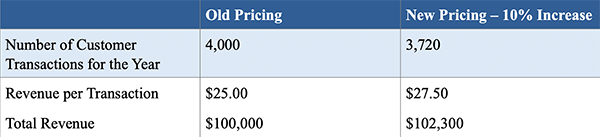
Keep in mind, if you raise your prices and lose a few customers as a result, you can still be ahead. Let’s say your farm generated $100,000 in revenue last year. To generate those sales, your customers spent an average of $25 per transaction, so you had 4,000 transactions over the course of the year ($100,000 total revenue divided by $25 per transaction).
This year, you decide to raise your prices by 10% so your revenue would be $110,000 for the same amount of product, and the average transaction would be $27.50. If you lose 7% of your customers, then instead of having 4,000 transactions for the year, you will have 3,720. Your projected revenue would then be $102,300 (27.50 * 3,720)—still ahead of the previous year.
In other words, whenever you have a price increase, you can afford to lose some customers and maintain your total revenue. Further, if you have fewer customers, then some of your expenses may decrease too.
Communicating value
In order to command a higher price, you need to explain to your customers why your products are priced as they are. You can communicate this through your packaging, signage, emails, and sales pitch. The message you communicate depends on what your customers value about you and the products you sell.
I want to clarify one point—what you think are the key features of your products may not be what your customers value. You may think your heirloom varieties are the most important, but your customers may care more that you grow organically. If you are not sure about the value you provide your customers, ask them. Specifically, ask regular customers with whom you’ve developed a relationship and you trust will provide honest feedback.
Here are some examples of messages that communicate value to your customers:
- My product is fresher than what is available through the supermarket or wholesale distributor. It will last longer, and in the end, the customer will save money.
- It tastes better than anything else available.
- I grow heirloom varieties not commonly available, and they have superior flavor.
- I grow using organic practices.
- I provide recipes and cooking tips with the weekly CSA shares.
- The CSAs are dropped off at convenient locations.
- I offer unique farm experiences to my customers like pick-your-own (PYO) and farm dinners.
Further, consider what you can do to maintain and deepen relationships with existing customers. What can you do to “wow” customers to stay memorable? What are some low-cost, high-impact strategies you can use? Remember, it is cheaper to maintain existing customers than to attract new ones. This could be as simple as offering small samples at your farm stand or creating dynamic displays.
Loss leaders and product mix
After careful consideration, you may decide that, in fact, you cannot raise your prices, or you can’t raise them enough to ensure their profitability. To be clear, it’s okay to have one or two products that don’t carry their weight,57 but the products that don’t generate profits need to provide another value to the business.
These items are considered loss leaders: they generate a loss but lead more customers to your business. Most businesses have one or two. The key is to make sure they are not your top-selling items, and you have other items with sufficient profitability to make up for them. If your loss leader is your top-selling item, then consider capping its production or stop selling it altogether. Continuing to sell unprofitable items at a high volume will drive you out of business.
In summary: One of the most impactful ways to ensure the long-term viability of your farm is to have an effective pricing strategy. That said, knowing what you should do isn’t always easy. Recognizing the mental blocks around money can help you move past them and better position you to do the hard, but important, tasks in managing your business for profits.
Julia Shanks is the author of The Farmer’s Office, Second Edition and The Farmers Market Cookbook, available from Growing for Market. She works with farming and food entrepreneurs to help them achieve financial sustainability through business planning, cash flow planning and financial feasibility studies. She is a Certified QuickBooks Pro Advisor. You can learn more about her work and watch videos on how to create a cash flow budget at thefarmersoffice.com. Listen to our interview with Julia on the Growing for Market Podcast at growingformarket.com/ or wherever you get your podcasts!
Copyright Growing For Market Magazine.
All rights reserved. No portion of this article may be copied
in any manner for use other than by the subscriber without
permission from the publisher.