











As I mentioned in my March 2013 article in Growing for Market, I tried a new trellising method in the hoophouse last year, which I ended up loving for cucumbers and hating for tomatoes. For some people, it works well for both, and in that case it saves time, money and materials in the lowering and leaning of the crop.

The system is called Qlipr and it was developed in Holland. The Qlipr system uses aircraft cable instead of pipe to secure the plants to. If you have a hoophouse with pipes for trellis anchors, Qlipr won’t work without using cable to suspend the crop. The Qlipr system consists of a piece of stiff, heavy-gauge wire and two clips to hold the plant. The wire has a bend at the top end, which hangs the wire from the cable. At the bottom end of the wire is a ball to keep the clip from sliding off.
The Qlipr clips are unlike any other trellis clips. They have an outer layer of metal, which gives the clip structure, and an inner layer of foam, which grips the plant securely without mashing it. When not in use, the outer layer of metal automatically springs the clip open. When in use, the foam part of the clip holds the plant and the metal part grabs the wire.
To use Qlipr, hang one wire which is about 4 feet long above each plant. Tie a piece of twine to the end of the Qlipr wire to nearly reach the ground. The ball on the end of the wire keeps the twine from sliding off.
Before the plant becomes top-heavy and flops to the ground, clip it to the string. As the plant gets taller, add a second clip. Keep leapfrogging the same two clips up the string as the plant grows until it reaches the wire
Here’s where the magic happens. With two clips attaching the plant to the wire, the next time the head is getting top-heavy it will have reached the top of the wire. The plant has run out of vertical growing space. So you take the bottom clip off the wire, the plant slides down the wire until the clip hits the ball at the bottom of the wire, and the clip that was at the bottom goes to the top to secure the head of the plant. This process can be repeated an infinite number of times until the end of the crop.
In the standard method of lowering and leaning, clipping is one job and lowering and leaning is a separate job. The beauty of the Qlipr is that it makes clipping and lowering all one motion. As you take the bottom clip off, the weight of the plant automatically slides the plant down the wire, and all the grower has to do is put the clip back at the top of the plant and lean the plant.
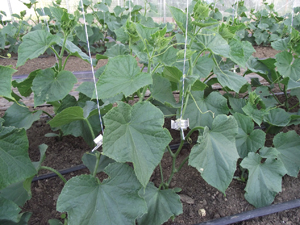
The other advantage of this method is that instead of using a new clip every time the plant needs to be clipped, the Qlipr method uses only two clips per plant, which get used over and over. When I bought them, the wires were running 50 cents each and the clips were running 6.5 cents each. For an investment of 63 cents per plant, this initially costs more than using plastic clips. Since the Qlipr system is reusable, it should be cheaper in the long run. You can get Qlipr from Hort Americas, a greenhouse supply company in Texas.
Labor being the biggest cost for many growers, the main benefit of this method is the labor savings. If you look online there are Youtube videos of Qlipr in use in Dutch greenhouses. I have never been able to get as fast as the flying Dutchmen on Youtube, but in my cucumbers there was a labor savings from this method.
Another benefit of Qlipr is that it makes end-of-season cleanup fast. With traditional lowering and leaning, at the end of the season you have tens of feet of vine, clipped to the twine every foot or so. It takes several minutes per plant to take the clips off to separate the compostable plant from the non-compostable twine and clips. If you figure a few minutes per plant times a greenhouse full of plants, this can be a big job.
The Qliprs worked very well for my cucumbers. They performed just as described and I plan on using them again this year. My tomatoes are another story. At first the system worked just as well on my tomatoes as on the cukes. But, as usually happens in my tomato crop early in the season, the plants got extremely vegetative. They grow fast with huge leaves and giant, fat stems as big around as my pointer finger.
The stems were so large that they took up all the available space in the clip, and made it almost impossible to get the clip off. All those labor savings evaporated, and I wasted hours struggling with clips.
The plants eventually settled down and achieved a balance between being too vegetative and too generative. The stem diameter went back to normal and Qlipr worked. Overall, I wasted a lot of time on tomatoes and I am not going to use Qlipr on tomatoes again. The cucumber stems stayed within an appropriate size range, even when young and extra vigorous.
If my tomato plants had not been so excessively vegetative, this would not have been a problem. I know growers who use Qlipr for tomatoes and are very happy with them. But they have heated greenhouses, and careful use of temperature is one of the main ways to control how vegetative tomato plants are. So my advice would be to try just a few Qliprs on tomatoes, and see if you like them, unless you have a heated greenhouse and good control over vegetative/generative steering of your crop.
In a future issue, I’ll write more about how to tell whether your vining crops are vegetative or generative and what to do about it.
Andrew Mefferd runs One Drop Farm in Cornville, Maine, with his wife, Ann, and does variety trialing for Johnny’s Selected Seeds.
Copyright Growing For Market Magazine.
All rights reserved. No portion of this article may be copied
in any manner for use other than by the subscriber without
permission from the publisher.