











By Josh Volk
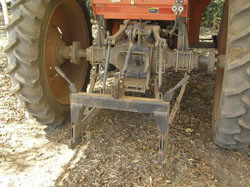 I learned to hook up implements to the tractor when I was an apprentice. I’ve always remembered that Andy, the farmer I was learning from, told me that hooking up an implement was the most dangerous job on the tractor, especially when two people are involved. Not only is it the task with the most potential for serious injury by being caught between the tractor and the implement, it’s also the one where I’ve scraped my knuckles more times than I care to remember, bruised my foot kicking the lift arms, and strained my back multiple times trying to lift heavy steel pieces while reaching and twisting awkwardly.
Connecting an implement to a 3-point hitch usually involves backing up the tractor to align perfectly with the implement, then getting off the tractor and pulling the hitch arms of the tractor over the hitch pins of the implement. As if this weren’t awkward enough, if you didn’t get the tractor into the right position, you’ll have to attempt to move the implement — a sure way to strain your back or, worse, be crushed by the implement as it tips off its stand. Or you can get back on the tractor, pull forward, and try it again. All this can take a lot of time for even the most experienced farmers.
A better solution from the standpoint of both time and safety is a quick hitch system, which allows the driver to change implements without getting off the tractor. Several types of quick hitches are available. These systems have one component that is permanently mounted to the 3-point of the tractor (the male part) and a separate component (the female part) on the implement. The male plate latches in under the female part and aligns itself as it lifts the implement. There is usually a cable or rope pull to disengage the latch when unhooking the implement from the tractor so that the operator doesn’t have to get off the tractor.
I started thinking about quick hitches recently when John Peterson from Angelic Organics in Caledonia, Illinois, wrote GFM the following note: “Jiffy Hitches save time and make a farm safer. We have Jiffy Hitches on 27 implements at Angelic Organics, and on 5 tractors. We can swap 3-point implements in two or three minutes. We are no longer endangering our employees’ safety in hooking up equipment now that we use Jiffy Hitches. We raise 40 vegetables and sometimes need to do as many as 5 implement changes per day… no problem at all with the Jiffy Hitch system.”
It reminded me of a conversation I had with Jim Leap when he was the Farm Manager at the University of California – Santa Cruz. I asked Jim what the most exciting new tool they had on the farm was, thinking it would be some new cultivation or tillage piece but he started talking about the quick hitch system that he had recently invested in. My memory is that for him, the initial decision had been a safety one. With lots of apprentices coming through the program who were not familiar with tractors and equipment, changing implements was difficult, time consuming, and certainly a potentially dangerous job, so a quick hitch system was an easy decision, even with the initial costs involved. The unexpected side benefit was that it changed the workflow with the tractors on the farm. Instead of feeling that he had to do everything possible with a single implement once it was hooked up to the tractor, Jim told me he was now very comfortable doing just one or two things and then quickly, safely, and easily changing to another implement to do another job. 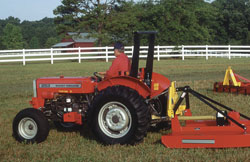
I can totally relate to both John’s and Jim’s comments and I’ve worked with one quick hitch system myself, similar to the Jiffy Hitch system that John has, or the Delta Hook system. The first tractor I ever worked with had a “top and tilt” kit added on. This is a hydraulic top link and a hydraulic leveling link for one of the lift arms on the 3-point, both of which are operated from valves mounted next to the seat of the tractor. At the time, I didn’t know how good I had it. Even without a quick hitch system, these two hydraulics made it much easier to mount equipment when the tractor wasn’t sitting exactly right. They also make it easy to adjust the draft angle and level in the field while in motion. Later, when I bought a new tractor I found out how expensive these add-ons are, but after years of fiddling with turnbuckles I can definitely recommend the expense.
The type of quick hitch that Jim Leap was using at UCSC is slightly different than the plate type. It has a square frame that is mounted to the tractor’s 3 point and then relies on larger pins that are retrofitted to existing implements. These types of quick hitches are more commonly available and many manufacturers put their names on versions. Google “quick hitch” and most of the image results will be a version of this frame. This style takes a little more precision in backing up to the implement, and also benefits from a “top and tilt” kit, but it only requires replacement pins for each implement, not an entire mating plate. Typically the latches also have to be operated from the ground in order to uncouple an implement, requiring the operator to get off the tractor (or make a long reach from the seat).
With either style of quick hitch systems, there are a few things to watch out for. One issue is with PTO shaft drivelines for implements requiring the PTO. Hooking up a PTO shaft still has to be done from the ground, and the quick hitches change the distance to the PTO, and sometimes the drive line angle, so compatibility might be an issue, or you might need a longer PTO shaft. Also, European equipment frequently has different pin spacings than standard U.S. pin spacings (which aren’t always standard either). For some systems this might mean you need to make extra modifications to match the implement to the hitch system. For the pin-style hitches, there needs to be clearance under the pins for the hitch to be able to attach to the pin. In both of these cases a good machine shop should be able to modify your existing implement to work with the hitch system you choose.
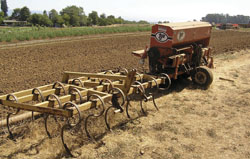 When I wrote John to clarify his endorsement of the Jiffy Hitch system he sent me back this comment, which I think gets straight to the point: “I don’t have any personal stake in marketing the hitches. I just think lots of farms should consider them, because they will save time and probably some fingers. I think standard 3-point hitch setups have not kept pace with today’s agricultural technology.”
Videos give a better understanding of how quick hitches operate. You can see a demonstration of the delta plate type of hitch at www.deltahook.com. For the other type, go to youtube and search for Quick Hitch Impliment (yes, it’s misspelled there.)
Josh Volk farms and writes at the edge of Portland, Oregon, and consults with farmers around the country. Contact him through www.slowhandfarm.com.
Copyright Growing For Market Magazine.
All rights reserved. No portion of this article may be copied
in any manner for use other than by the subscriber without
permission from the publisher.