











If I had to choose only one flower to grow in our hoophouses each spring, hands down, ranunculus would make the cut. With so many wonderful qualities it is impossible not to fall head over heels in love with them. After a winter of dark days and sterile South American product, designers and buyers are so hungry for something new and different. Daffodils and tulips are always well received, but in our neck of the woods, ranunculus steal the show! With tall stems, double ruffled blooms, a light rose fragrance, a wide color range and abundant harvest, they’re always the belle of the ball.

Three years ago, when I planted our first patch, it seemed like a pretty risky venture. I thought we’d be lucky if they made it through the winter. But to my surprise and delight they grew unchecked through one of the nastiest winters on record and flowered with great abandon for six weeks in the spring! I still don’t understand why more aren’t grown locally. Imports from California fetch insanely high prices and are only half the quality of locally grown blooms.
While ranunculus are somewhat tender, only growing in zone 7 or higher without winter protection, they are a great crop for the hoophouse or greenhouse.
Varieties
Ranunculus should be planted in fall, so now is the time to order corms. There are several cut flower collections to choose from: La Belle, Gigi, Super Greens and the new Amandine. All have long stems, large flowers and the coveted double blooms. I have personally grown the La Belles and Super Greens with great success and will also be trying Amandines next spring. I have stayed away from the Gigi collection in past seasons, even though they have flower heads the size of golf balls, because I have heard horror stories about entire plantings failing to flower properly. One experienced grower wrote to me this spring saying his Gigi crop was a complete loss. Yikes!
I believe buying the largest corms available (5/7) is a worthwhile investment. For only about .15 more per corm, production is greatly increased, often by 50-80%. We generally get 8-10 stems per plant and most range from 15-20” in height. Pink Picotee, White Picotee and Cream (which are actually a pale yellow) all boast 24 inch or longer stems.
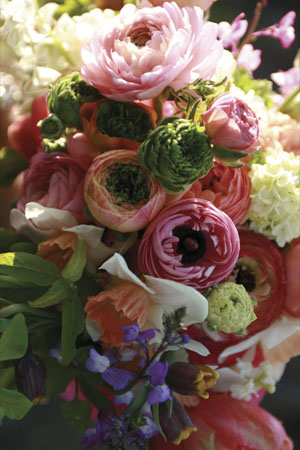
In the La Belle series, our top sellers are always the peach toned varieties. Champagne and Salmon are both exquisite! Pink is the second hottest color here. I love both Pink Picotee and plain Pink. Beware of Rose; we’ve had more than 50% disfigured flowers. After three seasons of disappointment I have finally culled it from the mix. For yellow, I adore the variety wrongly named Cream, which is actually a clear canary yellow. It has enormous flowers atop thick towering stems, the most massive variety of all. Orange is another huge seller for us. I have grown both Orange and New Orange. Orange had a lot of thin stems and about 30% are spindly singles. New Orange was much more consistent, with better flower quality and lovely pumpkin colored blooms. The past two years we’ve grown both Violet (actually deep burgundy) and Scarlet too. While they were both pretty, their colors were just too intense for early spring. Additionally they had many thin stems and puny blooms so neither will be reordered. White Picotee is a great variety with extremely long stems and blooms that are a mixture of white and purple. It worked great as our purple this season.
A huge winner for us this year was the new Super Green collection. We sold out immediately and had the entire crop prebooked after the first delivery. The Super Green Series looks as if it belong in a Dr. Seuss story! Each bloom has a strange green growth coming out of the center similar to bolting lettuce or a baby cabbage. I thought they might be too weird for our customers but amazingly the florists freaked out over them. Go figure! They come in a Mix, Rose, Red and Cream.
We grew both the Mix and Cream. Cream was a little shorter than I would have liked at 10-15”, but it didn’t seem to deter buyers. It worked great for both green, white and cream requests. The Mix was an absolute treat since it contained so many different colors ranging from cherry to gold, a beautiful salmon and lots of plain green. Next season I have tripled my corm order in hopes that it will satisfy some of the demand. Plants in this collection were very vigorous and healthy.
Gloeckner is introducing a new collection this fall called Amandine, which sounds absolutely wonderful. They are described as possessing the desirable characteristics of the La Belles with improved plant vigor and the ability to withstand warmer temperatures, in turn extending the flowering season. I’ve got 500 coming and can’t wait to see if they stand up to the hype!
Planting
Ranunculus are tender, needing winter protection if grown in all but the warmest climates. We plant ours in a single poly high tunnel but have spoken with a grower in Oregon (zone 6) who successfully grows them outside under low tunnels. I am planning a trip to their farm in October and will share all the details of their ingenious system in a future article.
I generally schedule our corms to arrive in late September, which allows enough time for presprouting before we plant in the hoophouse in mid to late October. In seasons past, I have planted corms as late as February 5 with surprising success. While the late batch didn’t flower as early as a fall planting, it was still quite productive.
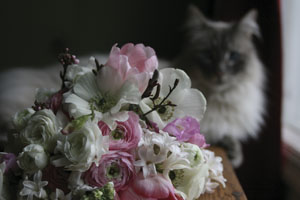
Included with each shipment is a direction sheet. It recommends soaking corms for 3-4 hours in room temperature water, leaving the water running just slightly during the process to help provide extra oxygen. Often corms come in small mesh bags, the type onions are sold in, and these work perfectly for the job. It is then suggested that a fungicide be added into the water for the last 30-40 minutes of the soak. Since we are organic I have always just skipped this step.
After soaking, corms should then be presprouted by packing them into ventilated bags with moist perlite or peat moss. I have always used flat bottom seed trays and peat moss which works quite well. Once packed, the corms should then be left in a cool place (50-55°F) for 10-14 days to presprout. It is important to check them regularly; making sure the medium is moist but not soggy. During this time, corms will swell to twice their original size and develop little white rootlets that resemble hair. Once these roots are 1/8-1/4 inch long, it is time to plant out. Last fall we experimented with planting corms directly after soaking in order to save the time and hassle of presprouting. While it was certainly easier, we noticed that as the corms sprouted (directly in the soil) there was uneven growth and a few blank spots where plants didn’t take. In the future I’ll follow the recommended approach since the end result was superior.
After heavily amending the beds with compost, rock phosphate and a balanced organic fertilizer we plant corms with 9 x 9 inch spacing, five rows per bed. Each bed gets 4 lines of drip irrigation and an application of compost tea monthly. In the coldest stretches of winter, when temps dip into the teens, we cover the plants with a layer of frost cloth but otherwise they grow and thrive in the cool, short days.
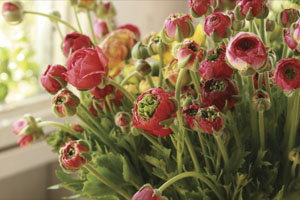
For the past few seasons our plants have started flowering the last week of March or the first week of April. Shortly after flowering begins, we start seeing the first aphids as well. When closely monitored and treated (we use Safer soap) they usually aren’t too much of an issue but if left unchecked in a warm hoophouse, the population can explode overnight. Once bud set occurs we also ramp up our compost tea applications to once a week which ensure lots of new growth and good plant health. Our crop normally blooms heavily through mid May and then, as if someone flipped a switch, they just stop. We then yank the whole crop and replant with heat lovers like celosia and basil. I always hate saying goodbye to this crop! Some growers save over their corms but so far we’ve been too busy and tired to try it.
Postharvest
Vase life on ranunculus is outstanding, often exceeding 10 days. Compared to the small, dry shipped product that is so common on the market, local ranunculus outshine and outlast the competition. I like to cut when buds are colored and squishy like a marshmallow, but not open, for the longest vase life. If cut open they still last a good week but are more fragile to transport. If you’re selling at a farmers market I’m sure these brilliant blooms will pull customers in off the street.
With so much going for them, ranunculus are definitely a crop worth considering. Blooming at a time when demand is high and local product is scarce, these beauties will have everyone talking and coming back for more.
Corms are still available and can be ordered from:
Gloeckner— 800-345-3787: www.fredgloeckner.com
Erin Benzakein runs Floret, a small organic flower farm in Washington State; www.floretflowers.com
Copyright Growing For Market Magazine.
All rights reserved. No portion of this article may be copied
in any manner for use other than by the subscriber without
permission from the publisher.