











Last spring we had solar panels installed on our farm for the first time. A combination of federal tax credits, USDA grants, and rising energy costs are making this an increasingly sensible economic decision for many farmers, in addition to the environmental benefits.
We started by looking at the power bills for our farm to determine our usage. We’d already made some energy-conserving improvements, such as tightening leaks and increasing insulation, since conserving energy is much easier and less expensive than generating it. On our farm we have three meters— one for our house, one for our worker house, and one that serves our barn and greenhouse—and our power company shows a year’s usage on every bill. From these bills our installer determined how many panels it would take to offset most of our usage.
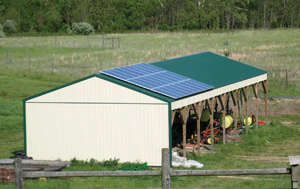
The next step was finding a site for the panels, choosing either a roof or an open space. In our case we’d recently built a 30’ x 80’ equipment barn that had a big new roof with a south-facing aspect. While we couldn’t afford to do it all at once, covering one side of that roof with solar panels would probably generate about 90% of the total electricity we use.
As a first step we put up 24 panels for an initial cost of almost $23,000, and an effective cost after grants and tax credits of about $12,500. We should save enough money on power bills to break even in about 10 years, and then have an additional 20 years of making money from our system before the panels start to degrade.
Our system is in two sets of 12 panels each. One set of panels serves our barn and greenhouse, while the other serves our home. The USDA’s Rural Energy for America Program (REAP) offers grants to cover up to 25% of the cost of a renewable energy project that serves agricultural purposes. Residences of any kind are not included, so even our farm worker house is ineligible, but the system that serves our farm buildings counts. Luckily, our installer was familiar with applying for the REAP grants, and helped us through the incredibly complicated and time-consuming process. We filled out form after form, providing all the details of the system, proving we’d installed the system, proving we could and did pay for it without the grant, proving we were a farm, and so on, providing both paper and electronic copies of everything we submitted. It probably took a solid week of work, but five months later we did receive $3650, or 25 % of the farm use portion of the project cost, which made the hours of paperwork more than worth it.
There are also federal tax credits available for both individuals and businesses that install renewable energy systems, under the Investment Tax Credit (ITC). This will be our first year using it, but it gives you a credit for 30% of the cost of installing a system, and as of now the credit has been extended at least through 2013. We’ll use this credit twice — once as individuals for the panels that serve our home, and once as a business for the panels that serve the farm — though in our case our business credit will pass through to us as individuals and the savings will all be on our personal taxes. Each situation is different, so get advice from an expert, but we think that many market farmers should be able to use this credit if they pay enough taxes to take advantage of it. In our case the credit will take $6,900 off the cost of our system, which brings the effective expense down to the $12,500 mentioned above. Finally, depending on your state, you may be able to make money selling Renewable Energy Credits based on your energy production. Here in Virginia, the credits aren’t worth much, but in other states they’re worth quite a bit.
We are happy with the solar panels on our farm. They fit naturally into our farm’s mission of environmental sustainability, and they have sparked more interest in solar in our community. At our age (39), an investment that will pay for itself in 10 years and start generating money long before we collect on IRAs feels like a good financial move. And it’s definitely fun to look out on a sunny day and know we’re growing our own electricity.
Eric Plaksin and Rachel Bynum own Waterpenny Farm, a 10-acre vegetable and flower farm in Sperryville, Virginia.
Copyright Growing For Market Magazine.
All rights reserved. No portion of this article may be copied
in any manner for use other than by the subscriber without
permission from the publisher.