










How to come back stronger after a natural disaster
Western North Carolina was hit with a catastrophic storm on September 27, 2024, when Hurricane Helene (downgraded to a Tropical Storm) ripped through a region already waterlogged from days of preceding rains. Historic flooding, landslides and high winds decimated entire communities and killed at least 106. The region is still recovering.
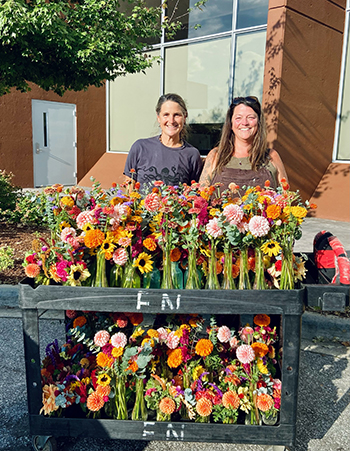
Vanessa Campbell (L) and Mandy Hornick with some of the flowers they donated after markets were closed. Photo courtesy of Vanessa Campbell.
In the shock and chaos, without power or communications and mostly impassable roads, locals rallied to support each other. Alyson Wade, who runs The Farm Connection nursery in Marshall, North Carolina, which supplies food and medicinal plants to farms throughout the region, checked on friends and neighbors. One of her first stops was Oak Holler Farm where she saw fields still lush with crops while retail and wholesale outlets were shutdown. Farmer Nick Listo was donating tubs full of broccoli, cabbage, kale, greens, lettuces and other produce to a food relief nonprofit.
Alyson understood that in the emerging food crisis local farms whose fields remained largely intact could help. She also knew that fall offered the last financial boost to farms and wanted these farms to remain viable. In a lightbulb moment she decided her role in the aftermath was to support farms who were helping others while also working to emergency proof their local food system.
“In the initial response everyone grabbed a shovel to dig a building out,” Alyson recalled. “Some of us asked, ‘What’s my highest use right now?’ All roles are needed. I didn’t pick up a shovel.”
Instead, with newly acquired skills on amplifying social media posts and drone video images of wiped out Marshall, she and partners put together a GoFundMe to reimburse farms for food donations and apply funds to build up the local food system. In three days it raised over $100,000 and topped quarter of a million so far.
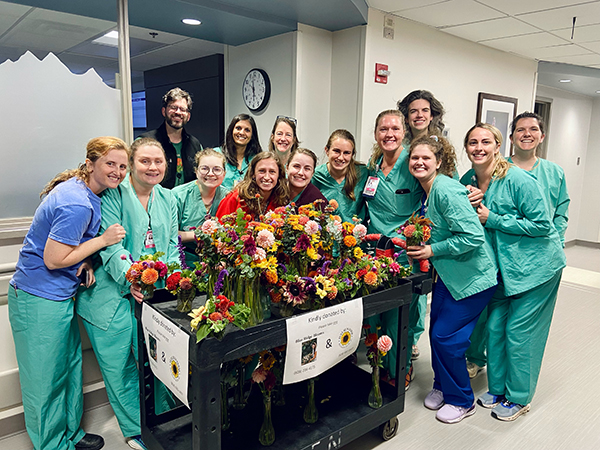
Nurses with some of the flowers that were donated. Photo courtesy of Vanessa Campbell.
Alyson headed out to farms. She stripped the process of red tape by simply asking farms to self-report in a text, email or paper format their crop and livestock donations. She handed over checks on the spot. Initially farmers refused the reimbursements, until finally relenting. “I’d look them in the eye, ‘this is for you, for feeding people’ and overwhelmingly they didn’t want to accept the money,” she said. “We really have some high quality farms that are doing the hard work to feed people.”
In the initial sweep, the GoFundMe distributed $137,000 to 32 farms (amounts of $1,000 to $12,000). They continue to track ongoing needs. The GoFundMe morphed into a 501c3 organization run by WNC Grassroots Media that is working to establish local food system infrastructure that can withstand future catastrophes. (The nonprofit also offers video, media and other fundraising support to other “change-makers” in the region.)
What Alyson and her team accomplished and continue to strive for offer lessons for farming communities everywhere that face disasters, climate or otherwise. Below are some nuts and bolts of the successful GoFundMe and experiences of the some farmers who benefitted.
Going viral
Just before the storm, Alyson studied use of social media video to promote her nursery business. Key ingredients: A strong visual and auditory hook in the first three seconds followed by a secondary hook to lay out the problem and solution. As part of the synergy in this effort, Alyson located drone video footage of Marshall underwater. Tyler Ramsey, a cinematographer with experience in reality TV and a drone and FAA drone pilot’s license and insurance, had filmed it.
Alyson tracked down Tyler. They traveled around shooting more docu-style footage and interviews of the aftermath. Tyler put together a launch video for the fundraiser. “I still did not have power when we made that video and got it posted,” Alyson said. She posted it in her car in the parking lot of the local church.
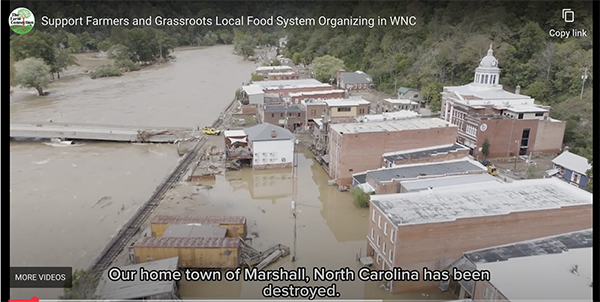
Screenshot from the Western North Carolina GoFundMe shortly after Hurricane Helene decimated the region. Image by Tyler Ramsey.
She applied her knowledge of when to launch to take advantage of the algorithms. She directed friends and family to watch the video to the end so that it expanded to a larger audience.
Many GoFundMe’s were started in Western North Carolina after Hurricane Helene. Yet, theirs paired with viral video techniques and professional video images helped it take off. (Check it out at https://www.gofundme.com/f/support-farmers-and-grassroots-food-system-organizing-in-wnc.)
Alyson and Tyler co-founded the nonprofit WNC Grassroots Media. Nica Rabinowitz — a textile artist with hands in regenerative agriculture and regional supply chains — the third member of the group, helped launch the social media campaign and manage the farmer disbursements. She is on the board of WNC Grassroots Media.
As money poured into the fundraiser, it was clear how uneven the damage was. Farms elevated above the bottom lands didn’t sustain the overwhelming damage. At first, Alyson wrote a check to farm that had lost all of its crops, but realized they didn’t have the funds to support farms with complete losses. Those farms would have to rebuild infrastructure, restore flooded farm lands, including soil testing to determine the effects of all the toxins that floated down. They would have to reimagine and rebuild or decide not to, she said. Those farms would rely on state and federal funding.
With three engineering degrees, including chemical engineering, Alyson understood the toxic muck that had saturated many fields, including from several PVC factories along the French Broad River. “Getting data is expensive and challenging, finding private labs, testing for the right things,” Alyson explained on the Thriving Farmer Podcast shortly after the storm. The bio-remediation is a long process, she said.
In the short term, the fund focused on farms that diverted crops to food donations. In an exception, they bought a refrigerator for a church that was a food distribution site after their refrigerator died.
What remains from farm reimbursements is going toward local food system infrastructure. “Community kitchens on wheels rolled in and started to feed people with no power,” Alyson recalls. “We need to be prepared to do that for ourselves in the future.”
The plan is to create a local food hub to support farms in general, but also a site that could run on solar and cook food with fire and the sun if power goes out for extended periods. Called Madison’s Kitchen, Alyson says they could start operating it tomorrow if they had a location. “In Marshall so much of our commercial space got wiped out, finding a place was almost impossible.”
Farmers feed those in need
Oak Holler Farm in Marshall, North Carolina, sits low in a holler so Helene’s winds blasted up over the farm. They lost fencing and pine trees, but the farm’s seven plus acres and four hoophouses weren’t impacted. In the week leading up to the storm, they placed hay bales and straw in culverts to slow down water, and dug out some of them and opened as much pipe as possible. They only got 13 inches of rain but lost power for five days.
Shortly after the storm, Nick started taking produce to shelters at a high school and extension office fair grounds where FEMA set up. He took totes full of vegetables. “I was told that they couldn’t cook or take food at the makeshift shelter setup at the high school,” Nick said. “I realized working with the local food bank was the best way to get as much food to people as I could.”
So, he started supplying Beacon of Hope, a food distribution nonprofit, with broccoli, radishes, turnips, lettuce and greens. Turns out a neighbor two hollers over works there, and since they couldn’t communicate by phone, he’d leave the vegetables at his food stand and she’d pick them up. This relay went on for two weeks. At that point, Nick says FEMA kicked in the doors and brought in more food.
Alyson contact him about reimbursing the farm for the donations. “I said F-off, give it to someone else,” Nick told me. “You don’t get into farming to get rich, but to feed people.” But she wore him down and the money helped him pay his crew in a trying time for everyone who lived in the region.
Nick initially reported wholesale prices of the crops he’d donated, but Alyson insisted in reimbursing retail prices. She wrote him a check for $5,000 that went toward the crew’s $15 to $17 an hour wages and for seeds for the following season.
Oak Holler has a slew of wholesale customers, a CSA, farmstand and sales through Sow True Seeds. After the storm he canceled the CSA and pro-rated customers who came back the following season. Some of the wholesale customers came back online before too long, including Mountain Foods in Asheville and TRACTOR Food & Farms, a nonprofit food hub in Spruce Pine. Local shelters stabilized and began paying farmers for the food they would distribute.
Like all the farmers I talked to, Nick felt angst because other farms suffered much more damage or were wiped out. “I don’t know if this directly pertains to farming, but when you come out of this there’s survivors guilt and PTSD,” he said. “My gas cans are never empty, I have more candles, wood for the stove, more cans of beans in the pantry, fermenting more. You realize how fragile the system is when you watch it crumble from a bad storm.”
Like Nick, Vanessa Campbell — who has been farming in the region since 1997 — carries the weight of the trauma in the region although her farm, Full Sun Farm, in Big Sandy Mush, North Carolina, only lost half of one field among the six acres in cultivation. Vanessa came to appreciate the role of a farm that was largely spared. “We kept doing our thing so that normalized things,” she recalled. “We were helping others to see we can get through this.”
The day of the storm — initially not knowing the damage Helene was causing — they harvested crops and flowers for the markets the next day. Yet, the markets — including the River Arts District in Asheville — were wiped out. (A couple weeks after the storm the North Asheville market set up at a temporary location in a parking lot.)
A couple of days after the storm with trees down and no power, Full Sun loaded up the harvest and gave the produce away, including to a local food pantry and Equal Plates Project, which purchases crops from small farms and turns them into meals distributed to thousands. “We had our whole Friday harvest and we went into town and gave stuff away, greens and winter squash, potatoes, onions, carrots,” Vanessa said.
About a third of Full Sun’s income comes from flowers. Vanessa and a friend Mandy Hornick at Blue Ridge Blooms decided to take bouquets to the nurses at the giant Mission Hospital in Asheville, which was in crisis mode. Its Emergency Room was at double capacity (200 patients) and initially there was no clean water when patients arrived drenched in toxic flood waters.
Vanessa and Mandy took several hundred bouquets loaded with dahlias, scented geraniums, sunflowers, gomphrena, eucalyptus and more for the nurses. The nurses turned around and told them they would take the flowers to the women in the maternity ward who weren’t having ideal birth experiences in the storm aftermath.
Alyson visited Full Sun Farm and asked how much they’d lost and how much they’d been donating and simply wrote them a check. “We both started crying,” Vanessa recalls. “Nothing like that had ever happened to me. It was so generous.”
Vanessa and her husband, Alex Brown, turned around and passed on a good portion of the $10,000 they received from the GoFundMe. They made a donation to Equal Plates Project and gave big bonuses to their six workers. “Some of their homes were really affected and they came every day,” Vanessa said. They gave crew time off to go help friends and clean out their houses. They also gave money to farms that were more affected. They kept a couple thousand toward their large produce donations.
When I chatted with Michael RiCharde at Good Wheel Farm in Leicester, North Carolina, earlier in the year, he double-tasked by picking up handfuls of plastic that had washed down into his pastures from farms and other general plastic detritus carried down in the raging flood waters. Despite organizing clean up days with friends who removed thousands of pieces of plastic, he was still picking plastic out of his fields.
Good Wheel has nearly 100 sheep, 600 laying hens, 100 Pekin ducks and two cows and two steers. In 2020, they started planting trees and shrubs in the pasture (hazelnuts, persimmon, honey Locust, Chestnut, Mulberry, and elderberry to name a few) partly in line with silvopasture designs and also to deal with a creek that floods and wetlands on what was originally a tobacco farm.
Before the storm, he coiled up and put away a polywire fence, pulled out temporary posts, cleaned up other unmoored stuff and moved the chickens high on hill, and the other animals out of the way. “We had probably six to seven acres underwater,” Michael said. In an area with 8-foot persimmon trees, he could only see the tips of the trees, which disappeared and popped back up as water and brush flowed over the tops. They also lost some trees and seven feet were carved out of the creek bank where it turns.
Trellising and a spray tank from a tomato farm upstream landed in his property along with pieces of a packing shed, a Ford truck bed and loads of trash. “Upstream where they were growing crops looks like the moon,” Michael said.
Meanwhile right after the storm, Good Wheel had a bunch of birds ready to butcher and the eggs were coming in. They started donating eggs and food to friends, family and some customers in need — and continued to feed them weekly for a while. “It was an emergency, this is my role to play in my community,” Michael said. They donated to a food pantry and The Food Connection, a local hunger relief organization.
A friend who is head chef at a local restaurant reached out as Michael was trying to figure out what to do with all the chickens. They smoked a hundred chickens and made soup and sandwiches which The Food Connection helped distribute. Local chefs and restaurants wanted a role and farmers were bringing them produce and meat to cook outside. Improvised set ups soon got shutdown because of food safety laws and no clean running water.
Family and friends helped Good Wheel set up their own relief fund to cover the big feed costs for all the animals and to pay employees. When Alyson came out the farm, she wrote them a check for $7,000, knowing they also other other relief funds. “She knew that we were going to continue to give and we took that as we need to keep giving,” Michael said. “We need to give way more than we’ve been given.”
He said that when markets finally were established again and people started moving back, the demand for local food was stronger than before. “It was a little overwhelming to not know if we were going to sell anything and then have record days in November and December, selling more than we had before.”
Jane Tanner grew cut flowers and specialty crops at Windcrest Farm and Commonwealth Farms in North Carolina, and helped manage the biodynamic gardens at Spikenard Farm in Virginia.
Copyright Growing For Market Magazine.
All rights reserved. No portion of this article may be copied
in any manner for use other than by the subscriber without
permission from the publisher.