











Grand Rapids, Michigan, is surrounded by some of the most productive fruit and vegetable farmland in the United States. To the west of the city is the largest blueberry production area in Michigan. Muck soils in the area contribute to Michigan’s ranking as #2 in the nation for fresh market carrots and celery. And north of Grand Rapids, the land is blanketed with orchards of apples, peaches, cherries, and other tree fruits.
With so much fresh market produce grown in the area, it’s not surprising that Grand Rapids has a long history of farmers markets. Ninety years ago, the city had four markets but over time only one survived: the Fulton Street Farmers Market.
Although the market has had its ups and downs over the decades, the Fulton Street Farmers Market has recently transformed itself into one of the most successful farmers markets in the state.
Three aspects of the market’s renaissance stand out as offering lessons to other farmers markets around the country. The first is a permanent structure, which opened in May, to protect shoppers and farmers from the weather. The second is a set of policies designed to bring old practices into line with current trends in farmers marketing. And the third is technology that is expected to bring in thousands of dollars of untapped federal and state food assistance.
Building a shelter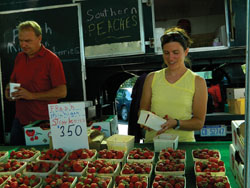
Since 1922, the Fulton Street Farmers market has occupied a long, narrow strip of land in a residential area. It consisted of a single aisle with vendor spaces on either side of the aisle, and rows of posts to which tarps could be attached for shelter. It was a tight squeeze for shoppers; “You couldn’t fit two strollers side by side,” said Tom Dudek, a native of Grand Rapids and Michigan State Extension’s Senior Horticulture and Marketing Educator.
Several years ago, the neighborhood association initiated a fundraising campaign to revitalize the market. They formed a design team, made up of 15 people — vendors, neighbors, Extension, city staff — to evaluate proposals for a new layout and buildings. The Project for Public Spaces did a feasibility study and proposed a design that widened the vendor space and moved parking to one end of the lot. The proposal would have required half the vendors to offload, then park their trucks. The vendors objected strenuously and the design team voted it down.

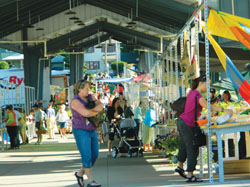
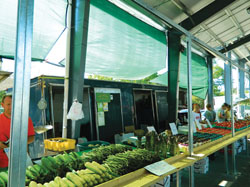
Ultimately, the design that was approved was similar to the existing layout but with a middle aisle twice the width. The market is covered by a roof, 14 feet tall to accommodate the largest box trucks, 650 feet long. Built-in tables line both sides of the center aisle. Each vendor space has a parking space directly behind it. Customer parking is on the other side of the drive.
In all, the new market has 118 vendor spaces, each 8 feet wide. Some growers take multiple spaces, and the average Saturday sees 60 vendors. The market is also open Tuesday, Wednesday and Friday from May through December, and Saturday only January through April. The cost per space is $10 on Tuesdays and Wednesdays, $20 on Fridays and $30 on Saturdays. On Sundays, a committee of artists runs an art market in the space.
The improvements cost $2.8 million, and there is just $200,000 left to raise. Once those funds are found, the final phase of the project, including a building with year-round indoor stalls and restrooms, will be completed.
Philanthropic foundations provided the greatest amount of support, followed by some city funds. The market raised $25,000 selling engraved bricks that pave the entrance. Altogether, 700 unique contributions have been made. “Everybody feels like ‘this is my market,’” said Christine Helms-Maletic, a neighbor who has served as a consultant on the project. “They feel they have a stake in it, and that’s the beauty of the thing.”
New attitudes
“Having a 90-year-old market is like driving a big freighter. You turn it slowly,” said market manager Melissa Harrington.
Case in point: Reselling produce. Although many in the community would like to see Fulton Street Farmers Market be a producer-only market, some of the vendors have been buying at the auction houses and reselling produce at the market for generations. So the market has implemented some new rules designed to encourage more local produce.
Since 2007, new vendors have been subject to an 80-20 rule that requires them to grow at least 80% of what they sell. A special certification program, “100% Homegrown” is available to vendors who sell only what they grow. And all vendors have to put up signs identifying produce that is bought in.
The market has a “product challenge” rule designed to cut down on vendors trying to discredit other vendors. A vendor can challenge another grower’s product by paying $100 to the market. The market staff then investigates and if the farmer is found to be violating the locally grown rule, the person who complained gets the $100 back. If the complaint is unfounded, the $100 is forfeited. “It’s cut down on a lot of tattling,” Harrington said.
The market also has embraced CSA farms by allowing them to use the Wednesday evening market for distribution — but they stipulate that the farmers also have to sell at the market. This year, five CSA farms are participating.
Another new policy that took effect just this year is a requirement that every vendor have $1 million product and general liability insurance. It’s available to members of the Michigan Farmers Marketing Association for $300 per year.

iPods for all
The market has long accepted SNAP, the main federal food stamp program, using a token system whereby market staff could debit a SNAP card in exchange for tokens that could be used to purchase food. A privately funded program, Double Up Food Bucks, doubles the value of benefits spent at farmers market. Last year, the market redeemed $131,000 in SNAP and $107,000 in Double Up benefits. Although the token system worked for those programs, it entailed a lot of bookkeeping and it could not be used for the federal WIC program, so those dollars were not being spent at market.
This year, Fulton Street is piloting an innovative Electronic Benefit Transfer (EBT) program to increase access to fresh food for low-income citizens. The state purchased an iPod with a card swipe device for every produce vendor at the market and the market installed wi-fi so that every vendor can access the internet to process card payments. Now, each farmer can accept all benefits, including WIC, and the money is deposited directly into the farm’s bank account.
“Sales are way up,” said Case Visser of Visser Farms. “It’s such an incentive for people to come to the market.”
Farmers are not required to participate in the EBT program — but all except one have chosen to do so.
Vendors report annual sales anonymously in order to help the market make the case for improvements. Last year, sales totaled $1.75 million, an average of $13,000 per vendor stall. This year, with the facility improvements and EBT, market staff projects sales of $2 million. And so far, the growth is happening.
“Our opening day (at the new structure) was a madhouse,” Harrington said. “We had 10,000 people. The month of May has been as busy as a normal July or August. One vendor told me he made more last Friday (June 8) than any Friday last year.”
Copyright Growing For Market Magazine.
All rights reserved. No portion of this article may be copied
in any manner for use other than by the subscriber without
permission from the publisher.