











Opportunities, lessons, and challenges
Last month we shared our formal Sustainable Agriculture Research and Education (SARE) Farmer Grant results around late season brassica disease management. Even after spending months gearing up for our project, we still found challenges to the reality of implementing scientifically sound field trials on a working farm during a pandemic, runaway inflation, and crazy weather.
This month we dig into our trial outtakes: what we learned about the process to design and implement an on-farm trial, what we wish we planned for, and impactful results that didn’t neatly fit our numerical data. Our goal is to help farmers interested in their own SARE project to be better prepared for the ups and downs of managing and assessing it.
What is a SARE farmer grant project?
I love the concept of trials designed by and performed on working farms. With all the solo time we farmers have in the fields and our heads, it’s fun to plot how things could be better done. Our big question came from years running an upstate New York CSA where every few seasons we get stuck under a deluge of rain and disease-inducing gloom. In such years, we lose between 35 percent to 75 percent of our fall brassica transplants. For a CSA farm where 20 percent of our boxes are brassicas, this is incredibly frustrating.
Such loss potential ripples through our planning and production cycles. In spring, we front-load shares with brassicas to offset any fall losses. In summer, we overplant wet-hardy storage crops as backup options. If the fall is one of our high-loss years, our members remain happy. But in “normal” years, we end up over-producing for our shares at a financial and labor loss.
Our big SARE question was whether it’s worth spraying these crops a ton, sparing no production expense, or if some crops might just (gasp) not be worth producing at scale for our CSA? This SARE Farmer Grant gave us our opportunity to trial and monitor high labor cost production combinations.
What SARE is not: free money
One thing to remember is that sometimes any grant opportunity gets turned into the idea that it’s easy money for your farm. Yes, we did get a chunk of change to run the project. However, after all the added costs in time, labor and materials the grant funds didn’t cover, we expended about 50 percent more to run the trial than we received in reimbursement. Yes, SARE is a reimbursement — you must pay up front for all the incurred trial costs.
Don’t go into a SARE grant viewing it as easy money or a way to save a struggling farm. But do consider a project if you have a research question that extra funding would allow you to address.
Trial design challenges: what we wish we knew
Narrow your measured variables: simple is better. We do tons of informal trials each year. Do we like this variety or that one? Will chisel plowing beds make carrots grow straighter? Is October 15th too late to seed triticale for a winter cover? These minimal-variable questions are simple to assess.
Because we wanted to know how different practices interacted with each other, our SARE trial became an unruly multi-variable beast. Even after cutting out trial zones, we had 60 treatments to monitor scouting, spraying, harvest and time spent. This felt like 40 zones too many. No doubt some more nuanced combinations were lost in the noise.
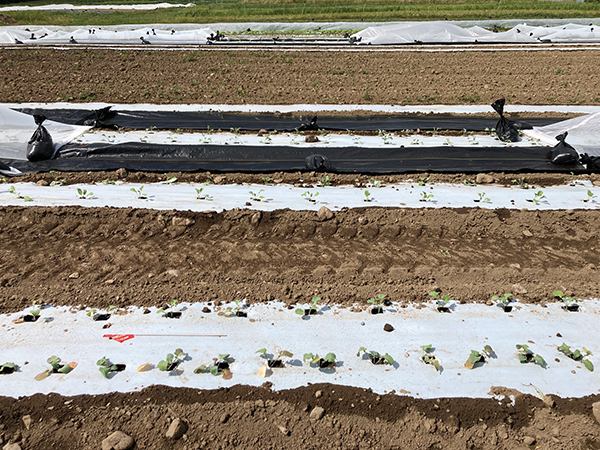 This was deep into us realizing that we had way too many variables, but too late to reverse course!
In one example of failing to anticipate mismatched variables, our established row cover system is 22-foot-wide covers over three hooped, 6-foot-on-center beds. Two people walk backward down the aisles tossing bags from the tractor bucket over one aisle for an efficient install. In our netting zones, we couldn’t match these cover dimensions and settled on using netting that only spanned one bed. It couldn’t share bags with abutting beds, so we ended up using 50 percent more hand-carried weight bags. Based on these labor costs, netting was less cost effective. But if we had better controlled material widths, would netted trial zones have yielded different results?
We caught this snafu early in the trial implementation and had a chance to reduce variables, zone sizes, and retool labor accounting. However, even after adjusting the project, it still involved an unwieldy and at times misaligned number of variables.
Make sure you communicate with your technical advisor. Before I get too deep in what we did wrong during this farmer experimental design refresher, I need to exonerate our technical advisor, who helped us stay on track with the proposal and talk us down to reality when we hit complications. SARE Farmer Grants require such an advisor. While it’s possible to find one who will rubber stamp your application, it’s better to work with someone who helps give trial design input from the beginning. Without our advisor’s guidance, we would have started with 36 additional variables, used a less effective fungicide rotation, and freaked out midseason when we became swamped by data.
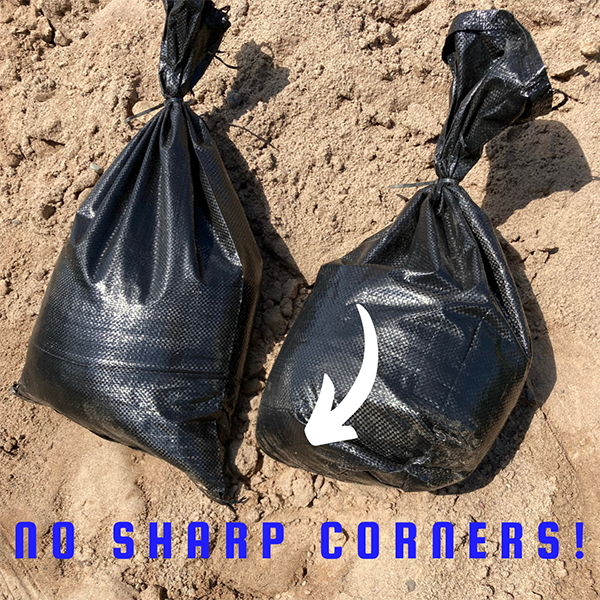
We had one single immediate big resource saving practice from this trial… that has nothing to do with what we tested. Instead, since we needed to make so many new (clean) weight bags for the trial, my husband finally convinced me that we need to make the time to turn them inside out *before* filling them. This way, those sharp little bottom corners don’t abrade through your row cover when it’s windy, significantly increasing the cover’s structural integrity and lifespan!
Set up and test your recording system in advance. We planned to use AirTable for recordkeeping. However, it got so dank and muddy, I didn’t want to ask our crew to use their personal phones in the field. We switched to log data on paper, which constantly got wet, stuck together, and morphed into a 4-inch-thick backlog of data entry that ate up a week of unbudgeted time. In retrospect, keep it simple from the start, set up a series of pre-labeled waterproof notebooks for recordkeeping, and budget extra time for the true labor of data entry.
Choose the data analysis tool that is most helpful. On a related note of over-ambition, we planned to run full enterprise budgets comparing each combination of cultural practices against one another. However, as we data-entered that ream of paper records, we realized scaled-down accounting would deliver perfectly adequate comparisons. We also didn’t need the extent of our excessive scouting and spraying note details so laboriously tracked.
In retrospect, spend more time as you design the trial to critically think about what is important to measure to determine what’s working. Do you need counts of each pest or lesion on every zone every week, or is the date when each problem first shows up information enough?
Build in redundancy: Price for inflation and surprises. Our biggest challenges were not in the fields but rather skyrocketing supply costs and COVID. Because we pre-purchased some supplies, it became hard to accurately assess what inputs cost. When 2022 hard goods ran 46 percent higher than our 2021-created proposal, it blew our supply budget and necessitated sizing down some trial zones.
Our team was hit by COVID in September 2022, right in the heart of the trial. Some health issues lingered into winter. At that point, we limped into home lugging our lightest backpack sprayer in slow-mo. In retrospect, with such a labor-intensive fall trial underway and COVID rates rising, we should have recruited an additional employee after school restarted to have better staffing redundancy.
Don’t stress too much — it’s a farm trial, not a lab. Our technical advisor had to remind me of this as we scrambled to adjust to spring’s tighter budget variables. The point of the SARE Farmer Grant is that these trials happen on working farms. SARE understands that if you plant one crop and the seed fails to germinate, you might have to make the farmer-ly decision to substitute something different on the fly. All variables in a commercial production farm can’t be controlled through pre-planning, but is that part of what enhances the results, that they are realistic on a working farm?
Null results are still valid results. We’ve run enough farm trials that I have no idea why we expected this project to be hugely conclusive compared to our informal explorations. Maybe it was the excessive flagging, stopwatches, and that pile of records that made it feel authoritative.
Our results from this trial were not smoking-gun conclusive and that felt like a huge letdown (even if that’s how science works). We did think the process generated solid metrics to assess our operation. Results don’t have to be statistically significant to have a valuable impact on production practices.
The trial left us with fresh questions, just not in the areas we measured. We set out to test how cultural controls like row covers and landscape fabric influence brassica disease management across three different fungicide application intensities. But midway through the summer we started to observe that field location, variety selection, and timing potentially played more of a factor in the trial than the many variables we were so studiously measuring. While we couldn’t go back to track these newly noticed trends, these observations gave us rich food for thought for future operations.
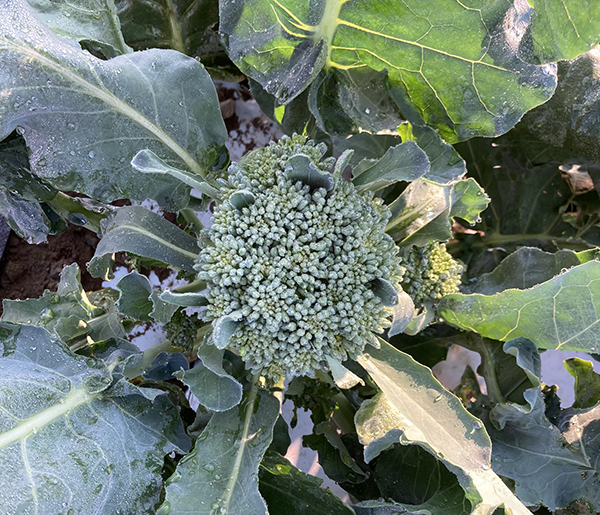 All sprouting broccoli varieties likewise started off with light alternaria infections, but after initial harvest of the center (marginal quality) shoot, continue to yield normal, healthy yields for over six weeks.
What did we learn from our exercise in prolonged plant torture? As organic producers juggling wet weather, tight margins, a maximal CSA member to staff ratio, and limited efficacy pesticides, we strive to rapidly terminate crops when they seem like they have irreconcilable issues rather than nursing them along at huge cost. Actively monitoring and not killing disgustingly infested crops created a conundrum where sometimes such crops grew out of their disease and yielded a good profit. Other times they just died more expensively. Should we let crops fester more often?
In 2022, Bermeo cauliflower and BC 1611 sprouting broccoli oozed with actively disgusting Alternaria, but then produced healthy, high-yielding new growth. Is this normal, good genetics, fungicides kicking in, or just plain old luck? Should we let diseased crops live? Yet other zones kept past the point where we normally terminate them saw a total loss. It was unclear if stringing plants along is an economically good idea, but these observations led us to more questions around varieties, plant vitality, and disease resistances.
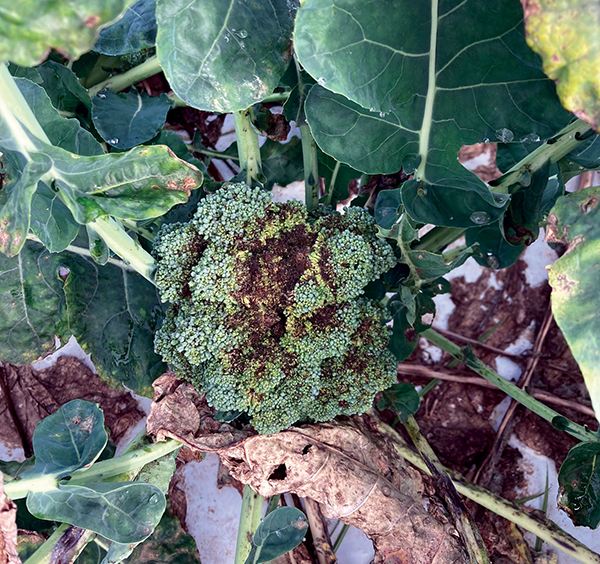 This is an example of some of our plant torture in an untreated broccoli zone with heavy alternaria pressure in 2022. This is representative of what some of our fall plantings can look like in a bad year!
Does timing matter more than fungicides? While we trialed treatments across the season, we hadn’t set timing up as an independent experimental variable. Since 2022 weather was so wonky, we added an extremely late speculative broccoli planting. We had run out of space so we transplanted it literally touching the foliage of our most heavily Alternaria infested earlier planting. Yeah, we were sick and not thinking straight. Because it was such a long shot, we didn’t once bother to spray this late crop.
Yet this neglected planting was healthier than earlier abutting ones and had a solid harvest. This was frustrating (we literally did NOTHING), but also an interesting side observation during a trial where we wanted to assess if throwing the kitchen sink of prevention at a crop made a difference. Could something like timing (or luck) be more effective than organic controls?
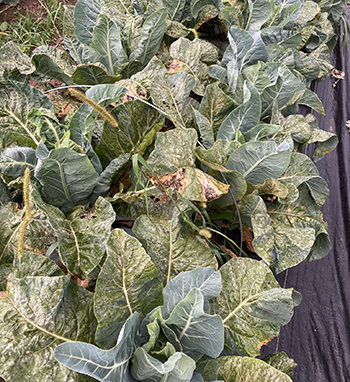 Bermeo cauliflower producing marginally more healthy looking new growth.
Should we retrain customers to eat different things? Unfortunately for us, there is no overlap between large brassica cultivars that purport some resistance to our fall diseases and varieties that successfully grow on our farm site. However, some varieties consistently retained more marketable quality under higher disease pressure. Sprouting broccolis and cauliflowers outperformed traditional head varieties, producing acceptable quality yields even when lightly infected. After our SARE trial, we doubled down on the concept of retraining customers to accept such disease hardy crops in substitution for more finicky mainstays.
Time tracking
How did intense time tracking impact our understanding of our farm’s operation? Our direct trial results confirmed that our current operating system is on target for these crops. However, keeping such tight data raised questions about the value of our actions, amendments, and crops. It stimulated discussions among our wider farm crew and community about the temporal and financial sustainability of diversified organic production. Is it worth being organic in such a high-moisture environment when the customer wants nice looking product, but organic fungicides have limited efficacy?
Tracking also forced our acknowledgement that we grow too many things. Juggling all these variables over just a fraction of our field operations was eye-opening around our farm’s operational complexity. How much financially stronger would we be if we moved away from a single-farm CSA model to something more streamlined, flexible, and collaborative?
Doubling down
If a crop is hard to grow for us, why do we keep doubling down? We know this lesson, but in the whole cult of diversified, do-it-all-yourself CSA production, we keep forgetting it. Running a CSA farm where members expect vast diversity makes you fall in the trap of trying too hard on crops that might never grow well for you. For us, this is our customer’s third favorite crop: heading broccoli. People want broccoli every week in ever growing quantities, and since it’s only $1.69 a pound at the grocery store, they have a perception that it’s cheap to grow.
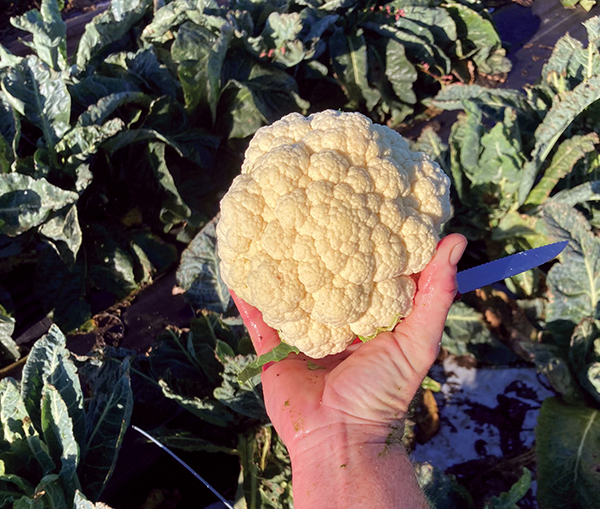 This is what the Bermeo heads looked like after the plants bounced back from alternaria. The heads averaged a pound, but the healthy leaves still tested positive for alternaria.
When we forget this lesson in planning season and start digging in to grow twice as much broccoli as we need to make sure we have enough, it doesn’t guarantee us twice the crop, but rather twice the potential crop loss. As a CSA-first farm, we primarily look at our whole-farm mix of income and expenses. This SARE trial exposed some crop-specific losses that we have been trying to overcome through spending more misplaced time and energy, when the better response may be to stop growing some things.
Do loss leaders make sense?
Do high popularity, loss leader crops still make sense in a CSA as costs and weather risks grow? As much as we and our customers love broccoli, our conclusion from this trial is that rather than changing how we produce large brassicas, we should adjust our late crop mix toward more reliable species and varieties. This was made especially clear when our direct seeded treatment’s input cost stayed under $.10 per unit while the large brassica zone costs ranged from $.50 to over $2 per unit. Stopping commercial production of more financially iffy crops improves farm functioning and the bottom line, even if we have considerable market demand for these dropped crops.
Overall, both formally and informally, participating in this SARE Farmer Grant Trial gave us lots to ponder and test in the future as we design smoother farm operations. If you have a thesis you would like to test, it’s well worth the effort. Just make sure to put in the time to develop a project that effectively answers your farm’s big question. You can find your region and application at www.sare.org.
This article is based upon work supported by the National Institute of Food and Agriculture, U.S. Department of Agriculture through the Northeast Sustainable Agriculture Research and Education program under sub-award number FNE22-030.
Maryellen Sheehan farms with her husband at Hartwood Farm in central New York, after growing in the Hudson Valley, New Hampshire, and Massachusetts. They raise vegetables of all kinds, previously mostly for CSA but now a growing wholesale market and their local community, but secretly just want to grow trees.
Copyright Growing For Market Magazine.
All rights reserved. No portion of this article may be copied
in any manner for use other than by the subscriber without
permission from the publisher.