











Part 1 of 2: Why and how to organize
We’re in our fifth year running a flower CSA at Moonshot Farm in East Windsor, New Jersey. Our subscription program has morphed, changing in length and price, with adjustments made as we implement lessons learned. We’ve grown it from 25 memberships the first season to nearly 600 this year. Our CSA is now the backbone of our farm business. Here are hard lessons we’ve learned along the way while building our successful flower CSA.
Defining the “Why” of the CSA
The CSA model has its roots in vegetable farms. It offered a way for farmers to earn income during the off-season, share some risk with their customers, and build a reliable outlet for their weekly produce. In exchange, members may receive a discount. Some of these benefits might make sense for flower farmers, but I think it’s also important to recognize that flowers and vegetables have some differences.
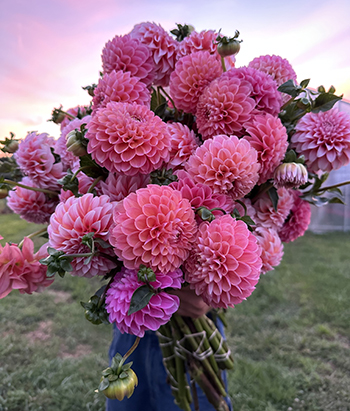
While our farmers markets are on the weekend, our CSA allows for a mid-week outlet of short-lived flowers like dahlias.
There are a lot of reasons why a flower farmer might choose to add a CSA, and I encourage you to be conscious of your reasoning. I meet a lot of farmers starting out offering a CSA just because there isn’t a barrier, unlike, for example, getting accepted into a farmers market or building a relationship with a wholesaler.
One reason to start a CSA may be to get off-season income and cash flow during the winter months. As our farm has started growing year-round, this rationale has carried less weight for us.
Similarly, you might start a CSA to raise funds for infrastructure. We did this in late 2022, when we were converting one of our greenhouses to geothermal heat. We created an ambitious and expensive flower CSA, offering members a full 12 months of blooms, to help fund the project. We successfully raised the $50,000 needed, but it also caused a lot of stress as we were essentially in debt to our members.
Looking back, it may have made more sense for us to pursue an USDA Farm Service Agency operating loan for the project rather than funding it through a CSA or relying on the CSA for cash flow. While CSAs often provide a discount of 10 percent or even 20 percent off produce, FSA operating loans are currently at just 5.2 percent.
The loan may offer lower terms and also be lower risk, especially for a newer farmer. CSA customers who do not ultimately get their money’s worth from their membership likely won’t stay customers for long. Meanwhile, the FSA has programs in place to pay loans back slowly over time and may allow for flexibility for farmers unable to make payments due to crop failures or disasters.
As our farm has matured, we’ve come to a new reason for running our CSA: to handle abundance and provide a mid-week outlet for our harvests. Our farm’s largest outlets are our farmers markets, which are on Friday and Saturday. Especially for short-lived flowers like dahlias, our Wednesday CSA provides a critical outlet for our Sunday and Monday harvests. These flowers would otherwise be deadheaded or composted, as they are too old for a weekend farmers market, so we are able to spoil our CSA members without a big cost to the farm.
Keeping your “why” in mind as you set up and run the CSA is key. Since our CSA is meant to be an outlet for abundance, we’ve cut the CSA out of our leaner months like November and December, where longer-lasting flowers are in bloom and can all be brought to market.
Structuring a flower CSA
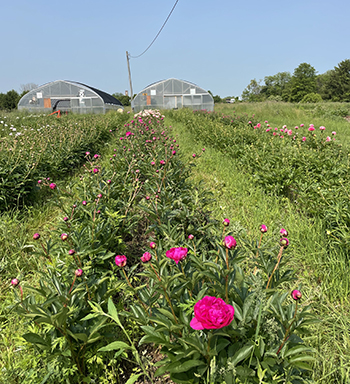
Many successful flower farms run single-variety CSAs for brief blips while a certain, popular flower is available. Examples might include a Dahlia CSA, a Tulip Share, or a Peony Membership. We’ve had enough major crop disasters on our farm that this approach feels high risk to me. A late frost or a botrytis event could wipe out an entire peony harvest, for example. If I were running a single-variety CSA, I’d ensure we had good backup plans, like the ability to buy in flowers from another local farm in case of disaster.
Instead, we take a lower risk approach and offer a mixed bouquet to our CSA members. We never promise certain varieties, but instead inform customers what flowers may be in bloom.
We’ve played with a few different seasonal structures, from a full-year, 12-month CSA to a six-month subscription, and now offer three 3-month seasons: Winter (January-March); Spring (April-June); and Summer/Fall (August-October). This ensures we have the CSA to use up blooms during abundant seasons, while also building in some much-needed breaks.
CSA frequency
Most vegetable CSAs run on a weekly basis, with members receiving a big box of vegetables every week. For meal planning and family feeding, this frequency makes a lot of sense. But a weekly model never made a ton of sense for our flower business.
For starters, many of our flowers last way longer than a week. Some of our biggest crops, like tulips, lisianthus, lilies, and asters, often last ten days or longer. It didn’t make sense for us to give people weekly bouquets and have their flowers just build up with the previous week’s flowers.
Also, weekly blooms might hurt our farmers markets’ sales. If our best customers were getting flowers every week, they likely wouldn’t also be shopping from us at the market. And there is a limit to the number of bouquets I can make in a week.
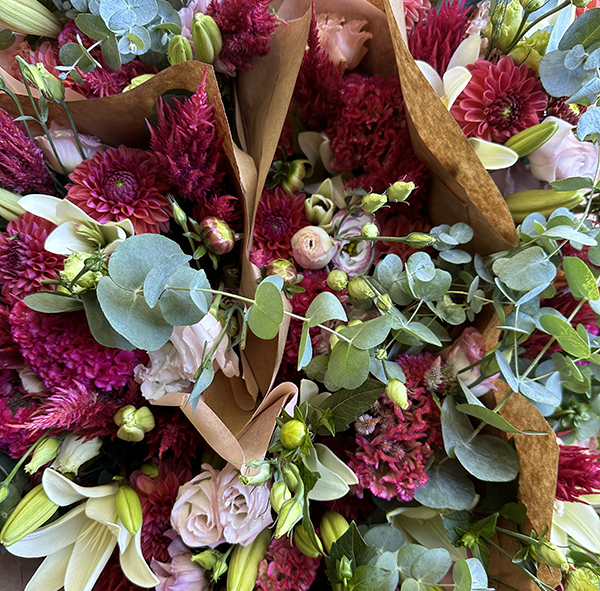 Rather than focus on single-variety CSAs, we help minimize risk around a sole crop by offering mixed bouquets.
Since its inception, our CSA has operated on a monthly basis. Members get one bouquet per month and we rotate through different groups of members. Group A gets flowers on the first Wednesday of the month and Group B gets flowers on the second Wednesday, and so on. People are familiar with a “Bouquet of the Month” model, so it was an easy sell. We were able to build our CSA to include hundreds of members, without ever having to make more than 100 CSA bouquets in a week.
Maybe most importantly, the monthly model has really helped us to manage cash flow. We find most members will get their monthly bouquet, then shop at our farmers markets the other weeks of the month. Joining the CSA makes them feel a lot of loyalty toward our farm, so they’re more likely to buy flowers from us than from other flower vendors during the busy summer months. Ultimately, they feel part of our flower and farming community and want to support us however they can.
CSA pick-up locations
While we initially had all of our CSA members pick up directly from our farm, we quickly learned that we could build our membership by adding additional pick-up locations in other areas and reaching customers who might not want to drive to pick up directly from our farm. We currently offer six pick-up spots across New Jersey and New York City, in addition to the farm.
We’ve tried to add pick-up host locations thoughtfully, selecting towns with higher average household incomes as flowers are a luxury item. We’ve also sought out businesses that share similar values as our farm, such as bakeries using locally grown produce and zero-waste lifestyle shops. We do not offer our farmers markets as CSA pick-up locations, as the whole point is for our CSA to be on a different day.
We’ve never paid our host locations, instead we present the idea to them as mutually beneficial: they’ll allow our customers to pick-up bouquets, and we’ll bring customers with shared values directly to their location, often on a slower day of the week. We get great feedback from our hosts that our members usually pick up a coffee, bottle of wine, or other purchase while retrieving their flowers.
We also provide our pick-up hosts with a bouquet each month to enjoy. As a bonus, the bouquet usually gets put on display and serves as advertising for the farm. To minimize the burden to our hosts, we try to limit the pick-up hours and work around their normal schedules.
Our best host locations have been as excited to partner with us as we are with them. They share our social media posts, are friendly to our members, and are thrilled each month as we arrive with buckets of blooms. Some hosts have been less enthusiastic, and we’ll notice our customer retention rates dropping off. We aim to have at least 10 to 15 members per pick-up site, to make delivery worth it and will drop a site if we can’t keep it at those numbers.
This year we’ve also started shipping our CSA to a limited, local region. It’s been a great way to make the membership more accessible. I’m sure there will be lots of lessons to share around shipping when we have more experience, but so far, so good.
Marketing the CSA and additional benefits
Although we accept membership on a rolling basis for our CSA (until it sells out), we usually make a big deal about launching it. Generally we launch it in late October or early November — leaving plenty of time for people to buy it as a gift before the holidays. This timing also coincides with a lot of fall bulb bills rolling in. We used to launch our CSA around Black Friday, but found that by then we were too busy marketing our other holiday offerings and the message got watered down.
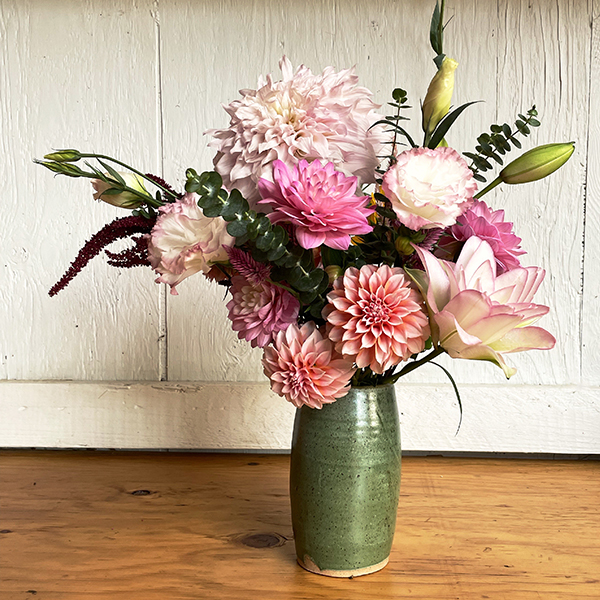
Other membership benefits we provide include a newsletter and a vase handmade by local artists.
Our CSA members certainly get larger bouquets than our market bouquets at a discounted price, but we never advertise this discount. We’re worried about folks comparing our market flowers to our CSA bouquets. We’re also worried about attracting the wrong kind of customers who are looking for cheap blooms.
Instead, we market other benefits of the CSA. It’s a chance to receive the best blooms off our farm and a way to learn about new kinds of flowers. Members receive a monthly newsletter all about their flowers, with history, fun facts, and vase-life tricks.
As our farm has grown, we often don’t bring mixed bouquets to market anymore, relying instead mostly on straight bunches and single stems, which are much less labor intensive. The CSA is often the only outlet for people to get pre-made mixes from us. “If you want a mixed bouquet, join the CSA!” is a phrase we often repeat.
We also stress that our CSA members get priority over our other outlets. During a gray stretch last January, we had to miss a few markets due to delayed production, but we still ensured all of our members got their flowers.
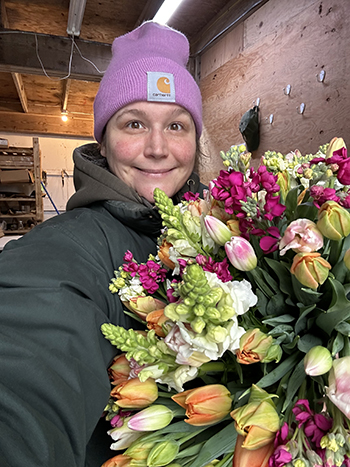
Our CSA members get priority over our other outlets. Last January we skipped markets due to not having many flowers, but ensured our CSA members still got their bouquets.
Brainstorm other “soft” benefits that may resonate with members. We offer a Members Only Farm Tour each year where we give folks a quick tour of our farm and show them all of the fun behind-the-scenes secrets. We find that the members who attend this tour almost always sign up again for the CSA in the following year.
We’ve also partnered with a local arts organization to make custom vases for our CSA members to purchase. The vases were only available to our members and not to the general public, which made them feel very special.
We try to start advertising the CSA at least four to six weeks before the launch, building excitement as well as a feeling of scarcity; some of our locations do sell out in just a day or two. We also print postcards to hand out at all of our markets and provide to our host locations to distribute.
Offering a CSA-only farm tour has been a great way to connect with our members and help build their relationship with the farm.
We’ve gone back and forth between using the phrase “CSA” and just calling it a “Bouquet Club” or “Flower Subscription.” This year we’ve gone back to “CSA” as we think it really captures our model of sharing the risk and reaping the reward. In our area, vegetable CSAs are quite common and people seem familiar with the concept.
Managing expectations: A member agreement
If you own a direct-to-consumer farm, you probably already know by now that people don’t read. Despite carefully laying out the CSA format and rules on our website, we always get a lot of questions and confusion. Over the past couple of years, we’ve created a Membership Agreement. Everyone who purchases the CSA must agree to these rules. Some topics in our agreement include:
Rules around missing pick-up (for our farm, leftovers get donated)
What happens if a host location goes out of business
Inclement weather plans
Non-refundability
We’ve previously included this as a PDF document to all members, but next year will be working on a “click wrap” type website. People will have to check individual clauses in order to make the purchase.
Despite setting the ground rules, we still find that some folks just don’t get it. They’ll miss pick-ups, request make-ups, or just generally complain. At first, we’d try to woo these people back by offering them additional flexibility. We’ll now just let them go.
While we don’t officially allow refunds, we refund members occasionally and kick them out of our membership just so that we don’t have to deal with them anymore. Sometimes difficult members cause me a lot of personal stress. To combat that, I’ve started tracking them as a percentage. Last year we received four complaints, out of around 300 members, or just over 1 percent. Meanwhile, we received dozens of compliments and praise. I’ll take those percentages!
Ultimately, we’re trying to make our CSA really work for our farm and our family schedule. If customers want special requests or specific items, they’re welcome to shop at our markets or place a special order.
Value-added CSA floral products
Committing to a CSA can be a lot of stress if your production doesn’t match up with what you’ve promised. We’ve been on the other side of this as members of local vegetable CSAs. Those farmers have done a great job of using value-added products in their boxes. When April harvests were smaller than expected, they’d add a few cans of tomato sauce, salsa, or hot sauce to the box to make up for the smaller share.
There are a few ways we’ve applied this concept to the flower CSA. Dried florals serve as a great back-up plan if an early frost wipes out the last week or two of bouquets. We’ve also utilized potted bulbs such as amaryllis or hyacinth. These tend to be more forgiving and have a longer shelf life than fresh cut flowers, so can be a good addition to reduce the production risk of the CSA. Wreaths, dried lavender, dyed fabrics, and other value-added products could all be great additions to the flower CSA, especially during times when harvests are lean.
Despite occasional production stress, the CSA has been a great business model for our farm. While farmers markets can vary so much due to weather and other factors, the CSA allows for consistency and reliability. It’s also built up an amazing community of customers who join the CSA year after year.
Stay tuned for Part 2 of this two-part Flower CSA series, where I’ll discuss crop planning for a successful CSA.
Rebecca Kutzer-Rice owns Moonshot Farm, a specialty cut flower farm in East Windsor, NJ. She grows flowers year-round including in a geothermal greenhouse, for retail markets in and around NYC.
Copyright Growing For Market Magazine.
All rights reserved. No portion of this article may be copied
in any manner for use other than by the subscriber without
permission from the publisher.