











Many of us only know safflower as an oil we might use in bulk to fry some potatoes, and while it is very tasty that way (ask me about my French fry addiction), it is also an exceptional cut green for growers with hot dry summers. I first learned about safflower from my mentors Calvin and Julie Cook at Arrowhead Dahlias, who are among the best flower farmers around. My first seed came from Wild Garden Seeds, and was their ‘Superior Orange’ variety. Seed is easy to save, and if you like the wild, be-mohawked look of the orange or yellow flowers, or if your florists do, that’s another great way to use them. There is a creamy white cultivar that may be better for those outlets.
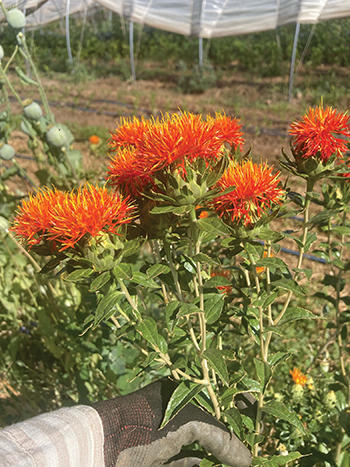 A side view of safflower in bloom.
But the real star of the show is the foliage. Those of us in the arid West (we’re in Colorado) often struggle to grow or find quality greenery, and we sigh when our customers ask for eucalyptus or ferns. Annual and perennial greens like bupleurum, mints, sage, and lemon balm have worked well for me, but safflower really is a backbone of our summer bouquets, giving us the stiffness and color we need to survive those 90°+ farmers markets.
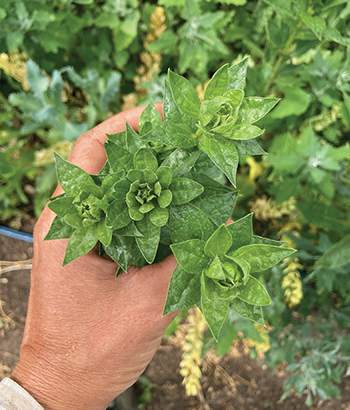 As the stems begin to bud up, they create a beautiful rosette of buds with great texture and variety. One must not harvest too early! Safflower that has not yet budded up will wilt when cut. First, look for the top of the plant to begin branching. Then, the buds will start to form. My favorite stage is when the sepals are still round, and the bud is somewhat flat. The buds at this stage tend to be a lighter green than the leaves, which is lovely. Any point after this in maturity is acceptable for harvest, until the flowers start to wither.
The little buds hold up great in boutonnieres, corsages, or flower crowns, too. These stiff, unwilting greens are a deep emerald color that brings out the best in all those hot-color summer annuals like zinnias, sunflowers, and dahlias. It can be an incredible structural green for bridal bouquets and table arrangements. As the stems begin to bud up, they create a beautiful rosette of buds with great texture and variety.
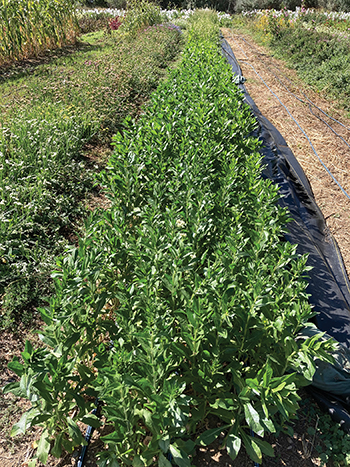 The author’s last safflower succession of the season shows you how closely she plants it to keep it from becoming too bushy.
I sow safflower every month, starting early March through early July on my Zone 5b farm. My favorite thing about it is that the seeds are large and work really well with a Jang or Earthway seeder. I use a G-12 or C-12 roller in the Jang. I like to seed densely, 0.5 to 1 inch spacing in the row, and 6 rows on my 4’ bed top. This gives me stems that, like a sunflower at close spacing, are not too branched and are usable in bouquets. A safflower plant growing on its own can get quite bushy!
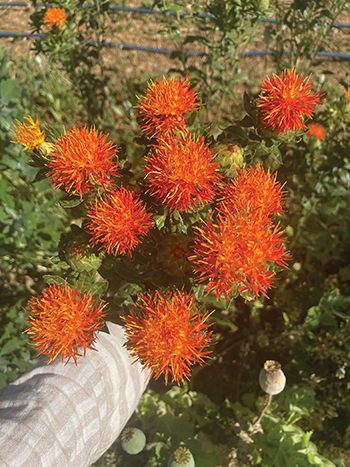 Safflower in bloom viewed from above.
At my scale (1.5 acres), a planting of just 25-50 ft on this schedule is sufficient for foliage and flowers. Safflower germinates quickly and easily with irrigation; you may try a piece of row cover over the top for those June and July plantings to keep moisture in. Overhead irrigation works best for germination, but they may be germinated on drip as well, with proper attention to saturating the soil surface. Flower farmers will appreciate the large-seeded and fast-germinating nature of safflower!
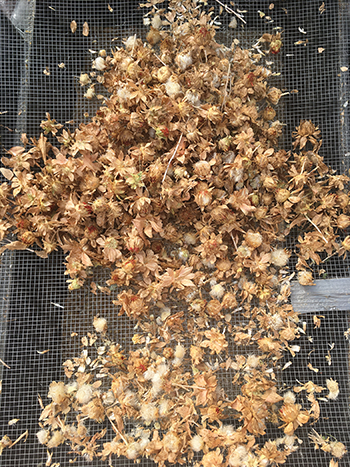 Dried safflower seedheads.
Safflower requires nothing special except water and full sun. It’s happy in even my worst soils on the farm, quickly crowds out weeds when planted densely, and is in general a delightful crop. It can also be used as a fast cover crop with very durable residue – just be sure to cut or crimp it before seed forms as it is an aggressive grower and could get weedy through self-sowing.
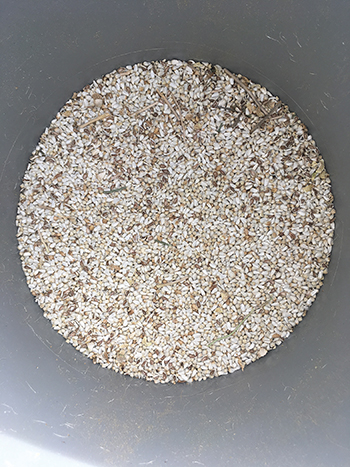 Threshed and cleaned safflower seeds. Due to their large size and relative ease of extraction from the dried flowers, safflower seed is easy to clean and save yourself.
One must not harvest too early! Safflower that has not yet budded up will wilt when cut. First, look for the top of the plant to begin branching. Then, the buds will start to form. My favorite stage is when the sepals are still round, and the bud is somewhat flat. The buds at this stage tend to be a lighter green than the leaves, which is lovely. Any point after this in maturity is acceptable for harvest, until the flowers start to wither.
Once the flower really begins to form, it becomes pointy, and the sepals will be prickly and spiny. The unopened buds at this stage add lots of texture to bouquets. Finally, a little bottle brush of color will pop out of the top of the bud – now you’ve got to sell that bright orange pop! Though there are white and yellow varieties, too. Many florists really love the whimsical look of these flowers.
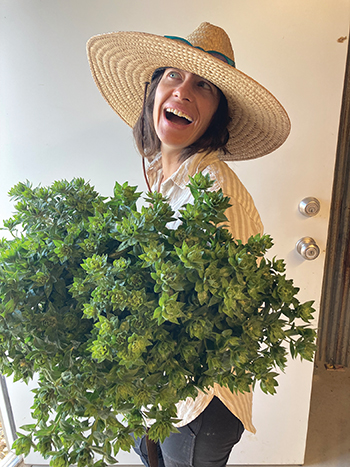 The author with some safflower that has formed flower buds and is ready for use as greenery. All photos courtesy of the author.
Safflower in bloom can also be dried for later use. Like most things, it dries well hung upside down in a drafty dark place. Or, you can hang it in the greenhouse at bud stage to bleach out for those trendy winter weddings.
Once the flower has faded, seeds start to form in a large seed head atop the plant. Wait until you see fluff coming off the seed heads – at this point, seed is ready to harvest. There are a couple of basic methods for doing so (unless you have a combine for safflower seed!): 1) Using your flower snips, cut mature seed heads into a bucket or bin, then spread them out on a tarp in a dry place to continue drying. 2) Lay a tarp beside your bed of mature safflower, and cut the plants down onto the tarp. Leave them in the field to after-ripen, so you’re sure of getting most of the ripe seeds from the crop.
When the seed heads are cut and dried, you’ll need to thresh them to extract the seeds. Stomping on the seed heads works, or crushing them with your hands. I’ve also put them in a burlap bag and hit them with a stick (this was during an angrier farm season of mine). Another method would be to drive over them with a heavy vehicle. This is probably the best and least labor-intensive method.
After threshing, use screens to separate plant material, and winnow with fans to blow away the fluffy chaff. Once extracted, safflower seed is very easy to get quite clean. I hope you’ll give safflower a try for a quick, sturdy summer green!
Helen Skiba runs Artemis Flower Farm with her partner Nelson Esseveld. They are part of the Treehouse Farm Collective in Longmont, Colorado, sharing land and infrastructure with two other farm operations. Artemis offers subscription bouquets, wedding arrangements, on-farm workshops, wholesale blooms (working mostly with the Colorado Flower Collective hub), tulip bulbs imported by Nelson’s family in Holland, and dahlia tubers. Helen can be reached at helen@artemisflowerfarm.com, and you can find out more about the farm at www.artemisflowerfarm.com.
Copyright Growing For Market Magazine.
All rights reserved. No portion of this article may be copied
in any manner for use other than by the subscriber without
permission from the publisher.