










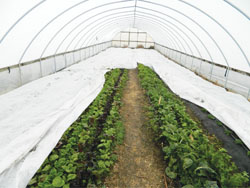
High tunnel growers should be aware that keeping the plastic on tunnels year-round can result in a buildup of salt in the soil that can damage some salt-sensitive crops. Seedlings are especially susceptible to salt.
Salt-sensitive plants are less able to take up water from saline soils and can become water stressed. Sodium, chloride, or sulfate levels may become toxic and cause nutrient imbalances with potassium and calcium. Yields can be reduced significantly. Other symptoms of salt injury include necrosis (burning) of the leaf margins, stunting, wilting, and even plant death.
According to Dr. Elsa Sanchez, associate professor of horticultural systems management at Penn State University, the first step to preventing crop damage from salt buildup is to do a soil test every year. The soluble salts test may be an addition to the basic soil test, with an additional fee, so be sure to request it when you take your soil sample to Extension. When you get the soil test results, compare it to the chart on the next page to determine if you have a problem that needs to be addressed.
Soluble salts accumulate because the high tunnel covering prevents leaching by rain and snow. Also, most tunnels are irrigated by drip irrigation, which also limits leaching. Both organic and inorganic fertilizers can cause elevated levels of soluble salts. Compost, especially, can raise soluble salt levels quickly.
In a two-year nutrient management study of Penn State’s high tunnels, applying even 1 inch of compost provided excessive amounts of nutrients. The baseline soluble soil level tripled in one year and increased six times in two years — to a level that could reduce yields of carrots, onions, bell peppers, lettuce, sweet potatoes, broccoli and potatoes. When 2 inches of compost were applied, soluble salt levels increased 13 times in two years, to levels considered strongly saline.
Dr. Sanchez suggests these ideas for preventing or dealing with high levels of soluble salts:
Build new high tunnels in areas with good drainage to promote leaching.
Avoid overapplication of nutrients. Using soil test reports, apply only the amount of nutrients plants need.
Select fertilizers with low salt indexes. Avoid the use of nutrient sources containing animal manures, which tend to be high in salts.
Use irrigation water with low salt levels.
Use sprinkler irrigation to establish seedlings. Sprinkling can help leach salts around the plants.
Leach out salts before planting. As a general guideline, 6 inches of water will leach about 50 percent of the salts, 12 inches will leach 80% and 24 inches will leach 90 percent. Sprinkler or drip irrigation can be used to leach salts. Drip irrigation will have to run for many hours to reduce soluble salt levels significantly. Penn State’s Commercial Vegetable Production Guide (see below) specifies the number of hours needed to apply 1 inch of water, which depends on row spacing and the drip tube flow rate. For example, with a 0.45 gallons per minute flow rate, and rows spaced 4 feet apart, it takes 9 hours to apply 1 inch of water.
Remove the high tunnel coverings and leave them off as long as possible so the soil is exposed to rain and snow.
“Out at the high tunnel facility, I’ve been managing four high tunnels since 2003,” Dr. Sanchez said. “In the fall of 2007, the soluble salt level was on average 0.40 mmho/cm. That November, the tops of the tunnels ripped off due to high speed winds and because the plastic was getting old. We decided to leave the tops off until the spring. In April 2008, we put new tops on and had the soluble salt level of the soils analyzed. On average, the soluble salt level decreased to 0.09 mmho/cm or about 77 percent. Between November of 2007 and April of 2008, we got about 11.5 inches of rain.”
Resources
“Dealing with high soluble salt levels in high tunnels” by Elsa Sanchez: www.extension.psu.edu/vegetable-fruit
Penn State 2011 Commercial Vegetable Production Guide: http://extension.psu.edu/vegetable-fruit/production-guides/2011-comercial-vegetable-guide/pennsylvania-comercial-vegetable-guide-2011
| Plant response to soil salinity levels | |
| Salinity level(mmhos/cm) | Effects |
| Less than 0.40 | Negligible salinity; salt-sensitive cultivars of beans and carrots may show effects. |
| 0.40—0.80 | Very slightly saline; 25-50% decrease in yields of carrots, onions, peppers, lettuce |
| 0.81—1.20 | Moderately saline; seedling injury possible; 25-50% decrease in yields of broccoli, potatoes, plus plants above. |
| 1.21—1.60 | Saline; beets tolerant |
| 1.61—3.0 | Strongly saline. |
| Greater than 3.2 | Very strongly saline. |
| Source: Pennsylvania State University, Agricultural Analytical Services Laboratory |
Copyright Growing For Market Magazine.
All rights reserved. No portion of this article may be copied
in any manner for use other than by the subscriber without
permission from the publisher.