






Perkins’ Good Earth Farm is a permanent-bed, deep-compost, no-till, and certified organic/Real Organic Project certified farm in De Motte, Indiana. We provide the veggies you need and love for our neighbors and community and a safe and beautiful place for the traveller. My wife, Julie, and I are currently in our 17th year of farming (7th year full-time) in rural northwest Indiana. Our gross sales in 2024 from farm produce on 1.5 acres and value-added kitchen items was more than $239,000.
In this article, I report on the main reasons I used to justify the purchase of an AZS Rinse Conveyor. We affectionately call it “Petey.” Petey was a $12,300 investment for just the base machine and an additional $3,800 for add-ons. We also share some specific crop tips from having used Petey for the last five months (July through November 2025). A great review of the AZS was written in the October 2024 issue of GFM. Additionally, the University of Vermont Ag Engineering website has very detailed videos and farmer interviews and profiles of the machine and other common methods of washing produce.
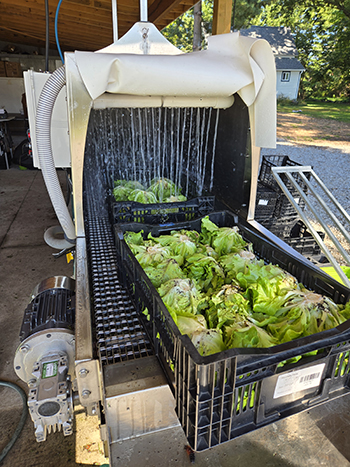
Prewashing and hydro cooling head lettuce. Harvest into crates limits handling.
If you’re farming one acre biointensively or less, I think an investment in foot-pedal washers, a barrel washer, or other cheaper upgrades could be a good middle stage as is demonstrated by Chart 1. We went from 1.5 acres to 2.25 acres in production in 2025, but because of double/triple cropping it is equivalent to 5 acres in production. For several years, I had been exploring various machines for post-harvest and had even built some (that never really worked like I envisioned).
We want to keep production labor expenses at 30 percent or less of total gross sales and knew mechanization of post-harvest was going to be needed to achieve that goal. Additionally, because we added another 3/4 acre in 2025 we were going to have to handle additional volume and variety of crops coming in on a weekly basis. I wondered if there was a post-harvest machine that could do it all on a diversified veggie farm.
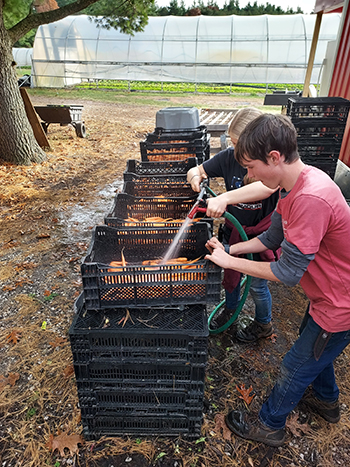
The “shake and bake” method for root crops.
Potatoes are a minor crop for us and the barrel washer was fast and affordable from what I had seen on other farms, but I wondered if a machine existed that could do more veggies. The AZS comes very close. We have a separate bubbler and dunk system for salad mixes and small greens able to process 80 to 100 lbs an hour. The AZS does all the rest of our crops, and significantly, they come out clean and not bruised. Plus, it cleans and sanitizes bins and bulb crates, and greenhouse trays. Need I say more!
Chart 1 gives the pounds or bunches per hour for common washing methods compared with the AZS machine by crop along with the labor hours we saved in just five months of use. For example, with carrots (no tops) we previously used what we call the “shake and bake” method. The whole goal is to limit the number of steps with the carrots. We used this method for all root crops and peppers.
We harvested a single layer (5 pounds) into a bulb crate in the field and brought up a whole load of single layer crates by golf cart or pallet if doing bulk harvest. We then sprayed and spun the bulb crate 360 degrees with a shake and good spray each ¼ turn. Once sprayed and cleaned, the single layer bulb crates were combined into one bulb crate weighing about 40 pounds.
We then put five crates onto a platform with wheels and put a reusable bag over the stack into the cooler. This creates a modular system we can pack from into different markets in different units, for instance in 1-lb retail units, 10-lbs or 30-lbs boxes, or in the black crate for our CSA pickup lines.
If we had stuck with this system, it would have taken us over 80 hours to wash the 6,000 pounds of carrots we harvested between July and November. With Petey, we washed this same amount in six hours and could still use the stack and bag system in the cooler. Additionally, as the carrots come off Petey onto the round table, we can pack orders into wax boxes as needed for larger orders. Or the produce can drop into the bulb crate after washing to be stacked and bagged.
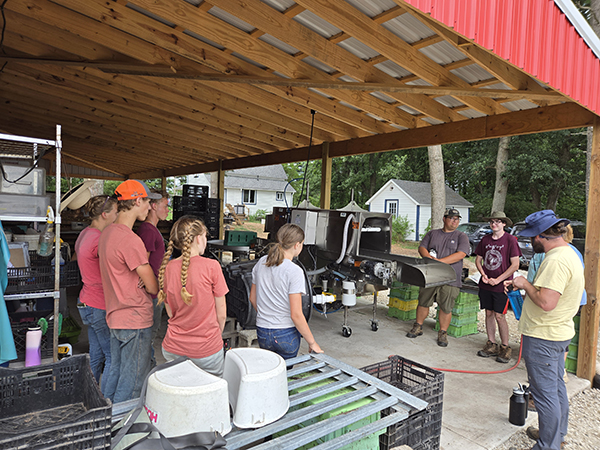
We had a small field day when Petey arrived in the wash/pack area of the farm.
Based on labor saving alone, Petey will pay for itself in 2-3 years. We also do batches of beets, salad turnips, rutabaga, and watermelon radish, which was not included in this data. Additionally, I will use it for garlic and onion harvest next year as we currently use a pressure washer for these crops already. (We got the AZS after the garlic and onion harvest this year.)
It was surprising to me that the largest savings were in tote and bin washing labor. We wash roughly 400 containers of various types each week so that adds up quickly. The more you can integrate the machine into weekly farm use, the faster it will pay for itself. We didn’t use the machine this fall for greenhouse tray cleaning, but we will this year.
Additionally, if you add in ergonomic improvements, cleaner produce, and that the time saved can now be used for additional harvesting, planting, washing, or just taking time off, then I estimate Petey will pay for itself in one full year on our farm.
Additional reasons Petey has worked for us:
Post-harvest is where a majority of our time is spent. The largest impact on labor cost per unit is affected here. The pace of work is hardest to set in the washshed. A conveyor sets the pace and can be sped up or slowed down depending on the number of workers or dirtiness level of produce. Worker drudgery and ergonomic issues are most evident in post-harvest. Our crew loves “Petey.”
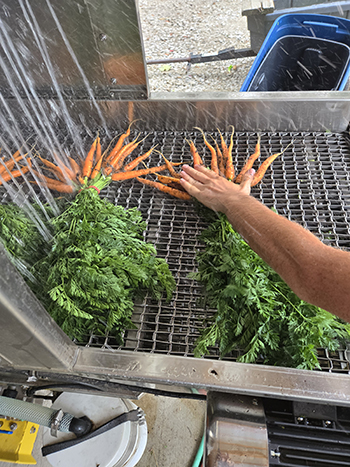
Lay bunches out in a single layer for washing.
We wash in small weekly batches, two to three times weekly, and with bulk crops like garlic, carrots, and potatoes four times a year. Setup takes about 5 minutes and shut down 15. The quality of washing has improved across all crops. Sometimes we wouldn’t wash for CSA, but now we always do. There are flexible settings with dials for both speed and intensity of wash water, so no matter the condition of produce it comes out clean and not bruised.
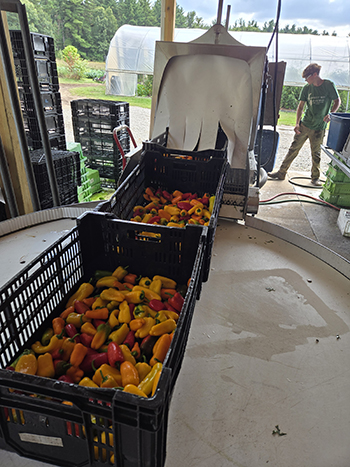
Lunchbox peppers getting washed after heavy rain.
It sanitizes produce if needed, particularly peppers for long-term storage without molding on stems. We washed slicing tomatoes from an aphid outbreak. We wash zucchini if dirty as needed. You can wash onions and garlic assuming there’s a rapid way to dry them. It enables us to custom wash for other farmers in the area. We washed 5000 pounds of potatoes this way.
Bunched crops can be washed with an add-on plate. We didn’t historically do bunched items, but now we do. This added another product to sell. There are lots of add-on options for expanding or specializing if needed in future.
Farmers can hydro-cool all crops, and with just CoolBots on the farm, this is critical for long-term storage of crops. We pre-wash and hydro-cool heads of lettuce.
There’s the dual use as tote/bin/flat washer and sanitizer, leaving them consistently clean. Need I say more. The high-pressure spray gun kit attachment aids in washpack clean up and tough cleaning jobs. Recirculating water means no ponding (a root-barrel washer wouldn’t have this feature). AZS can operate with limited water pressure.
It’s covered and has end flaps to limit overspray. It is easy to winterize, so it can be stored undercover outside. It takes about 10 minutes and 2 cups of antifreeze for the pressure pump.
Chart 1 also reveals that investing in a foot-pedal washer ($600) and root-barrel washer ($3,800), for a $4,400 total investment would save 140 hours of labor with our current crop volume for example, making those items a good investment depending on your volume of crops and markets. Again, the volume and variety of crops we grow, plus the value of washing and sanitizing totes/bins/trays, was key in making the investment. I want to be able to farm well into old age and that starts by investing in the right now.
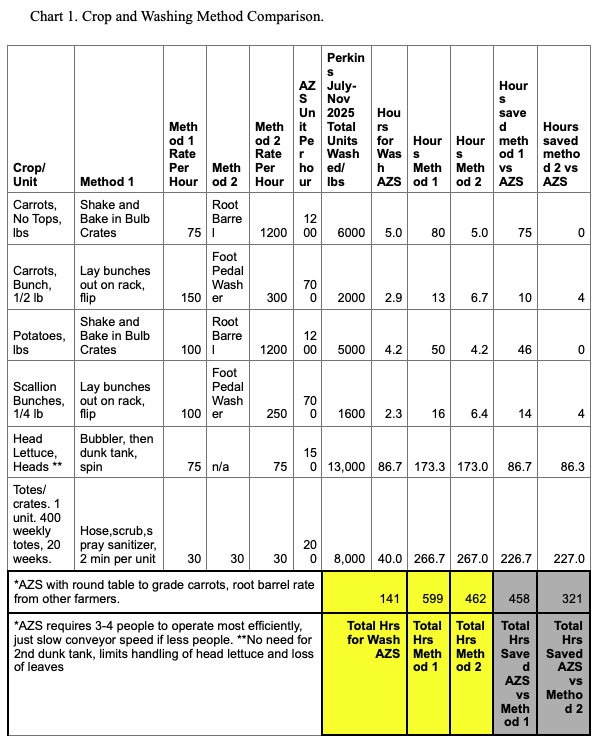
Chart 1: Crop and washing method comparison. The chart also reveals that investing in a foot-pedal washer ($600) and root-barrel washer ($3,800), for a $4,400 total investment would save 140 hours of labor with our current crop volume for example, making those items a good investment depending on your volume of crops and markets. Again, the volume and variety of crops we grow, plus the value of washing and sanitizing totes/bins/trays, was key in making the investment. I want to be able to farm well into old age and that starts by investing in the right now.
Additional tips. The AZS base machine can take six to eight months to fulfill upon ordering, so plan on that when purchasing. Get wheels for ease of washing under the machine and moving it. Get two sanitizer dosing tanks, one for bins and sanitizing, one for veggie washing. It’s quick to switch them out. A larger loading shelf is worth it; it holds a bulb crate, the smaller one doesn’t. Get an insert for washing bunched crops with tops, such as scallions, carrots, radishes.
Stage your veggies before washing so you spray the roots and keep them wet. Lay bunched items in a single plane on the conveyor to get the best washing. Also, harvest a single layer into a bulb crate — peppers, etc., so you are able to wash and then dump them into the final tote. It may require two run throughs or a spray at the end.
Full-size kale, spinach and Swiss chard can be hydro-cooled and washed. Send head lettuce upside down in bulb crates, then bubble. Bagging of potatoes right after washing doesn’t require a round table if sorted well at harvest. Three to four people is most efficient when running large batches.
I recommend you go visit a farm with an AZS Rinse Conveyor before purchasing. I did this on two different farms to fully convince myself it would be worth it. If you buy a used or older model, be aware of upgrades that have been done over the years as these are significant improvements. Additionally, when Petey arrived, we had a small field day where an experienced operator walked us (the whole crew) through start up, various settings, tips, and shutdown. Take good pictures and notes. This saved us hours of trial and error.
To learn more about Perkins’ Good Earth Farm visit us at www.perkinsgoodearthfarm.com or Facebook/Instagram.
Copyright Growing For Market Magazine.
All rights reserved. No portion of this article may be copied
in any manner for use other than by the subscriber without
permission from the publisher.