











And tips for improving germination of direct seeded crops
This winter I finally replaced the plastic on our hoop house which was getting a bit ratty after many years of abuse from wind, rain, sun and vandals with knives (our most annoying urban farming pest). The plastic wasn’t completely useless though, so I returned to a practice I’d used many years ago with good success: covering freshly seeded beds in cold soil with clear plastic to improve germination.
Here in the Pacific Northwest, we get a lot of overcast, damp days, and heavy, cold showers in the late winter and early spring – conditions that are particularly poor for germination of early direct seeded crops. Covering the soil with clear plastic helps warm the soil slightly, but I think just as importantly it keeps the soil near the surface, where the seeds are, at a consistent moisture level and prevents heavy, cold showers from washing out the seed. It’s important to remove the plastic as soon as the crop has germinated, especially if the sun comes out, as it’s easy to get the temperatures between the plastic and the soil up above a safe temperature for the cotyledons and to burn them.
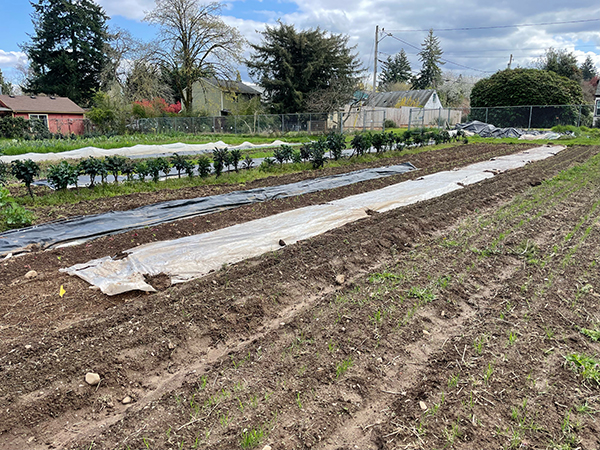
I cut the used greenhouse plastic into 4’ wide strips to cover single bed sections, which is typically what we’re seeding. I can also use the clear plastic to warm the soil and keep it drier in the weeks before seeding, and to pre-germinate weed seeds similar, but even more effectively than an opaque tarp. Though this does require another pass with the harrow or flamer to kill the newly germinated weeds before seeding. I’m never leaving these covers on for more than a week or two.
On crops like early arugula, mustards, radishes and carrots I can see germination a few days earlier, and certainly stronger using this method. Often my plastic isn’t exactly the right length for a full planting, so I get a natural experiment where some of the bed isn’t covered and that makes it obvious how much better the germination is with the plastic. For carrots specifically I remove the clear plastic when I see clear emergence of weed seedlings but before the carrots themselves have germinated so that I can flame the bed pre-emergence.
I’ve also used black plastic when germinating some of the slower emerging crops, either when clear plastic wasn’t available or when I wasn’t as concerned with warming the soil. For crops like early plantings of favas and potatoes which can take a few weeks to emerge, the black plastic will germinate some of the weed seeds well before the crop and then leave them extremely elongated and vulnerable to raking when the tarp is removed at the point where the crop is starting to emerge.
The first I remember hearing about something like this was someone talking about large scale melon growers who would seed at the bottom of a trench in the middle of their beds. The trench was immediately covered with thin clear plastic using a mulch layer. This creates a little greenhouse environment for the seedlings to germinate into. When the plants got big enough, they would come and slice the plastic open for the plants to emerge through. This short term, single use of plastic seemed a bit wasteful to me, but given the low cost of plastic, the relatively small amount needed for such a use and the benefits I’m sure it paid off.
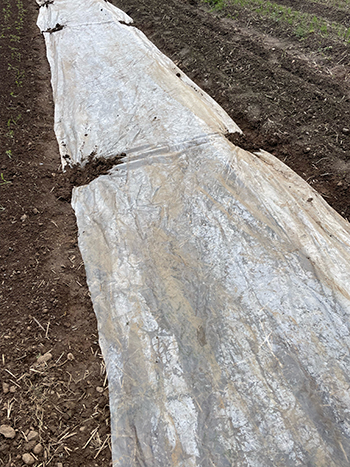
On our farm we don’t use sandbags, and instead use the soil that’s already in the field. With a shovel we dig a deep divot, place the plastic in the hole and hold it down with the excavated soil, pushing it in by stepping on it. The drawback is it gets your cover a little dirtier and you need a shovel, the benefit is less plastic expense and waste (sandbags), and no filling and hauling sandbags in and out of the field, you just have to haul a single shovel around.
Absent plastic there are numerous other little factors I’m always trying to pay attention to when direct seeding. Early in the season I set my seeding depth very shallow since moisture isn’t so much of an issue as low temperature is, and the surface of the soil is the warmest spot. I’m also looking at the weather forecast and trying to seed at the start of a sunny stretch of days when the soil surface will be warming and relatively drier to prevent rot. Later in the season I’m doing the exact opposite, setting the depth deeper and looking for cooler, overcast or wet conditions to keep the already warm soil moist and to again give the seeds a better chance of germinating.
Reading Tommie Burch’s article in the March 2025 GFM on In-Place Composting (a great new name for an age-old practice) I was reminded that what works in one farm’s conditions may not translate well to other farms, and it’s probably the same for many of the practices I’m talking about here. I’m not sure if it’s temperatures, general soil conditions, or something else, but what takes just a few weeks for him to break down in the soil on his farm in Arizona, takes months for me on my similarly sized and equipped farm here in the Pacific Northwest.
I did note that he’s using the same approach to germinating seeds with black plastic in cool months, and the opposite approach to what I’ve been talking about above, putting down white plastic (or rather just flipping a black and white tarp with white side up) while the seeds are germinating in a hot climate, and I’ve been meaning to try this myself when seeding our fall plantings of spinach – always a tricky one for us as it prefers cooler germinating temps but we often have to seed it during the hottest part of our summers. And even though the exact practices might not be a match on our two farms, there’s a lot of overlap in the way we prep our beds, and apparently the way we approach improving seed germination with tarps is similar.
Josh Volk farms in Portland, Oregon, and does consulting and education under the name Slow Hand Farm. He is the author of the books Compact Farms: 15 Proven Plans for Market Farms on 5 Acres or Less, and Build Your Own Farm Tools, Equipment & Systems for the Small-Scale Farm & Market Garden, both available from Growing for Market. He can be found at SlowHandFarm.com.
Copyright Growing For Market Magazine.
All rights reserved. No portion of this article may be copied
in any manner for use other than by the subscriber without
permission from the publisher.