


This spring, Seattle Wholesale Growers Market turned 14 years old. Our updated mission statement reflects the growth of an ambitious idea into a resilient business. We are a farmer-owned cooperative dedicated to serving the Pacific Northwest and beyond through the cultivation of high-quality flowers and a resilient, ecologically-centered floral community. Today we have 19 owner-members from Washington and Oregon, representing well over 200 accumulated years of knowledge producing specialty cut flowers.
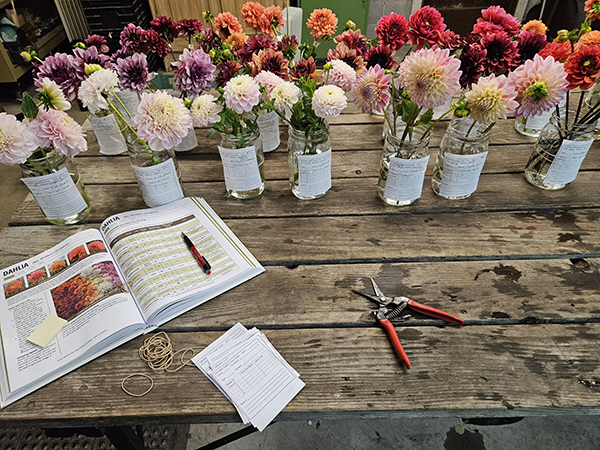
This is what the Dahlia vase trials looked like. All images courtesy of the author except where otherwise noted.
As with most farmer collectives, much of our expertise has come from first-person, self-taught, or hands-on experience gained over years of flower farming. While there are courses and reference books, nothing compares to putting in the time, in the field or greenhouse, personally evaluating your farm’s productivity and performance. Here at the Growers Market, our most effective way to increase expertise has always come through farmer-to-farmer exchange of knowledge, a time-honored method by which generations of growers have gained and honed their skills.
.png)
This sharing relies on trust, which takes time to build. In our case, a rising tide does indeed float all boats, although not without growing pains and hard work. Over the years, a lot of informal education happened when members visit one another’s farms or meet in person on delivery days, as we swap advice and tips, share recommendations, or suggest specific varieties and practices.
Flower farming includes traditional row crops such as dahlias, marigolds, and zinnias, but also merges with fine gardening and the world of fashion trends, creating nearly endless possibilities for innovation and crop diversity. While invigorating and potentially profitable, that much diversity can present extra challenges in a collective marketplace such as ours.
On the bright side, the flea market aspect draws creative florists, who never know what they might find at the Growers Market on a given day. However, customers also expect consistent quality and reliability. With hundreds of unique seasonal products, we recognized early on that wrangling the chaos would be a daunting but necessary process for the survival and growth of our business.
Research to standardization
In 2019, we applied for and received a USDA Rural Development grant which included funds to hire John Dole, Professor of Horticulture Science at North Carolina State University, to review and advise us on harvest and post-harvest practices on specific crops.
It’s a little ironic that the COVID-19 pandemic gave us extra time to further vase tests and evaluate best practices for the top crops grown by our farmers. We took the time to create product spec sheets for hundreds of botanicals. It was something we absolutely needed to do in order to provide our customers with consistent, high-quality, and reliable products coming in from so many different farms. We knew this fulfilled a need for information not otherwise available in the industry.
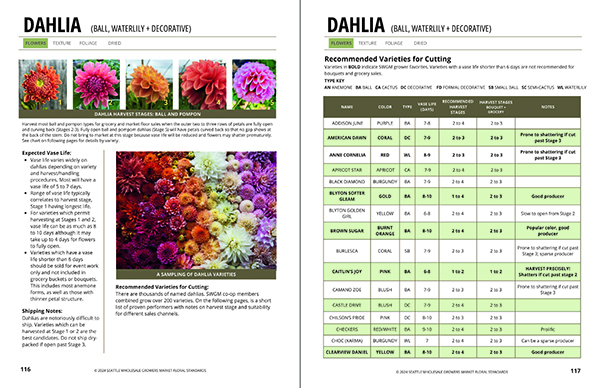
Part of the dahlia spread from the book Floral Standards, available from Growing for Market.
From 2020 through 2024, we set up trials to evaluate key attributes such as vase life and ability to ship dry-packed for products about which we lacked information. We also conducted extensive vase-life trials by variety and stage of harvest for dahlias and roses. In all, we compiled findings for 230 floral crops.
Why take the time to do this highly detailed work? Customers have expectations and the collective’s or cooperative’s brand is dependent upon meeting those expectations. For members of collectives and cooperatives like ours, it’s especially important to standardize products. One person’s idea of a bunch may not necessarily be another person’s idea of a bunch. Harvest stage can play a critical role in vase life.
.png)
Our board and staff were in agreement that by elevating and professionalizing this information for our members, we would enhance the Growers Market’s reputation as a premier resource for top quality specialty cut flowers. In September 2024, we published Floral Standards: A Practical Guide for Harvesting and Delivering Professional Quality Products. The 336-page guide is now our gold standard, and we hope it will be equally useful for others.
Vivian Larson, owner of Everyday Flowers and a cofounder of the Growers Market, often joked that she kept all of her essential growing knowledge inside her head. She wasn’t the only one. Now we have a reference book that captures so much of this valuable information and also helps growers like me remember bunch counts and stem height standards on seasonal crops from year to year.
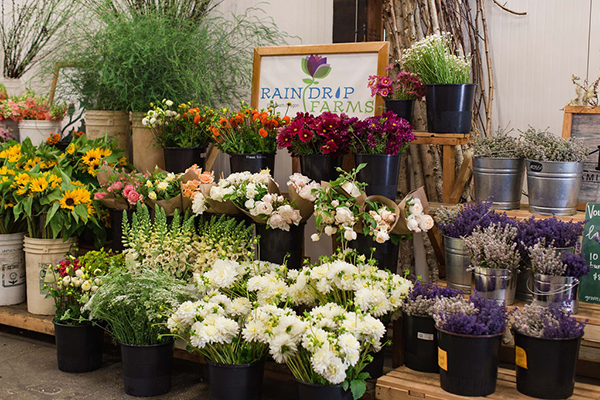
The book Floral Standards establishes a clear standard for blooms at the Seattle Wholesale Growers Market. Photo (c) Missy Palacol Photography.
We have found that Floral Standards has proven to be an excellent tool for onboarding new growers. It is likely not humanly possible to train someone in the hundreds of floral crops that the Growers Market offers customers throughout the year. Standardizing crop information streamlines communication across our member farms and empowers staff — team members who are on the front line working with customers week in and week out — to keep on top of potential quality issues. Customers also find it useful, particularly in knowing what vase life to expect and how to handle various floral products.
If you’re like me, you’re a plant lover whose head is easily turned by new types of specialty cut flower crops. While Floral Standards is filled with data, our farmers were especially generous sharing their favorite varieties. This information gives farmers who want to expand their crop mix new ideas about what to grow, whether it’s someone who wants to experiment with woody ornamental crops or plant uncommon perennials or even a common type of annual they haven’t grown before.
Our favorite varieties are printed in bold-face type in charts throughout the book. These are the high performers that growers feel confident saying, “yes, that one is actually worth the real estate used to grow it.”
Even within our region (western Washington and Oregon, USDA Zones 6 to 8), we experience a good deal of variability in microclimates. Not all crops grow in all areas, and some items that behave well in our region are invasive thugs in other places. Most growers can translate the information fairly easily to their region as I observed recently while speaking to the Utah Cut Flower Farm Association in Provo, Utah. Floral Standards notes potentially invasive crops as well as ethylene sensitive and poisonous plants in keeping with our mission of being good stewards to people and planet.
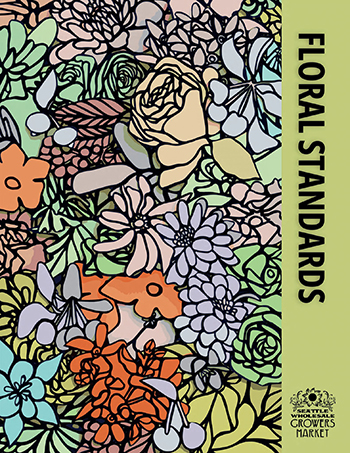
The cover of the book Floral Standards- A Practical Guide for Harvesting and Delivering Professional Quality Products. The 336-page guide is available from the SWGM and Growing for Market.
While flower farming can be a highly satisfying way of life, we also know firsthand that it’s not the easiest way to make a living. We hope Floral Standards helps to build the success and reputation of all growers of local flowers, not only in our area, but nationally, and globally.
You can order the guide from Growing for Market here. The 336-page book with 425 plus full-color photographs was printed by Consolidated Press in Seattle, Washington.
Dahlia vase trials
Although they bloom in different seasons around North America, dahlias are one of the most universally grown and potentially profitable of all cut flowers. Yet, we realized we knew very little about their individual characteristics. Sure, dinner-plate dahlias are short-lived and best for events only. But, what else: Will they open more after cutting? Do floral solutions actually extend vase life? Do ball dahlias have a longer vase life than other shapes? Which ones are reliable for putting into weekly bouquets?
To find out, we first delineated stages of harvest from Stage 1 (one petal unfurled) to Stage 5 (a fully open bloom) and documented each stage with photography. Once we had the stages identified, we solicited samples from our farms to trial in an insulated room with an environment maintained within two degrees of room temperature (68°F).
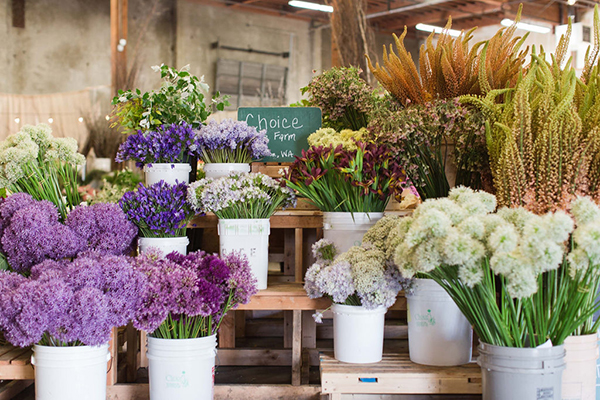
A scene from the floor of the SWGM. Photo (c) Missy Palacol Photography.
By trialing more than 150 varieties, we learned that named varieties of dahlias can be as different from each other as individual Homo sapiens. Vase life varied from three days to 14 days. Some barely unfurled a petal after harvesting; others rocketed forth into full bloom from tight bud stage and were prone to premature shattering if harvested too open. This information —included in five pages of charts, with notes and growers’ favorites bolded — is to help farmers home in on potential profit-making varieties.
STAGE 1: A few types of dahlias can be cut when the first petals are unfurling from the bud and are showing color; these will continue to open if placed in commercial floral preservative (Crysal Clear, Floralife Crysal Clear or similar).
STAGE 2: Some dahlias will open when harvested with one ring of petals fully open, the most promising varieties for shipping. ‘Cornel’ is one of those varieties that a lot of people grow. It’s a classic. But it can’t be picked past about Stage 2 or it shatters in a couple of days. There are other varieties that require waiting until Stage 3 to harvest, or you won’t ever see a real flower.
STAGES 2-3: Most waterlily, decorative, ball, and pompon types of dahlias can be harvested for grocery and market floor sales at Stages 2 and 3, when the outer two or three rows of petals are fully open or curving back.
STAGE 4: Dahlias which will be used for event work within a few days of delivery can be harvested at Stage 4.
STAGE 5: Dahlias should not be brought to market when fully open at Stage 5. Flowers harvested at this stage have significantly reduced vase life and may shatter prematurely. Fully open ball and pompon dahlias will have petals curved back so that no gap shows at the back of the stem. This is not recommended for market sales.
The origin of SWGM
I attended the Association of Specialty Cut Flower Grower’s 20th Anniversary Conference in Portland, Oregon in 2008. At that time, Jello Mold Farm was just getting started. Someone asked a provocative question: Where did we see our industry in the next 20 years?
This question ignited an interest and passion for the local flower movement which led me to serve a term on the ASCFG Board and help found the Seattle Wholesale Growers Market in 2011. Always innovating, I have served on the co-op board since its beginning, helping to shape its trajectory into a vibrant business entity.
Diane Szukovathy and her husband, Dennis Westphall, these days are more “leaf farmers” than flower farmers, as their 5-acre Jello Mold Farm has matured. They dovetail their offerings to complement other farms. She worked with growers and staff to coordinate the SWGM’s Floral Standards book to help flower farmers work together to build a lasting industry based on quality and shared knowledge. You can order the book here.
Copyright Growing For Market Magazine.
All rights reserved. No portion of this article may be copied
in any manner for use other than by the subscriber without
permission from the publisher.