











Farmer-led cooperative arrangements for big purchases
A group of North Carolina farmers created a co-op to share equipment and tools. They exchange them in a way that feels fair to everyone, and they manage the business of the cooperative without making too many demands on busy farmers. They’ve been at it for more than a decade, so the name, Tool Legit, is fitting.
Tool Legit is one of a handful of equipment sharing groups featured in this article. Arrangements for using the same tools come in many forms. Sometimes it’s simply a casual, personal exchange. At the other end, it’s established legal entities with complex agreements. In other cases, regional government agencies or non-profits are involved. The inventory of tools and equipment may be very limited or long, from hand tools to high-priced, large equipment, such as the soil steamer featured in this article.
Yet, in all cases the goals seem similar: to help farms reduce individual capital spending, improve efficiency, save labor, allow for new crops or techniques, scale up more affordably, access otherwise inaccessible specialized equipment or simply try out routine equipment before making an individual farm purchase.
Tool Legit in North Carolina
George O’Neal of Lil’ Farm located 20 miles north of Durham in Timberlake, North Carolina, is a founder of the well-established equipment sharing co-op. “I was always borrowing equipment,” he told me. He and farmer Kelly Owensby wrote a grant proposal to RAFI (Rural Advancement Foundation International) to start an equipment sharing group.
Before they knew the outcome, they went ahead and started a cooperative with five farms that swapped a tiller and a bush hog, while using a tractor from another farm. They got support from the University of North Carolina Environmental Law School to help them write up articles of incorporation for a Limited Liability Corporation.
Then in 2011 the $27,000 RAFI grant came through, and they expanded the cooperative to 10 farms. The first purchase was a $4,000 dual axle trailer, then a second used trailer for $1,000. Then, they added a ridger, a bush hog, a tiller, a disc harrow, a spring tooth harrow and a few other tractor implements. They wanted a spader but the $10,000 price tag was too high. Fortunately, a retiring farmer gave one to the cooperative.
The highest-priced item the first year was a manure spreader for $4,500. Alas, with that came a hard lesson. “When the first farm used the manure spreader, it broke, it had been put together wrong,” George said. “The equipment dealer we bought it from put it together wrong but wouldn’t cover the repair after it had been used.”
The $500 repair came out of the first round of membership dues. Initially, each member paid $400 a year. During the pandemic, they dropped it to $250 and have left it there. The co-op doesn’t buy new tools every year, but George said they’re coming to a point where they need a cash injection. “We could raise it up to $500 in a year to make a purchase,” he said. Meanwhile, 13 years on a lot of the original equipment has been replaced with new equipment, he added.
Right now there are 13 co-op members. They keep it at more than 10 but fewer than 15. Young farmers find their way to Tool Legit. They only take market farmers, not hobby farmers. They try to keep members within a 45-minute drive from each other, more or less.
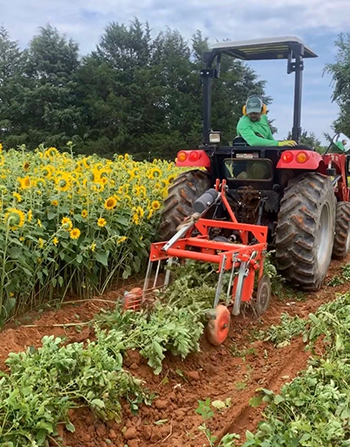
Ross Mickens of Open Door Farm in Cedar Grove, North Carolina, using the Tool Legit co-op’s Checchi & Magli potato digger. Photo by Jillian Mickens.
They require attendance at an annual meeting, usually during winter, where they debate new purchases. Unanimous agreement is required to buy new equipment, a majority of farms is not enough. “We all have to agree to it or not get it,” George said.
They use Google email and a google group to communicate and arrange equipment exchanges. “We tried google calendar for a while, but people didn’t update it,” George said. The last farm to use a piece of equipment and trailers holds them until the next farm wants it. Their hydraulic wood splitter spends most of the time at a farm that heats its greenhouse with wood, while others periodically come and get it.
The tool and equipment inventory is kept on a shared Google spreadsheet that catalogs what they have and when it was last used. Every winter they track down every item and produce a maintenance report.
One of the most commonly swapped items is the Terrateck wheel hoe system used to weed hoop houses. With all its attachments they spent $1,000. The flail mower also frequently makes the rounds to knock down cover crops. Each farm only needs the potato digger two days a year, but around the same time for everyone. Yet, George said sharing has never really been a problem.
He said the co-op steers clear of difficult people. “We don’t get involved with pains in the ass,” George said. “We’re very handshake oriented.” It also helps to choose members with differing crops and farm plans so there’s less simultaneous demand for particular equipment, he added.
The tool inventory includes hand implements, such as a Jang seeder. “Sometimes the tool library is a way to try out equipment,” George said. “They don’t know if that’s the one they need for their operation.” For that reason, farms with more money don’t tend to stay in the co-op too long. “People trial the tools,” he said. “It’s a library for a reason.”
The members enhance each others knowledge of the tools, said current Tool Legit president Will Cramer from Ever Laughter Farm in Hillsborough, North Carolina. “Getting a lot of people using the same tool, you get a lot of ideas about how to use it and how to best use it,” Will said. “We’re country neighbors, if we didn’t have the co-op I wouldn’t interact with these folks. They were more acquaintances before the co-op, but now friends. I get a farm tour when I go to pick up equipment.”
The co-op decided to bypass tractors because an insurance agent warned them about tractor-related lawsuits. They also don’t share trucks or anything that drives.
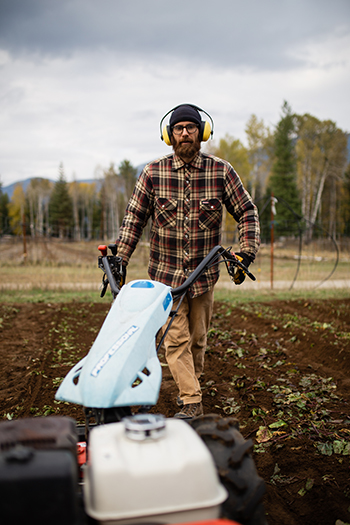
Nicolas Walser using the BCS power harrow at Linden Lane Farms.
While individual farms have their own insurance, the co-op purchases a basic damage and theft policy through the Farm Bureau. In general, if a farmer breaks something while they’re using it, they’ll figure out the repair, but don’t have to cover it financially.
“If you drop the tool in your pond, you might be on the hook for it,” Will added.
So far, they’ve had no major accidents or problems, just a few annoyances. All George could come up with was that a member let her boyfriend use equipment for his outside business. As soon as they told her that wasn’t cool, that stopped.
Will has been a Tool Legit member from the beginning. Knowing that tractor attachments were available through the co-op made his decision to buy his own tractor easier. It helped him scale-up his farm. Co-op farms range from 1 to 2 acres like Ever Laughter, while other members are working 4 to 6 acres.
Will leads the annual meeting, where they will hash out future purchases. On the wish list is a tractor backhoe attachment. Will said they’d have to find one that would work with all their tractors. At past meetings they considered a trencher, but he said many farms don’t need to set up irrigation or work on drainage and trenchers are easy to rent.
Lately they’ve been debating a soil steamer. “It’s the biggest item we’ve ever looked at,” Will told me. “Things we’re looking at now are more expensive with larger upkeep costs.”
The $30,000 and up price tag for the soil steamer is more than they have in the cooperative’s bank account. Sometimes they have to save up for five or six years; also they’re hoping to find the time to apply for grants. “It would be the most expensive purchase to date so there’s no consensus yet,” George said. “A few people really want it and a few people know they won’t use it.”
Shared soil steamers in New England
Starting in the fall of 2020, farms in New Hampshire have been sharing a Sioux Model SF-20 Soil Steamer purchased with $29,995 in SARE’s (Sustainable Agriculture Research & Education) grant money overseen by the Cheshire County Conservation District. The conservation district is a good example of a county-run tool sharing model that makes high price tag equipment available at relatively low-cost rental fees to help support local farms.
Every so often the conservation district asked Bruce Wooster of Picadilly Farm in Winchester, New Hampshire, what equipment they ought to add to rentals. Bruce suggested a soil steamer, which he’d seen presented at a conference. “It’s out of reach for most in the farm community,” he said. “It’s hard to justify that kind of outlay.”
Bruce’s farm is the host site for the soil steamer. He learned to maintain and run it and has trained other farmers how to use it. A SARE’s trial assessed how the steamer helps farmers manage high tunnel crops and also evaluated how an equipment sharing model plays out. The final report is linked here: tinyurl.com/bdfj3dae.
Most of the farms are using the soil steamer to reduce chickweed in high tunnels. “For those overwintering greens and spinach in September and October, chickweed has been a hassle,” Bruce said. “It takes more time for hand weeding to have a clean harvest.”
Farms also use it to combat soil fungi, for example, in the spring before planting summer tomatoes to get ahead of common diseases. They’ve also used it to sanitize greenhouse trays, pots, and distribution containers. One farm filled a box truck with seedling trays on pallets and funneled in steam to circulate around and sanitize the trays, Bruce said.
Most of the scheduling is handled through the conservation district using google calendar, and it’s moved from farm to farm on a trailer. Several dozen farms have used it since it first became available. They pay $100 per tunnel to rent the steamer. It takes roughly 15 hours to steam the soil in a 96 foot by 30 foot tunnel and about 50 gallons of diesel, Bruce said.
The conservation district requests that all its equipment comes back in good shape to avoid a fee. “We ask that all farmers clean rented equipment of any materials, remove mud from disks, wash equipment, and wax prior to returning the equipment. Equipment that is not returned based on this requirement, is subject to a $100 cleaning fee.”
Bruce isn’t paid to host the soil steamer, but gets first dibs on using it. It’s important to have someone keeping track of all the moving parts: the hose that moves the steam, the steam sock, the tarp, the chains and other pieces. The steam sock has to be cleaned, and they’ve had to replace and repair a few parts. He stores the generator under cover so it stays dry.
Having this specialized equipment shared across the region has been valuable. “It’s a good example of win-win opportunities for those of us involved in farming,” Bruce said.
The Cheshire County Conservation District equipment rental site offers instructional and demonstration video links on soil steaming at tinyurl.com/2sw4bx4k.
John Bliss at Broadturn Farm in Scarborough, Maine, had the same impulse, to create an equipment sharing co-op to bring a soil steamer to his flower-filled high tunnels and to other farms in the region to deal with weeds and diseases in tunnels. So far, there has been mixed success.
John got four neighboring farms to agree to participate in the co-op. He successfully applied for a Specialty Crop Block Grant through the Cumberland County Soil & Water Conservation District for a soil steamer and accessories that came to $36,787. The plan was for the conservation district to rent the equipment to the co-op farmers and within about five years with the initial investment paid off, the co-op would own the soil steamer outright.
A little over three years in, that plan has not panned out. The costs were still too high for what was a fairly unfamiliar process. “Perhaps not everyone was drowning in chickweed like we were,” John said. Co-op membership was $250.
Broadturn, the host farm for the soil steamer, and other co-op members pay a rental fee of $300, plus the fuel and labor costs, estimated at another $300, to sterilize soil in a 100-foot by 30-foot house. “We did steam super deep, about 4 inches,” John said. “Every inch of depth uses a lot more fuel and a lot of energy, but steaming allows us to get rid of weed seeds and disease, so it seems like a small price to pay for a fresh start.”
Once the soil steamer is paid off, John anticipates lowering the fee. The fees go straight to the conservation district and maintenance or parts come from that money that has been paid in.
Now, there are three solid co-op members and other farms farther away are using the soil steamer. The initial plan has been evolving. “We’re going to open it up more widely for others to join the co-op,” John said.
The takeaway for John: “It’s really important to have buy-in with co-op members before you start accumulating equipment. Expensive machinery is fine, but it should probably be not so experimental.”
Kootenay Local Agricultural Society in British Columbia
A group farmers in the Columbia River basin joined forces to create the Kootenay Local Agricultural Society (KLAS) in 2008. They created a local certification, Kootenay Mountain Grown, but then a provincial law made it obsolete by specifying organic certification. Yet, the society has benefitted area farmers in other ways, not the least of which is a tool and equipment sharing program spread across the large mountainous and landlocked region.
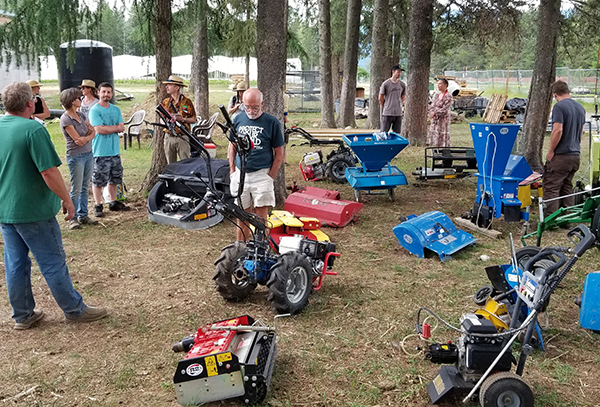
A Kootenay Local Agricultural Society Tool School event in partnership with Young Agrarians to educate users about the equipment offered and how to use it responsibly. Photo by Hailey Trook.
The geography makes it difficult to access food, so 95 percent is trucked in. That makes local food production vital, but also difficult. So pooling resources for tools and equipment keeps expenses for individual farms down, said Matthew Carr, current president of KLAS who owns Linden Lane Farms, which produces 10 acres of diversified vegetables and fruits, and Cultivate Horticulture, which manufactures greenhouse kits for farmers and backyard growers and distributes innovative farm tools and equipment.
Central to the KLAS tool library is a fleet of BCS equipment: Tractors, tillers, power harrows, rotary plows, seed spreaders, brush mowers and chippers are available to rent by KLAS members, who pay a $25 annual fee to join along with $30 each year toward maintenance. Members then pay $40 a day to use the tractor and an additional $40 for attachments. The original equipment investment came from grants from the Columbia Basin Trust, which distributes profits from damming the watershed. The trust continues to support and subsidize the cost of the equipment sharing.
They added the flail mowers and power harrows last year as more people were asking for them for cover cropping and practices with less soil disturbance.
The equipment is held at three hubs: Creston, Krestova, and Kaslo with Creston the most central and busiest. Matthew’s farm is the equipment host site in Creston. They recently built a shed to protect the equipment in winter. “We’ve got people who will travel two hours away and pool with other farmers,” Matthew said. KLAS also has three trailers for moving the equipment around.
Informally, the farmers in the region also help each other out by consolidating orders, for instance. “If someone is going to Vancouver they let people know they are going to a supplier to see if anyone needs anything,” Matthew said. “I’ve had farmers pick up things for me when driving by a place. If you’ve got a broken tractor, it’s a two hour drive. That’s how isolated we are.”
Matthews father, Nigel, is the Tool Guardian who oversees maintenance of the fleet and is a stickler for how members use and handle the equipment. It’s important to bring equipment back clean because some farms are organic, others not. Renters have burnt out the oil, clogged the engine or made a bad repair, such as dealing with broken rotary plow rototiller tines by welding them on backwards (instead of bolting them correctly). Replacing parts can take weeks and take equipment out of use.
“That’s the hardest part of renting,” Matthew said. “Every farmer thinks they can fix it if they break it.”
Such mishaps don’t happen as often as they used to. “My dad can be scary to renters, he’s serious and explains what happens,” Matthew said. They host equipment events on their farm to demonstrate general maintenance, such as changing the oil.
The budget for the tool library is tight. They’re looking at a more sophisticated equipment booking system and for now are using their website and emails. Originally they were cash based, but now accept online payments.
In the future, they would like to access more grants to expand the number of equipment hubs and reach more towns. Matthew, now 29, started his farm during high school on 3/4 an acre, and he rented one of the BCS tractors, which transformed how he farmed. “This program is great, young farmers can get involved no matter the size and scale and test out the equipment.”
Jane Tanner grew cut flowers and specialty crops at Windcrest Farm and Commonwealth Farms in North Carolina, and helped manage the biodynamic gardens at Spikenard Farm in Virginia.
Copyright Growing For Market Magazine.
All rights reserved. No portion of this article may be copied
in any manner for use other than by the subscriber without
permission from the publisher.