




To be completely honest, I don’t have the most followers. I don’t know how to go viral (yet), and I’m unsure of all the best practices to work the algorithms behind social media. But I have figured out how to use social media to my advantage by mastering the mindset needed to show up regularly in a focused and joyful way.
Why is this important? Because social media marketing is one piece of the farm marketing puzzle. If you’ve struggled with figuring out why it’s beneficial or are avoiding it on the regular, here’s what interacting regularly on social media allows you to do:
- Connect with new potential customers
- Build and nurture relationships with existing customers
- Showcase your most recent work or products
- Share video and photos of your farm (which your people LOVE)
- Find new people to network with (other business owners)
- Network with people and businesses from your community (which leads to all sorts of good stuff)
Plus, you can do it on your phone from just about anywhere. Sounds amazing, right?! Even with all the benefits of social media, many people struggle with the feelings and emotions around doing the work. If this is you, I’ve got you covered.
I’m going to walk through the steps I’ve used in my business to use social media to my advantage.
Step 1: Stop the scroll
I have an absolute no scroll policy when I’m on social media. Ever notice how time just flies by when you’re scrolling? You have limited time during the day to get your farm tasks done so don’t waste it scrolling. Unless, my friend, scrolling makes you feel good or somehow benefits your life.

People love to see what you do behind the scenes and in-process. Photo by Gardenwild Floral.
But I’m guessing, if you end a scroll session, you’re probably feeling worse about your life and not better. Do me a favor and go see. Next time you end a scroll session, ask yourself, “How do I feel?”
Every time I log on, I have a purpose. Whether that’s creating a post, story or reel, answering DMs or checking in on a follower or an industry partner. The job is intentional. And that one job is all I’m doing. Don’t let scrolling distract you from the task at hand.
Step 2: Schedule time to check, comment, and post
In order to use social media to your farm’s benefit it needs to be treated like another task in your business. It’s time to stop hopping on social media whenever you’re moved to do so. Put your social media tasks in your calendar and stick to it. For me, 30 to 60 minutes per day tends to be plenty of time to do what I need to do.
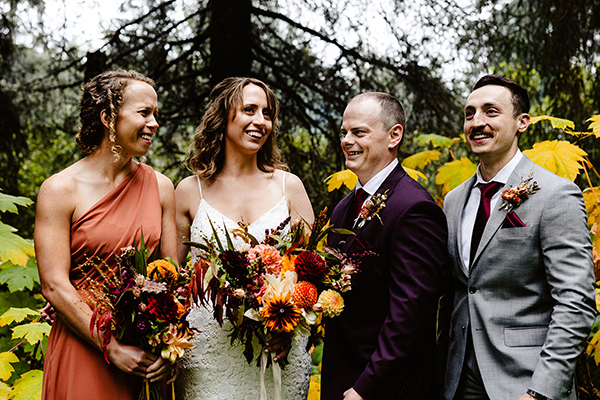
If you produce a finished product like bouquets or boutonneires, people will want to see that too, and it will add to your online portfolio. Photo by Lauren Roberts.
If you’re used to hopping on whenever, it’s time to create a new habit so you can stay in control of your time. Social media sites are designed to be addicting. Seeing a “like” activates our brain and gives us immense pleasure. Because of this, checking social media can become a tough habit to break. Set your timer, stay focused on the social media activity you told yourself you’re working on and finish when the time is up so you can move on to your next task.
Even though social media is a “free” marketing channel, your time isn’t free. You need to be accounting for your time in your business, even when you’re on social media. You’ll soon realize that these free platforms are actually big money spenders, time-wise.
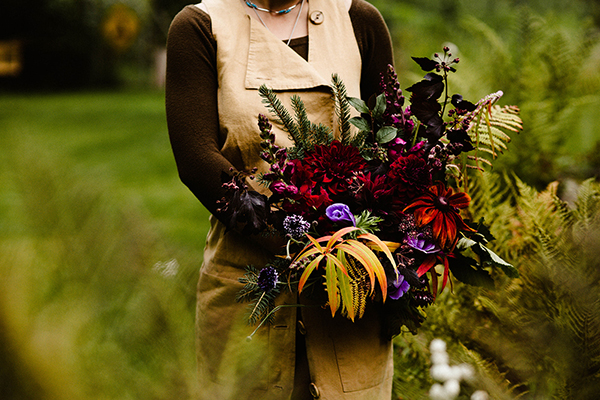
A shot like this gives potential customers an idea of the type and scope of work they can expect and are a great way to advertise your services.
Stay incredibly focused by allocating time each day or week to these tasks and then stick to it. In addition, never post and ghost. Use your social media time to check for comments and comment back. If someone takes the time to tag, share or interact with your content, be over the moon and show your appreciation by thoughtfully commenting back to them.
Step 3: Create five to ten content buckets
Do you struggle with what to post about on a regular basis? Feel uninspired to create content? Or just unsure what your followers want to hear about? Creating content buckets allows you to focus your content so you’re never unsure what to post about. It also allows for some diversity in your feed so your followers stay interested. This keeps your posts on brand and engaging.
For example, if you’re a flower farmer maybe your content buckets are:
1. in the field (photos, fun facts, videos of you, your people and your flowers in the field)
2. behind the scenes in your office or studio (your customers love seeing what it really takes to operate your farm)
3. portfolio of bouquets/designs (here’s where you can edit and curate the most beautiful photos of your work)
4. you and your team (people love seeing other people so get used to showing your face)
5. the farm dogs or cats (people go crazy over farm animals and pets)
6. customer testimonials (build credibility and show how much people love your product by sharing testimonials)
Create content buckets that make sense for your business and that are interesting to you. That way, when you’re out and about on your farm and ideas pop into your head you can: filter them through your content buckets, and then make yourself a note of your idea for your next social media marketing time.
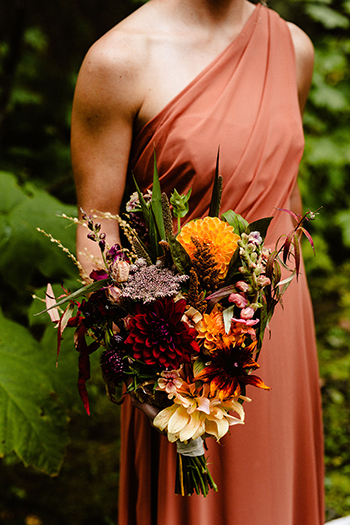
Customer testimonials build credibility and show how much people love your product. So if you have happy customers, ask if you can share their feedback. Photos by Lauren Roberts.
I’ve found that generating content buckets helps me be more creative. Creativity sometimes does best when it has parameters or boundaries. If you can post about anything, then suddenly the mind goes blank. But if you decide you’re posting about your farm dog every week, you can easily see all the possibilities: your dog amongst the flowers, your dog sniffing a bouquet, your dog lazing in the sun, etc. Creativity needs a container.
Step 4: Track your activities on a spreadsheet
If you’re not a spreadsheet geek, stay with me here. This has been a game changer for me. Tracking activities with a spreadsheet allows you to organize information and analyze activity. Here’s what my networking spreadsheet has: key people I want to connect with regularly (local businesses and other wedding or coaching pros), contact email, phone and address and a box to account for outreach. Every time I comment on something or reach out to someone I check the box that says “outreach.”
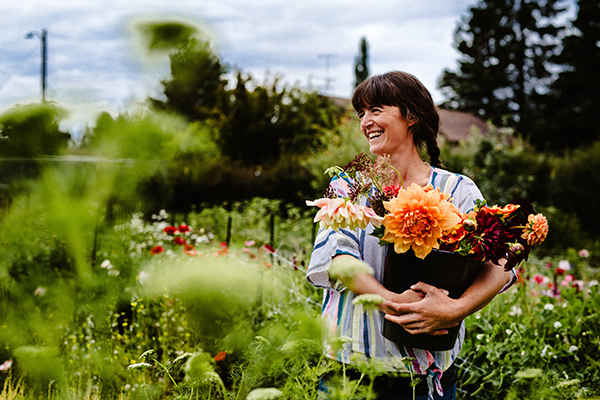
Field shots can be a mainstay of a farm soical media feed- like this shot of the author in the field.
I do this to stay focused on the task at hand and to keep up on my networking. There are people in the community that I want to stay very engaged with throughout the year. If you’re top of mind, referring customers to you is an easy task. You can also create a spreadsheet for tracking engagement with posts/reels/stories. Analyzing how certain content performs can be beneficial in learning what people want to see and how to engage more with your audience.
Step 5: Strengthen in-person relationships
I’m all about leveraging online and in-person networking to work in tandem. Great relationships are made in person and online. My goal is to meet one-on-one with a business owner weekly in my community year-round. I often use social media to find them and warm up to them. You can warm up to them by commenting on posts, saying “hey” in the DM, sharing a post they created, following them, etc.
Once I’ve warmed up to them a little and I’m pretty sure they’ll recognize my name, I’ll hop in their DM and ask them to meet for coffee. I believe this old-school approach to marketing is where it’s at. The connections I’ve made, new things I’ve learned, ideas I’ve generated and collaborations I’ve started through my coffee dates just this year has been so incredibly worthwhile.
After each meeting, I hop back in my networking spreadsheet and make comments about each person. I want to remember something personal about them and something noteworthy about where they are in business so taking notes is super helpful. While the payoff for networking isn’t always immediate, over time you will generate lots of momentum in your business.
Step 6: Create a social media manifesto.
This is my absolute favorite step in mastering social media. Make whatever social media platform you are using, your platform. You get to decide how you show up, what you say and how you say it. Ultimately your message needs to resonate with your customer, but you also need to feel compelled to get on there and share.
Don’t get wrapped up too much in what other people in your industry are doing. Focus on you and your business and what makes your product or service unique (YOU are part of what makes it unique).
Your manifesto needs to communicate why you are sharing and posting. And it needs to cover what you’re offering your followers. The following is an example of the manifesto for our urban flower farm and floral design studio, Gardenwild Floral Design: “It is my belief that people want connection. This is what all our marketing is about: connecting with other people.
Gardenwild’s social media “why” is to connect one-on-one with a human being. That’s why we show up everyday, multiple times a day. These are our guiding principles for social media: We show our beautiful work. We inspire and lift others up. We give value: links to blogs, tips on wedding planning, design and gardening, etc. We support our client community and network community. We do this through tags, shout-outs, shares, etc. We show our real selves: unfiltered, unapologetic, imperfect and human. We do this through video and stories and behind the scenes posts. We want our customers to feel like there are real human beings behind our feed. We reply to every comment, DM and new follower with an uplifting and positive voice. We show our faces on video and on posts, because ultimately people want to connect with people.
Now it’s your turn! Why do you want to show up on social media? Write out a short manifesto and decide on your five to ten content buckets. Write it out and look at it before every social media task you do on your farm.
Greta Lewanski is owner of Gardenwild Floral Design, an urban flower farm and floral design studio in Anchorage, Alaska. She’s also a mindset and business coach for women farmers and entrepreneurs. Find her online at: www.gardenwildfloral.com and www.gretalewanski.com. Find her enjoying the heck out of instagram @gardenwildfloraldesign
Copyright Growing For Market Magazine.
All rights reserved. No portion of this article may be copied
in any manner for use other than by the subscriber without
permission from the publisher.