











Versatile, profitable and good for pollinators
Snapdragon, or Antirrhinum, is a staple spring and early summer crop on our farm. We do succession plantings in our unheated greenhouses and in the field for eight to ten weeks of continuous harvests. They are a fairly easy cut flower to grow, and they produce an incredible number of stems per square foot, making them quite profitable. You can dry snapdragons and add them to everlasting bouquets for sales during the winter months. They are also an edible flower.
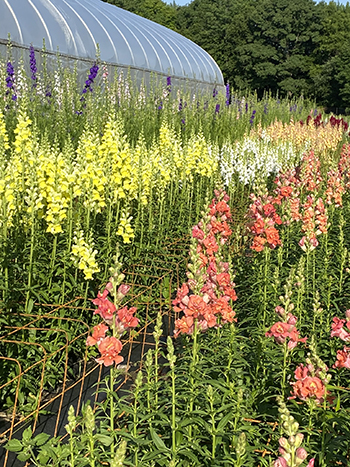
Heavy snapdragon production on June 25 in Upstate New York. All photos courtesy of the author.
Snapdragons come in dozens of varieties of shades and styles, and they are a designer’s dream come true. They are a nostalgic flower that customers recognize and recall vivid childhood memories of playing with the snappy petals. Flowers that evoke emotions and memories like this tend to be top sellers at our farm stands, plus they meet our mission of bringing beauty and joy to our customers. Finally, they are a great source of nectar and will attract pollinators and beneficials to your fields.
Varieties
There are hundreds of varieties of snapdragons to choose from. I buy all of my seed from Geo Seed and Johnny’s though I’m sure you can find most of these varieties from any large flower seed supplier. In the Geo Seed catalogue, they are listed under the Latin name Antirrhinum.
Snapdragons are split into different series based on their bloom time and ability to flower in low light (winter) situations. Since I’m only growing snapdragons in the spring, I don’t pay too much attention to the different series. I’m sticking with varieties that have the thickest stems and flowers and the best colors.
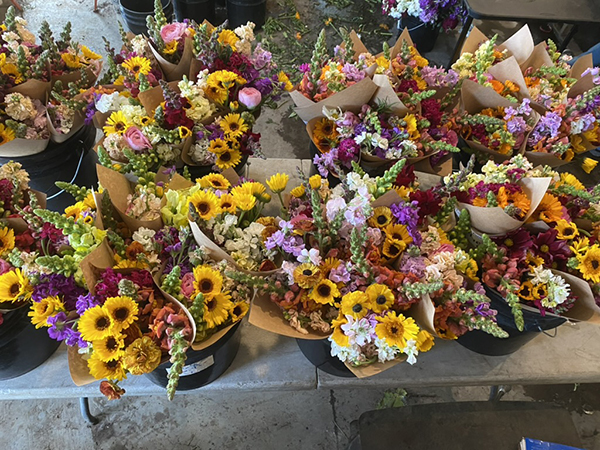
Early summer bouquets featuring snapdragons.
I keep it simple by focusing on my four favorite series: Potomac, Chantilly, Madame Butterfly, and Avignon. Among these series you will find every single color shade of your dreams, plus a lot of floret diversity which is fun in design work and also in straight bunches.
I grow the Potomac series because they are productive, have great stem length, and an incredible choice of colors. Potomac Lavender is a dusky, pale purple, quite rare in the snapdragon world. I love using it in rainbow bouquets, and it blooms when I don’t have too many other purple flowers on the farm. I’m also partial to Potomac Dark Orange and Bronze.
The bronze and orange in snapdragons are more salmon than anything else, and are touched with a glowy pink on the petal edges, looking like a sunset. In the Potomac series, I also grow Pink and Appleblossom. The Potomac Pink smells (and looks) like bubblegum, and Appleblossom is the cutest white and pink bicolor. I love mixing the orange, bronze, pink, and appleblossom varieties for straight bunch sales, and this color combo is my most popular at farmers markets.
Potomac White is a must grow, especially if you do any bridal design work. They are the fattest white snappies I’ve grown, like they were meant for a bridal bouquet. I always grow the Potomac Yellow for it’s electric coloring. Yellow is a a cheerful and optimistic color that’s going through a revival in the flower world. Finally, I limit myself with the Potomac red shades. I love them, but I find that my customers are drawn to the lighter and brighter colors. Potomac Red, however, is like crushed red velvet. It’s a heartthrob of a flower, so I do grow it in limited amounts.
The Chantilly series have an open throat, “wildflower” look, and they come in gorgeous salmon shades. I grow the Bronze White Throat, Pink, Deep Orange, and Light Salmon. I’ve noticed that the Chantilly series is more prone to dropping petals and has a shorter vase life than the other varieties, so I grow the Chantilly Series in limited quantities. They are a true joy in design work, and a mixture of the orange and pink shades in a straight bunch is another popular choice at market. The Madame Butterflies are a double flower, and so frilly and thick they remind me of a scoop of ice cream. I grow the Bronze, Ivory, and Red in this series. They bloom about a week behind the other varieties.
Finally, the Avignon series is a newer strain that was bred to bloom in the cold, making it a great variety for early plantings in the high tunnel. I grow the Apricot II and Silver II, and I’m completely obsessed with these gorgeous varieties.
Seeding
Though their tiny seeds may seem intimidating, snapdragons are easy to germinate and come up about seven to ten days after seeding. Pace yourself if you are seeding by hand — it takes patience. I usually find myself clenching my shoulders up in concentration, so don’t forget to take lots of breaks to stretch your shoulders and neck.
We drop two seeds per cell to ensure that we get germination. We use the 4-inch paperpot chains for our earliest planting, and then we plant into 128 air prune trays for the second planting. We still don’t have a vacuum seeder, so it is a slow and meticulous process of dropping seeds by hand into each cell.
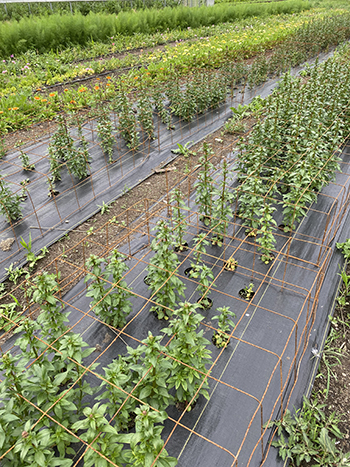
Concrete mesh cages sit right on top of the bed (no staking required) and support the long stemmed flowers as they grow through.
Cover the seeds very lightly with vermiculite or potting soil. We germinate in our “incubation room,” one of our walk-in cooler rooms outfitted with a heater and thermostat set to 70°F. If you have an extra insulated room, it’s an easy way to get a jump start on your germination times, especially if you live in a frigid climate like Upstate New York. Just make sure the trays go into the incubation room fully saturated, and check on them daily. Once you see even a single seed germinating, you’ll want to pull all of the trays and get them into the greenhouse for light.
Plan on starting snapdragons about 10 to 12 weeks before transplanting. We do two sowings — January 7 and February 25. The first sowing is in 4-inch paperpot trays for high tunnel planting. The second sowing is in 128 air prune trays for field transplant. Snapdragons can take a light frost, so we aim to get them planted as early as possible in the spring. Also, snapdragons are very forgiving. If you are running late in getting seeds started, I would say you can start them into March and April with success in your summer garden.
Transplanting
Our first planting is when our paperpot trays are ready to go in the ground in unheated high tunnels in mid-March. We squeeze them in as tightly as possible in the high tunnels, thus the 4-inch spacing. We use a 30-inch-wide bed, and the tunnel beds are about 90-feet long. One 4-inch paperpot chain perfectly plants one row in our high tunnel beds. We are able to carefully squeeze in five rows per bed planted with the paperpot transplanter.
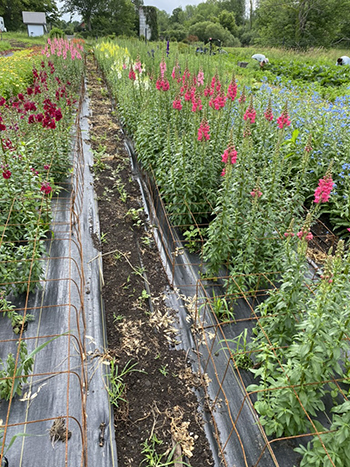
Metal support cages and pre-burned landscape cloth aid in snapdragon production.
The 4-inch paperpots are perfect for the early season. Because we pack them in so tightly, I don’t have to worry if I didn’t get perfect germination or if some plants don’t make it. We do a pass or two with interchangeable-head wire weeders while the plants are small, then once the snapdragons fill in, their tight spacing helps to prevent weeds.
We use the air prune plugs for field plantings. In our climate, that’s late April, and I recommend getting them started as early as you can in the spring. You could do a third planting in late May, but I find that snapdragon production slows in the heavy summer heat. We prioritize growing them as early in the season as possible in both the high tunnel and the field.
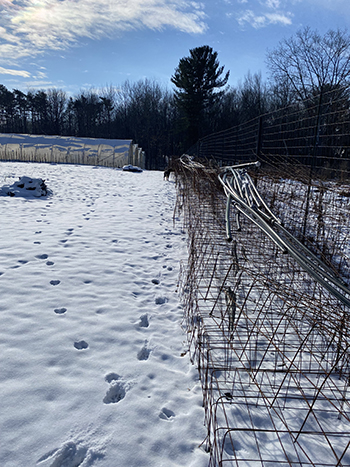
Concrete mesh cages stored along the fenceline in winter, with stored irrigation pipes on top.
Because most flowers are slow growing and have a long bloom period, we try to plant all of our flowers into pre-burned landscape tarps. The landscape tarp does a great job of suppressing weeds while keeping the soil protected. We plant snapdragons into tarps with a 6-inch spacing. We don’t thin, and instead welcome any plugs that had two seeds germinate. Flowers bring a high return per square foot with intensive spacing, so don’t be afraid to pack them in.
Greenhouse versus field
Every flower would love to be grown in a tunnel. The protection from wind and the elements, plus the diffused light, causes flowers grown in a tunnel to have long stems and perfect flowers. I believe that snapdragons deserve some space if you have room to spare in your precious high tunnel real estate.
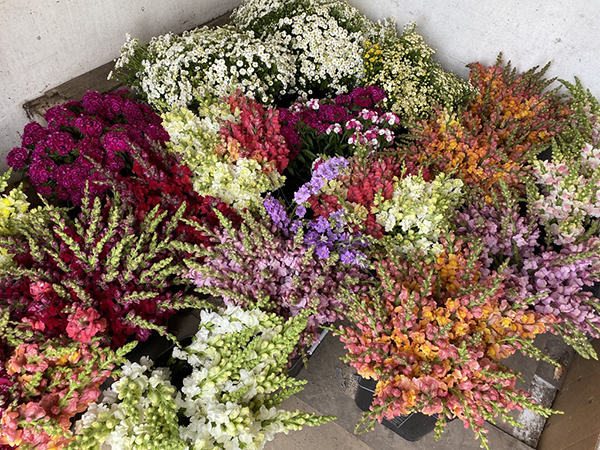
Freshly picked buckets stashed in the walk-in cooler.
My market is most ravenous for fresh cut flowers in the spring and early summer. There’s also less competition from other growers in the early season. Especially in our cold climate, customers are desperate for some color and joy after surviving the long winter. We find it very hard to keep up with the demand during May, June, and early July, though it might be a few months earlier if you live in a warmer climate.
The reason to prioritize greenhouse space for your snapdragons is to get those early blooms. You will also get incredible stem length on greenhouse grown snapdragons. We harvest snapdragons from the high tunnels mid-May through June, and then from the field from late June through July.
Pinching and trellising
I personally do not pinch, since I grow hundreds and hundreds of them and I don’t see the cost benefit for doing so. Plus, the primary bloom is the best — it is tall and fat with florets. I find that the side shoots quickly grow after I take the first cut and are plenty long. The secondary blooms aren’t quite as thick and have a more slender stem, making them a perfect filler for bouquets.
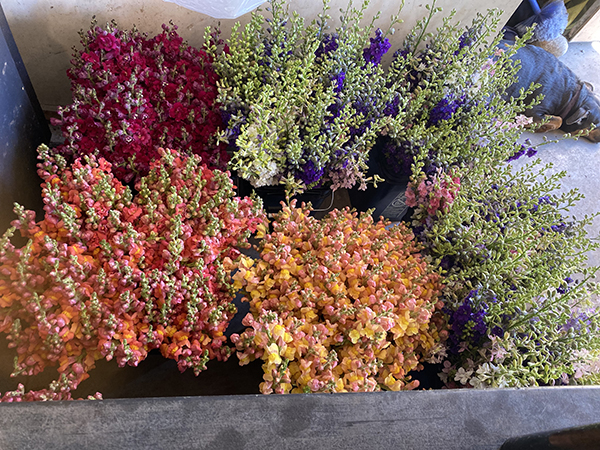
Snapdragons and larkspur.
Snapdragons get quite tall and require trellising to keep them upright. There’s nothing worse than seeing plants that you’ve nurtured for months fall over in a rain or wind storm and start growing stems with sharp right angles.
We have slowly invested in reusable metal cages for trellising on our farm. As a regenerative farmer, I’m constantly scrutinizing how to reduce plastic waste on my farm. The trellis netting that most flower farmers use is fine if you are just starting out and can’t afford to invest in metal cages. If you are in it for the long haul, I highly recommend switching to reusable metal cages.
Horti-Trellis personally drives me crazy. I snip holes in it while harvesting, and I’m constantly scratching myself on the T-posts that are used to hold it up. It used to take two crew members at least an hour, plus back breaking labor, to gather T-posts, pound them every 10 feet down the row, then fuss with the tangled Horti-Trellis and learn how to pull it tight enough to actually hold the flowers up.
Now, we use metal cages that we’ve built from concrete mesh panels. You can get the mesh panels at any hardware store. Be forewarned, they are not cheap. But they are a reusable investment that you will be able to use for decades on your farm. We have invested little by little over a few years. Building cages is also a good winter chore. If you keep crew members on year-round, it’s nice to have jobs like building cages for the winter months.
There are different pre-cut mesh panel sizes, so you may want to shop around to find the right dimensions for your situation. The best size for our farm is a 5-foot by 10-foot panel. When you bend these into cages, the dimensions are 1-foot tall by 8-feet long by 3-feet wide. We build the cages by cutting out the corners, then folding the sides down. We use a small piece of wire to tie the corners together. We put the cages on the growing beds after we have done at least one weeding and the transplants have started to fill in.
Two people can set up trellising on a 100-foot bed in about 15 minutes. The cages are very lightweight and easy to move. It’s nice to work with a partner. Sometimes you need an extra set of hands when settling the cages over the growing plants, especially in intensive plantings with 6-inches or less spacing between plants.
Harvest
Snapdragons are fast and furious when they start blooming. We pick twice a week to keep up with the production. It’s all hands on deck to get the blooms in before the heat of the day. We rush the harvest directly into the walk-in cooler.
Since we are harvesting for direct sales at our farmers market stands, we cut when at least five florets are open. I’ve found that retail customers prefer to buy a stem that is more fully opened. On the flip side, as a farmer and a business owner, you want to ensure that your customer gets a flower with a long vase life. So, we walk that line of harvesting at the perfect point for both a sale and long vase life.
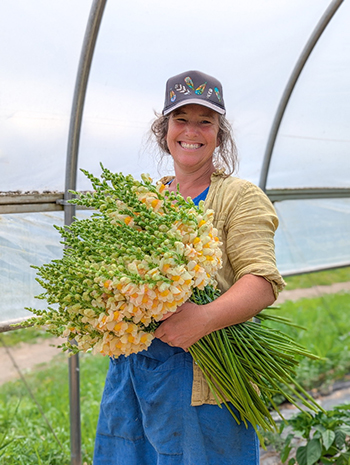
Author Corinne Hansch holding an armful of Avignon Apricot II snapdragons.
Snapdragons are a great flower to train employees on harvesting. Their tall stem length makes it easy for folks to get the hang of how to harvest a 20-inch stem. They are pretty straightforward to strip, though I recommend using gloves to protect your fingers when you are stripping hundreds or thousands of stems per harvest.
On our farm, we don’t drag buckets down the row during flower harvest. We load up the market van with clean buckets filled about 1/3 full of water and drive to out to the field. During harvest, we collect as many stems as we can hold in one hand, then run them to the buckets in the van. It’s great to have two people on opposite sides move down the row together. When one person makes a run to the buckets, they always grab their partner’s handful of flowers. Another strategy for speed is to keep the fastest harvester picking while the less experienced person does most of the running to the buckets.
Snapdragons will always orient themselves straight up post-harvest. It’s important to pack your buckets with the stems straight up and down or else they may get a curve in their stem during storage in the walk-in. Since snapdragons are so long, we use a taller, square 4-gallon bucket to support the long stems and keep them straight in the bucket.
Though it seems so simple, there is a skill to packing flowers in buckets. I notice that harvesters don’t pay too much attention to how they stick handfuls of flowers into the buckets, and often there are stems poking in every direction and flowers getting tangled. It’s worthwhile to take time to make sure you and your crew are packing buckets efficiently so that you have less damage to your flowers.
Marketing
We sell snapdragons both as straight bunches and in mixed bouquets. They produce thousands of stems per 100-foot bed, so we make them a feature in our mixed bouquets in early summer. I spend very little time on my market bouquets, and instead of carefully arranging like I would for a wedding bouquet, I’m simply bunching mixed stems. I create a basic recipe, like six stems snapdragons, six stems calendula, three sweet William, three feverfew, two foliage, spending no more than two minutes per bouquet. We sell our bouquets for $25 to $30, depending on the market.
Straight bunches are also very popular at the farmers market. All my straight bunches are designed around price per stem. If you are growing for florists, straight bunches are generally 10 stems per bunch. At farmers markets, our customers want a good deal on a pretty bunch of flowers, so again we walk that line of charging a fair price for ourselves while making the flowers accessible for our customers.
In early spring, when they are just starting to bloom and are in high demand with my customers, I can make my bunches on the smaller side. In the summer, if I have a lot of snapdragons that I need to sell, I can make the straight bunches a bit fatter to promote sales. We charge $15 per straight bunch or three for $40, and we sell so many with this strategy.
We wrap all of our bouquets and straight bunches with Kraft paper. We use a sticker with our farm logo, USDA organic label, and the name of the product, “Snapdragons,” to hold the Kraft paper wrap. Doing the extra step of wrapping and labeling our flowers protects them during transport and at market, where they tend to get beat up as customers pick and choose a bunch.
We are also building brand recognition with the label. We’ve found that we make more sales with products that have clear signage, and we are educating and empowering our customers with the flower name on the label.
Drying
After reading Hannah Muller’s book Designing with Dried Flowers, I learned that they are drying snapdragons at Full Belly Farm. I decided to give them another try this year. I agree with her advice to focus on more of the pink, orange, and yellow shades. The Potomac Pink and the Avignon Apricot dried particularly nicely. The whites tend to turn a bit brown, and the red shades turn almost black. Snapdragons do look nicer dried if more of the florets are all the way opened before you hang to dry.
The dried snapdragons are also great dried flower bouquet material. I charge the same for my dried flower bouquets as my fresh to keep consistency with my customer base. We wrap dried bouquets with the same Kraft paper wrap and sticker with label and logo. I’ve also loved using the dried snapdragons in wreaths and other design work this winter. (See “How to dry flowers that come back from market,” from the February 2023 GFM or in the archives at growingformarket.com/.)
Corinne Hansch is an organic farmer, writer, mentor, activist, chef and entrepreneur. She farms with her husband and a hard working crew at Lovin’ Mama Farm in Amsterdam, NY, while homeschooling her three kids. She grows over 400 varieties of veg and cut flowers using regenerative practices such as no-till, perennial plantings, and living wages for employees, producing over 50,000 pounds of food per year and hundreds of thousands of stems of cut flowers on three acres. They direct market at five regional markets per week and are building a line of value added products for online sales.
Copyright Growing For Market Magazine.
All rights reserved. No portion of this article may be copied
in any manner for use other than by the subscriber without
permission from the publisher.