











If you drive through Ohio’s rural countryside you’re likely to pass some 19th century-era barns that were built through the collective labor of a community barn-raising. While the tradition is maintained by Ohio’s thriving Amish population, the concept of a community cooperative is enjoying a renaissance among the “English.” Yet this 21st century version of a barn-raising has taken a decidedly high tech turn: rather than hoisting barn beams, neighbors are coming together to help one another install solar panels.
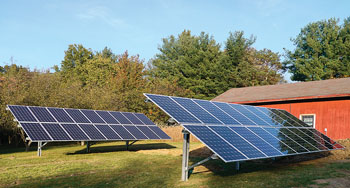
Similar to a barn-raising, the solar co-op taps the social capital of the community to provide labor for mutual assistance. The concept is simple: “members” come together to assist others in the installation of their systems or to negotiate better pricing through bulk orders of solar panels.
The idea to form a co-op in our community came while my husband, Jeremy, and I were contemplating adding a solar array on the roof of our home in 2012. After suffering from sticker shock at the $24,000 quote from a turn-key solar company to purchase and install a small (<3 kW) array, Jeremy decided to research the possibility of a DIY installation of the panels.
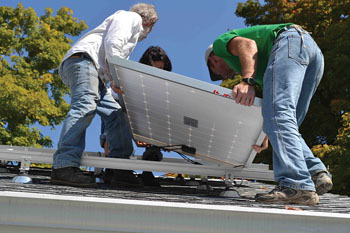
Wanting to get some experience before trying this on our own home, Jeremy volunteered histime and labor to help a local contractor, Richard, who is also a certified solar installer, expand an existing array at his farm. In exchange, Richard agreed to help us install panels at our place. It would be a win-win. Sensing that this labor exchange could benefit more than just our two families, Jeremy sent an email to other friends, colleagues and acquaintances they thought might also be interested in solar. The response was overwhelming. The email list quickly grew to dozens of families and it was standing room only at the group’s first meeting. It quickly became obvious he’d hit on the untapped potential of collective, community spirit. It was there that the Granville Solar Co-Op was born.
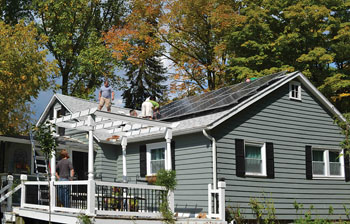
When it came time to install our solar array, we were humbled by the number of folks who willingly showed up to scurry up ladders, help hold the panels in place or simply hand up tools and refreshments for those working on the roof.
Throughout the installation, Richard explained each step so that the process could be easily replicated at the next home. It took just a few two-hour work parties over the course of a few different days to have our entire system installed and ready to be hooked up to the grid. The total cost of the equipment: $6,800. With a 30% tax credit, our total out of pocket expenses dropped even further. Prices for solar continue to drop significantly and the same system would cost approximately $5,800—just two years later. At current electricity rates, our system will “pay for itself” in about six years (one of the first questions we always get, despite the fact that no other home improvement investment is held to this same standard. But I digress…)
Since its inception just two years ago, the solar cooperative in our small town has installed seven systems that generate over 50,000 kWh per year of clean, renewable power and have saved homeowners tens of thousands of dollars in installation costs. The list of people interested in participating now tops 80.
”I just love having this solar array providing nearly all of my power needs,” stated Abram Kaplan, a professor and visual artist whose work often depicts Amish farms and sustainable farmscapes. “And the best part is that a small group of us figured it out together and set the whole thing up. I look forward to the opportunity to help others do the same thing.” Kaplan’s 36-panel, 10 KW system would have cost nearly $50,000 to install professionally, but his net costs after the federal tax credit was 30% of that. He’s looking at about a 4-5-year payback period on the investment.
Among those helping Kaplan was Mark McVay, owner of Cat Run Ranch Flower Farm outside of Granville.
Mark and his wife Karen recently installed a 12 kilowatt system. Their 48 solar panels now produce enough energy to power their home, two farm golf carts, a Chevy Volt and the pump that runs their flower farm’s irrigation system.
Taking what he learned from the co-op, McVay was able to negotiate a discounted installation price for his system. In the coming months, he will install additional panels on a barn roof in order to cover the electricity use of the outbuildings, floral cooler and other equipment. He plans to do the installation himself, with help from other solar co-op members.
“We invested in solar for the health benefits—for people and our planet. The less electricity we use from Ohio’s dirty coal-burning power plants, the better,” Mark shared. “We also want to be an example and hope others will invest in solar arrays too. We love our system.”
As the cost of solar panels continues to drop, more small farmers are installing solar arrays to defray rising energy costs and to improve the sustainability of their operations.
At our home, our 2.75 KW solar array helps to power the lights used in our basement “grow room” where dozens of varieties of cut flowers get their start before being transplanted to the field or hoophouse at Buckeye Blooms, the cut flower farm & floral design business I co-own with my mother, Kay Studer. The 11 panels produce enough electricity to cover approximately 55% of our energy use.
The USDA has a grant program REAP that further incentivizes renewable energy for farmers: http://www.rurdev.usda.gov/bcp_reap.html For market farmers, there is the added benefit of being able to differentiate your operation and the goods you produce using clean, renewable energy. Whether you promote that on your website, or via a simple sign, “My farm uses clean, renewable solar power” at your farmer’s market booth, don’t dismiss the opportunity to market your investment. An increasing number of consumers seek sustainably produced goods and many are even willing to pay a premium. If nothing else, it is a terrific conversation starter.
I can’t tell you the number of times we’ve told our solar story to friends, colleagues, and more than a few nosy neighbors. During those conversations, we find most people are all intrigued by the idea of installing solar, but have the misconception that it is inordinately expensive or too technical or simply too scary to do as a DIY project. When we tell them we did it ourselves, what it cost and what the payback time will be, we love watching jaws drop. We even have a cult following of solar stalkers who track our panel production via our online monitoring system: https://enlighten.enphaseenergy.com/public/systems/F3EX119906
Word of our little solar project has spread. A group of sustainable farmers and rural residents in Western Maryland interested in replicating this model invited us to give a presentation on the co-op model. Meanwhile, Jeremy is drafting a detailed step-by-step manual to support those interested in DIY solar installation.
The future is very bright for solar power. Our hope is that someday soon we’ll see old barns topped with new solar panels—all made possible by neighbors helping neighbors in old-fashioned and new-fashioned barn-raisings.
Susan Studer King is a freelance writer and co-owner of Buckeye Blooms, a small flower farm and design studio she operates with her mother on their fourth generation family farm near Lima. She splits her time between the farm and her solar-powered home in Granville.
Copyright Growing For Market Magazine.
All rights reserved. No portion of this article may be copied
in any manner for use other than by the subscriber without
permission from the publisher.