











No action from your state or province yet? Here are some ideas…
It should come as no surprise to farmers that soil health is big news these days. And rightfully so. Methods to minimize tillage, for instance, are increasingly popular as more consumers recognize the value of soil health and the carbon-sequestering potential of good agricultural practices. What might come as more of a surprise, however, is that in recent years many states across the country have made substantial headway in developing their own soil health policies.
Although individual policy initiatives have made news in their home states, the nationwide trend of states developing their own legislation to address soil health hasn’t generated much publicity. Just after this article was written, a bill was introduced in the Canadian Parliament to create a national soil health strategy. It is still in the earliest stages of its journey towards becoming law; we will monitor the situation and follow up on all the pending legislation in a subsequent article.
For market gardeners, there are several reasons why this trend is especially important. For starters, in some cases these statewide healthy soils efforts represent possibilities for farmers to take advantage of newly created programs. Also, as organizations across the country push to develop their own initiatives, there is a unique opportunity for farmers to participate in re-shaping soil health policies across the country.
Here’s a quick overview of what has happened to date and what you need to know to get involved going forward.
Why soil health?
As farmers, we hardly need to be told the benefits of healthy soil; organic farmers have preached about this for decades. Soil forms the foundation our individual livelihoods and provides food for our families and communities.
Recently, soil has become more culturally important. More people have come to see that healthy soil doesn’t just underlie responsible agriculture, but also can address other environmental concerns. Healthy soils, for instance, are less prone to erosion and help to mitigate soil loss. They also retain more water, helping to reduce flooding and decrease runoff, a leading source of water pollution. And certainly not least, healthy soils store carbon, making them one of agriculture’s strongest tools in the fight against climate change.
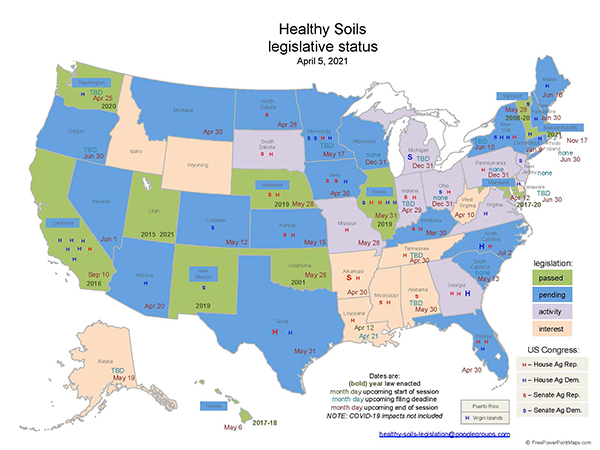 The status of healthy soils legislation in states across the country as of April 2021. Graphic courtesy of Steven Keleti.
So, how do we improve soil health? To many market gardeners, the answers are familiar. Common techniques include reducing soil disturbances, covering the soil and keeping living roots in the ground. Minimizing soil disturbances (like tillage), helps to keep a soil’s structure intact, providing soil aggregates that allow for adequate drainage and aeration and a stable habitat for soil microbes and bacteria. Keeping the soil covered even outside the growing season retains moisture, reduces erosion and insulates the soil, helping to keep the temperature stable for microbial life. Finally, keeping cash or cover crops growing in the soil also promotes soil health, since living roots secrete exudates that feed soil microbial life.
Healthy soils legislation
Given the current political climate, it is no surprise that federal policies don’t change too quickly. Soil health is no exception. Although there is federal funding to improve soil health through agencies like the Natural Resource Conservation Service (NRCS), many policy groups haven’t been satisfied with the amount of federal support.
So, over the past several years organizers have started to take matters into their own hands. Different states have taken different tacks and created substantially different legislation, but the underlying objective has been the same: To improve soil health across the state, frequently by providing assistance or incentives for farmers to improve their practices.
In 2016, for instance, California created a Healthy Soils Program that, among other approaches, provides funding for on-farm projects that promote soil health, including: “mulching, compost application, herbaceous and woody plantings, cover cropping and no or reduced tillage” (https://tinyurl.com/a3xthukt). Maryland, on the other hand, in 2017 passed legislation to create the Maryland Healthy Soils Program, which aims to assist farmers through research, training and technical assistance. Other states are considering (or have already adopted) other strategies for improving soil health, including ideas like paying farmers for the ecosystem services that healthy soils provide and providing grant funding for upgrades to no-till equipment.
Healthy soils programs
In many states, the ultimate objective of the organizers is to create statewide healthy soils programs. These programs (legislatively created) are frequently set up to receive continual funding and administration by a state-level agricultural agency. Massachusetts, for instance, passed legislation in January to create a statewide Healthy Soils Program. The Massachusetts chapter of the Northeast Organic Farming Association (NOFA) led the multi-year organizing effort, working with farmers and partner organizations from across the state. As NOFA MA explained in a newsletter:
“This healthy soils legislation creates a fund and a program to provide education, technical assistance, and financial incentives to farmers and land managers to utilize healthy soil practices, thereby improving soil health throughout the Commonwealth while supporting farmers and promoting sustainability. Healthy soil practices include no-till or low-till farming, use of cover crops, reduction in synthetic fertilizer and more.” (https://tinyurl.com/5fwuw2xb)
Though we’ve known the importance of healthy soil for a long time, the difference is that now, in states with healthy soil programs, change can be accelerated through state-funded assistance. Massachusetts isn’t the only state with a robust healthy soils program. Eleven states (California, Hawaii, Illinois, Massachusetts, Maryland, Nebraska, New Mexico, Oklahoma, Utah, Vermont and Washington State) have passed soil health legislation. And it seems likely that at least twenty states (including Florida, Kansas, Maine and Minnesota) will file at least one piece of soil health legislation this year.
Individualized approach
Inspired by the success of early adopters, many states across the country are still in the beginning stages of exploring healthy soils policy. About a year ago, for instance, the Ohio Ecological Food and Farming Association (OEFFA) began working with partners to organize the Ohio Soil Health Initiative (OSHI). According to OEFFA, the initiative’s goal is to “advance positive soil health outcomes that are based on sound principles and increase the adoption of validated healthy soils practices by securing Ohio’s commitment to healthy soils policy and programs.” (https://action.oeffa.com/soil-health/)
The Ohio initiative is made up of diverse stakeholders, including soil scientists, soil and water conservation districts, the Ohio Farmers Union and environmental groups including The Nature Conservancy and the Ohio Environmental Council. Amalie Lipstreu, OEFFA’s Policy Director, explained that water quality has been a long-standing concern across the state and many stakeholders are interested in using soil health to address lingering water issues. This points to a substantial benefit of the state-by-state approach to addressing soil health. Legislation and programs can be shaped to fit a state’s needs and bring a diverse group of stakeholders to the table. Soil health doesn’t need to be a partisan issue, and in many states that have passed soil-health legislation, it hasn’t been.
Getting involved
So, what does this trend in statewide efforts to promote healthy soils mean for market gardeners? For starters, if your state has passed healthy soils legislation, research the policies to see how they might benefit you and your farm. It’s possible that a project you have in mind could be eligible for state funding. Or, perhaps your state is beginning to offer technical education or assistance. These programs and policies are, at the end of the day, largely designed to help farmers improve soil health. So make sure that you’re aware of any available assistance your state has to offer, and help spread the word within your local agricultural community.
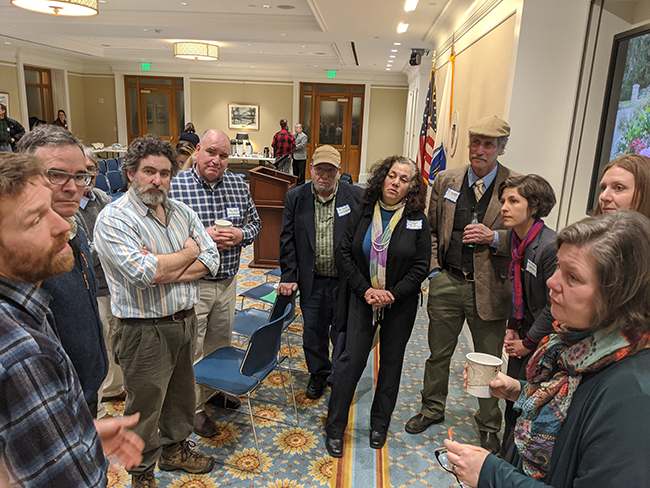 Farmers meet with Senator Jo Comerford (right) at the Massachusetts State House in February of 2020 to discuss healthy soils. Photo courtesy of Marty Dagoberto.
If, on the other hand, your state doesn’t already have a program to address soil health, it could probably use your help in establishing one. The creation of state-level policies to address soil health represents a unique opportunity for farmers to have their voices heard. As more states pass legislation and create healthy soils programs, there’s leverage for organizers in the states that haven’t.
So, use the resources that follow to figure out where healthy soil policies stand in your state. Maybe, like in Ohio, there’s a newly formed coalition that would value your input. Or, maybe you live in a state in which the conversation about healthy soil policies is only beginning and you can help to bring attention to the issue. Farmers have been at the forefront of conversation about soil health for decades. There’s no reason to stop now.
Resources
Learn more about existing or pending healthy soil legislation in your state using the interactive map maintained and updated by Nerds for Earth: https://tinyurl.com/txaxretj
The Soil Health Institute also maintains a list of soil health policies across the country: https://tinyurl.com/vm5c93e6
Robin Hackett is a farmer from Massachusetts where he previously managed Red Shirt Farm and Beetlebung Farm, two low-till market gardens. Prior to farming, Robin worked in professional kitchens and studied environmental policy. He currently lives in Ohio and is working towards opening his own farm.
Copyright Growing For Market Magazine.
All rights reserved. No portion of this article may be copied
in any manner for use other than by the subscriber without
permission from the publisher.