











January isn’t tomato season in northern Indiana, even if you have heated greenhouses like the two at Clay Bottom Farm in Goshen where I worked last year. But on a freezing winter day, Ben Hartman and I headed out to work in the tomato greenhouse anyway. We weren’t planting or trellising or harvesting or even tearing out last-year’s plants. Equipped with a skid loader (Ben) and a shovel (me), we were there to give the soil a makeover — Clay Bottom style.
“I have grown tomatoes for 17 years and it seems fairly consistent that soils under tunnels appreciate a reboot every four to five years,” said Ben, author of The Lean Farm. “We saw disease pressure higher last year and that triggered my thinking, okay, it’s time.”
It took us eight hours to remove the top three to four inches of soil and replace it with an equally thick layer of new leaf compost. By the end of the job, the soil was as good as new and I had received a crash course in tomato disease management.
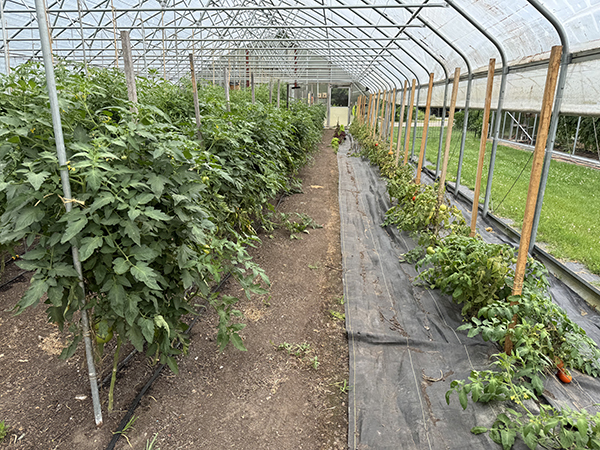
Tomatoes in the ASD plot (left) compared to the control plot (right). While the plants growing in the treated soil aren’t completely disease free, they’re mush healthier than the untreated tomatoes right next door.
For a young farmer like me wanting to gain experience and knowledge, Clay Bottom is a good place to work because in addition to being a farmer, Ben is an author and educator who uses the 1/3-acre micro farm he owns with his wife Rachel Hershberger as an incubator for lean farming systems.
At Clay Bottom, using space, time and resources efficiently is of utmost importance, and that has driven the search for disease management practices that fit the farm’s context. “On our farm we’ve tried several approaches over the years,” Ben said. “I’m not dogmatic about any one approach, it’s about choosing an approach that makes sense for your context.”
I’ll share what I learned at Clay Bottom Farm about tomato ailments, common and less-well-known disease mitigation strategies, and Ben’s favorite remedy: the soil swap. I’ll also discuss some strategies he doesn’t use and why.
Time to experiment
How did Ben know the tomatoes weren’t healthy last summer? The signs were clear: brown and yellow leaves, lots of sticky aphid residue and mold growing on leaves and fruits. The tomatoes still “paid for themselves,” he said, but the yields were lower than usual and the fruits smaller.
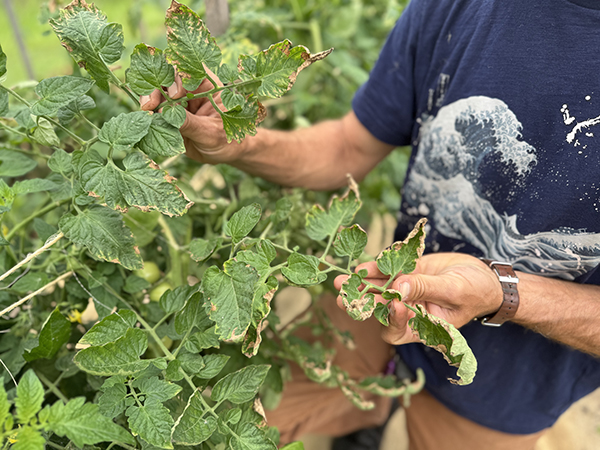
Hartman inspects leaf necrosis on the tomatoes treated with ASD. This may be caused by imbalanced soil nutrients.
He sent photos of the afflicted plants to experts at the Purdue University extension, and Dr. Wenjing Guan, an extension specialist with a focus on sustainable fruit and vegetable production, identified leaf mold, aphids, interveinal yellowing and necrosis — the latter two conditions likely caused by issues with soil fertility. Ben also suspected viral and bacterial infections.
Ben decided to try a few different strategies to test how well they fixed the problems. In half of one greenhouse, he did nothing but the routine “bread and butter” measures he takes every year. In the other half, he tried a new anaerobic soil disinfestation (ASD) process to target harmful pathogens. And in the second greenhouse, he did a complete topsoil replacement — a method that’s worked for him in the past.
In June of this year, I returned to Clay Bottom to check on the tomatoes planted in each site, and the results, as expected, were striking.
Genetics, pruning and hygiene
These are the bread and butter of tomato health, the tried-and-true practices that Ben uses every year, regardless of specific pathogen pressures to give his tomatoes the best chance at a healthy life.
Genetically, tomatoes originated in South America as a wild species with blueberry sized fruits. The process of domestication and breeding produced much larger fruits, but this came at the expense of disease resistance.
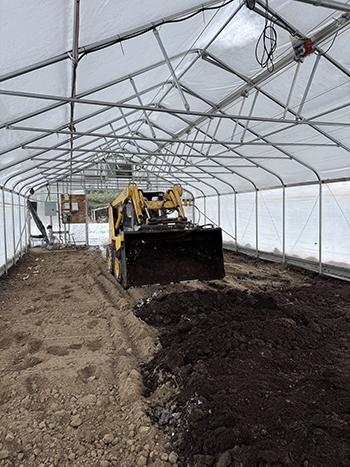
Hartman uses a skid loader to spread new compost after removing the top 3-4 inches of infected soil in one of the greenhouses at Clay Bottom Farm. All photos courtesy of the author.
Today’s domesticated tomatoes are much more susceptible to an array of pathogens than their early ancestors, but not all tomato varieties are created equal. Some varieties have been bred with better resistance to specific diseases.
Ben knows that growing tomatoes that are resistant to the specific diseases in his environment can make a huge difference, so he works with experts at the Purdue Plant Lab to identify the pathogens at his farm and choose varieties that are better able to handle them.
This year he is growing 11 different varieties of tomatoes, many picked for their disease resistance, including “Lemon Boy,” an F1 hybrid with high tolerance to over half a dozen molds, nematodes, viruses, rots, and cankers. Other top-performing tomatoes at Clay Bottom include “Abigail,” “Margold,” “Clementine,” and “Harvest Moon.” “Just by changing varieties on occasion,” Ben said, “we’ve found that it reduces problems.”
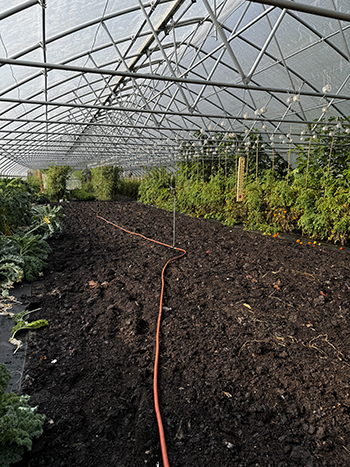
After applying the molasses and aged leaves to the ASD plot, Hartman irrigated the soil until water dripped out when he squeezed a handful. It took two four-hour waterings.
Grafting is a strategy farmers can use to improve the disease resistance of their favorite varieties by giving them hardier rootstocks. Ben has experimented with both doing his own grafting and buying grafted starts, but doesn’t do either one anymore. Grafting “does take quite a bit of time,” he said. And he’s generally happy with the results he gets from his non-grafted plants.
There isn’t room to go into detail on grafting in this article, but if you want to learn more and delve into the debate on whether grafting is worth the effort, check out these articles from the Growing For Market archive:
Graft tomatoes, especially heirlooms, for greater yield and disease resistance.
Grafting: worth the trouble?
As far as pruning, tomatoes’ naturally thick, sprawling growth habit has two problems: it attracts molds that thrive in the dense, moist foliage, and it allows pathogens in the soil to infect the plants through contact with the leaves. The solution is to keep plants well pruned.
Different farmers have different systems for trellising and training tomatoes, but Ben said the basic rule of thumb is that leaves should always be off the ground and air should be able to flow through the plants. “This means we like to be able to see through the plant, that tells us that air is getting through,” he said.
The plants at Clay Bottom are allowed to grow until they reach 3 feet in height, then everything in the first 15 inches is pruned away. “Disease wants to travel up the plant,” he said, “so removing those more disease-prone lower leaves keeps the whole plant healthier.”
For all plants, he uses a stake-and-weave trellising method. He stopped using lean-and-lower methods, requiring roller hooks or a Qlipr system, in order to save time. “‘Managed chaos’ is the goal,” he said.
Johnny’s Seeds offers many helpful resources on trellising techniques. Check out Pruning & Trellising to get started.
Humans keep ourselves healthy by washing our hands, dishes, clothes and other items we touch that could spread germs from one person to another. The same idea can be applied to tomato plants. At Clay Bottom, this means removing the dead tomato plants from the greenhouses at the end of the season and sanitizing tools, trellising equipment, ground cover, and even the greenhouse itself before the next season.
When tearing out plants, we carefully swept up as many leaves and rotting fruits as we could and took them to a compost pile outside before removing the ground cover. Compost from this pile will be used for trees and bushes, not garden plants.
Then, we cleaned all the poles, stakes and other trellising equipment in a bath of Oxidate solution (you can also use hydrogen peroxide). To disinfect the ground cover, we spread it on the driveway and sprayed it with the same solution using a backpack sprayer. We also used the sprayer on the interior surfaces of the greenhouse (plastic walls and steel supports).
These precautions don’t eliminate viruses and bacteria, but they help keep them from spreading. I know farmers who use a sanitizing solution to clean pruning tools between plants for the same reason.
These three strategies are important parts of Clay Bottom’s regular routines. But after five years of increasing pathogen loads and nutrient imbalances, they weren’t enough to restore health to Ben’s tomatoes. The section of the greenhouse treated only with these measures was so unhealthy that when I visited in June, Hartman had already pulled many of the plants out.
When these practices aren’t enough, it’s time to look at the soil.
Soil-based interventions
Soil is made up of a mixture of organic matter, clay, water, minerals and nutrients. But it’s not just a lifeless growing medium: it’s a community that includes many microorganisms including bacteria, fungi and nematodes — some are beneficial for garden plants, and some cause diseases. When parts of the system get out of balance, the plants suffer.
Greenhouse soils are especially susceptible to both mineral and biological imbalances because the environment is so contained. “What happens is the viral load increases over the years, diseases build up in the soil,” Ben explained. “And the minerals over time become imbalanced, especially salts (which) rise to levels that can be toxic to plants.”
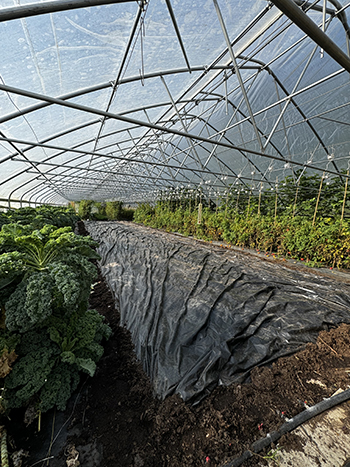
Covering the soil with a hole-free tarp is the last step in the Anaerobic Soil Disinfestation process. Tucking in the edges is important to keep out oxygen. At Clay Bottom, the tarp was left on for four weeks.
Soil and petiole tests from last year show high levels of sodium and a high soil pH. To Guan, those results weren’t surprising. In fact, those are the two most common problems she encounters in high tunnels. Other specific nutrient imbalances vary “from farm to farm, depending on production practices, input sources, and water quality,” she said.
It’s possible to correct deficiencies with mineral amendments. But Ben has veered away from this method because in his experience, it’s costly and only addresses part of the problem.
Anaerobic soil disinfestation
While soil amendments address mineral imbalances, anaerobic soil disinfestation (ASD) is a strategy that targets soil-borne pathogens, including bacteria, nematodes and fungi using a natural fermentation process. The idea, according to a fact sheet published by the Ohio State University Extension, is to kill soil pathogens by creating an anaerobic environment using water, tarps, a carbon source, and beneficial soil microbes.
There are three steps, which Ben and his sons completed last August. First, they applied a boost of easily-digestible carbon to the area, including about an inch of aged leaves and 20 gallons of molasses from a local mill (diluted by 50 percent and applied over 1,400 square feet). The soil was loosened before this application using the ripper implement on an Tilmor E-Ox electric wheel hoe.
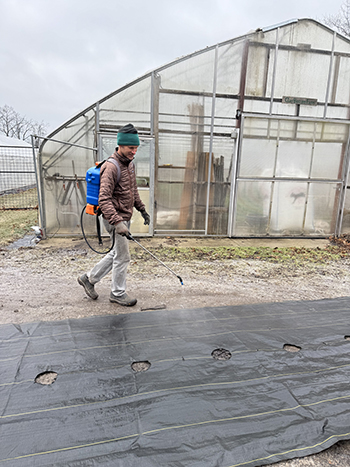
Hartman sanitizes a tomato tarp using an Oxidate solution in preparation for the next growing season.
Next, they irrigated the whole area for two four-hour periods until the soil was saturated and water began pooling on the surface. Then, Ben covered the area with his best silage tarp (no holes) and tucked in the edges with soil to keep oxygen out over the next four weeks while the beneficial microorganisms did their job of digesting the carbon, using up the oxygen and creating toxic waste products that would kill the unwanted pathogens.
For optimum results, the Ohio State factsheet recommends keeping the temperature inside at at least 85°F the whole time. Ben said it was hard to know if he achieved this. That fall, he planted the area in greens and noticed that weed pressure was reduced to near zero. But the real test came when tomatoes were planted in the spring.
The plants I saw when I visited in June looked much healthier than those in the untreated soil, but they still had some aphids and discolored leaves, possibly from remaining nutrient imbalances.
Soil replacement
The soil replacement I helped do in the second greenhouse might seem like a drastic approach, but Ben likes it because it’s simple, and addresses multiple problems at the same time. The idea is straightforward: remove most of the infected, unhealthy soil, and put it on the beds outside, where the tomato-specific pathogens won’t be a problem and the sun and rain will help restore mineral balance. Then, bring in new compost to dilute the remaining pathogens and build new beds.
The compost used at Clay Bottom is made almost entirely of leaves in two six-foot tall, 50-foot-long piles at the farm. Ben likes using the compost when it’s still coarse, about 80 percent decomposed. “My theory is that this is when it’s at its peak in terms of nutrients before the rains have had a chance to flush out the minerals,” he explained.
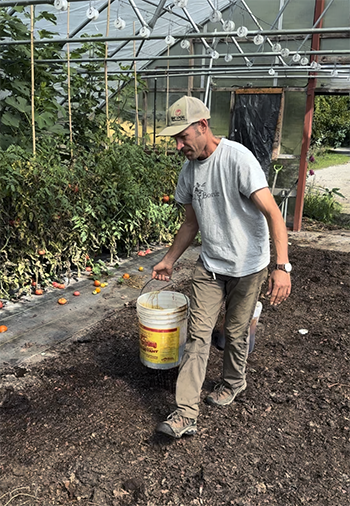
Last winter, we replaced the top 3 to 4 inches of soil, but Ben has also found that even removing just 1 inch can quickly reduce salt level because salts tend to rise to the soil surface over time. “The goal here isn’t perfect sterilization,” he explained, “the goal is reduction in viral load,” and a reset for the soil chemistry. “In the past we’ve seen that make a world of difference.”
For a 24-foot by 70-foot greenhouse, with two people working, the whole process took eight hours. When I returned in June, the tomato plants in this greenhouse were already taller than I am and lush, with almost no diseases, aphids or mold in sight. A few weeks later, Ben sent me pictures of the first tomato harvest.
I was impressed. But I still had some concerns about the soil disturbance this method required. If the soil is an ecosystem full of structure and life, is it okay to dig it all up and just replace it?
After some more research and thought, I believe it depends on the context. At Clay Bottom, I learned that all of the growing spaces, including this greenhouse, were started by piling 4 inches of compost on top of the existing soil, which had been tilled to kill the grass. Over time, the compost was colonized by bacteria, fungi, earthworms and other forms of life that turned it into a living soil community.
Removing that layer and replacing it with new compost is invasive, but it’s no different than the original process, and with time, a new soil ecosystem will form. Of course, this approach isn’t feasible for everyone. It requires lots of compost, a skid loader (or comparable machine), and a relatively small farm scale to make the labor realistic.
“We’ve found this to be the most effective and the most time efficient because it fits our context,” Ben said.
Other strategies
Some strategies that Ben hasn’t tried yet, but may work well on other farms include:
Crop rotation. Because of Clay Bottom Farm’s small footprint, Ben can’t rotate his tomatoes between different growing spaces. But for those who have the space, moving the crop every so often — instead of moving the soil — can be an easier way to get similar results.
Mustard biofumigation. The compounds (glucosinolates) in mustard that make it spicy, also help defend the plant against pests and diseases. Farmers can harness these compounds to fight diseases and nematodes in the soil by using specific mustard varieties as cover crops, chopping and incorporating them into the soil when they begin to flower. This strategy has been proven to work with potatoes and other crops. For more on biofumigation, read the article “Improving soil quality and treating root pathogens with biofumigation,” from the May 2024 GFM.
Solarization. Hartman knows farmers who use old greenhouse plastic spread over the soil to heat it up and kill pathogens before planting their tomatoes.
Steam sterilization. Injecting the soil with hot steam is another way to get rid of diseases. While not available in Ben’s area, soil steamers are a tool farmers can rent to sterilize the top few inches of soil in a greenhouse.
Fallowing. When asked about the best ways to deal with soil diseases and nutrient imbalances, Guan replied: “Sometimes the best approach is to simply give the soil a break.” The weeds that grow in unhealthy soils are often specialized in giving the soil exactly what it needs, whether that’s bringing up nutrients through a deep taproot, adding nitrogen, or loosening compacted soil.
To get the full benefits of this approach, the plastic on a greenhouse should be removed for a season, allowing the sun to disinfect the soil and rainwater to flush out excess minerals and rebalance the soil chemistry.
“In nature, doing nothing at times can be more beneficial than doing something,” Guan said. “Allowing the soil time to rest and recover can be an important part of restoring its balance and health.”
Sierra Ross Richer is a young farmer and journalist from Goshen, Indiana. She was drawn to farming through her love of working outdoors and her passion for sustainability. Sierra has worked at a number of small farms, including Clay Bottom Farm in Goshen, Indiana. As a freelance writer, she focuses on topics related to sustainability, agriculture, and Anabaptism. More of her writing can be found at her website, sierrarossricher.com, and on her Substack, Sierra’s Adventures in Sustainability.
Copyright Growing For Market Magazine.
All rights reserved. No portion of this article may be copied
in any manner for use other than by the subscriber without
permission from the publisher.