











How to time plantings for regular harvests through the season
The following is an excerpt from the new second edition of Sustainable Market Farming: Intensive Vegetable Production on a Few Acres (New Society Publishers April 2025) and is printed with permission from the publisher.
Many vegetable crops can be planted several times during the season, to provide a continuous supply. Don’t stop too soon! Use your land and time to provide seamless harvests of summer crops such as beans, squash, cucumbers, sweet corn; year-round lettuce, and winter hoophouse greens. Because the time between sowing and harvest varies according to temperature (and daylength in some cases), simply planting squash once a month, for instance, will not provide an even supply. Crops grow faster at some times of year than others, and the time between one sowing and the next needs to vary. To get harvests starting an equal number of days apart, vary the interval between one sowing date and the next according to the season. You need big sowing gaps early in the spring and shorter ones in the late summer or fall. By keeping records of sowing and harvest dates and using information from local growers, you can fine-tune your planting dates for better results.
Our first effort along these lines involved keeping a Veg Finder, a chart where we note planting date, first harvest, and last harvest (“veg” is the British abbreviation — you might prefer “veggie”). We use this for bush beans, summer squash, cucumbers, sweet corn, and carrots. We have a similar chart for lettuce, which is an exercise of its own. The original aim of the Veg Finder was to alert crews about which plantings were currently ready to harvest and where to find them. After keeping these charts for a few years, we started to use the information to improve our planting dates.
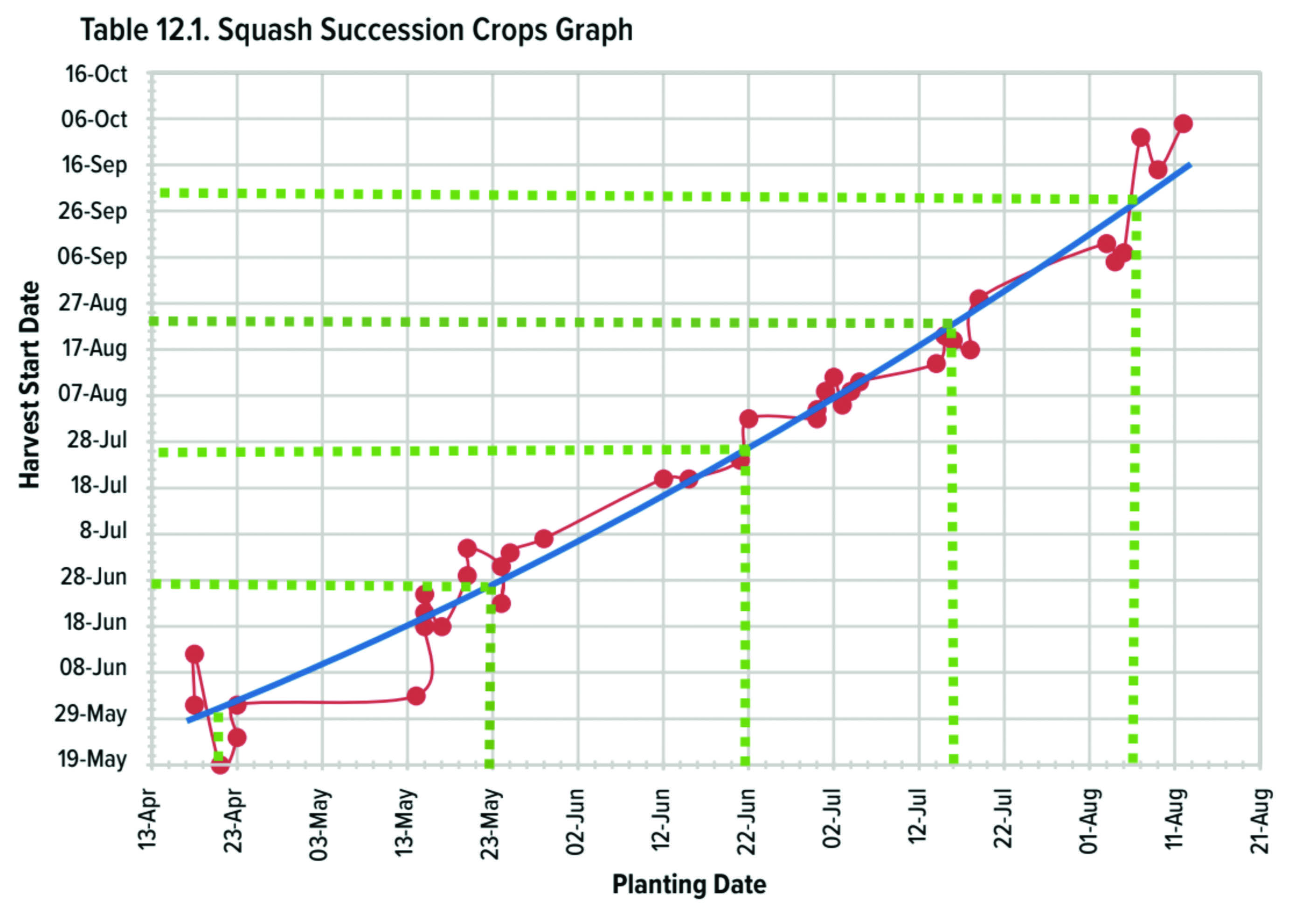
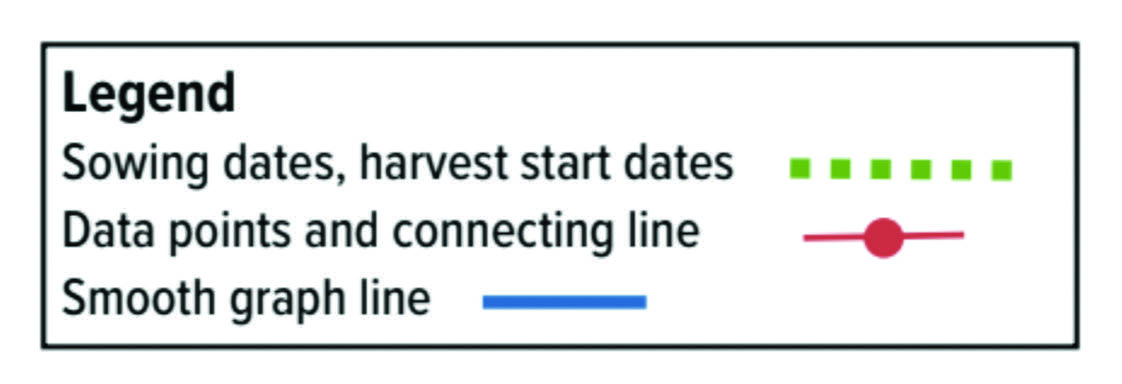
This graph shows how the author used historical planting dates and length of harvest to time squash plantings for continuous harvest.
Most growers are probably adept at planting as soon as possible in the spring. A lesson for me has been not to plant too early! Keeping old cucumber transplants on hold through cold early spring weather is just not worthwhile. I finally grasped this the year we set out our first and second cucumber plantings side by side — the second ones did better than the first and were ready just as soon!
As spring temperatures and daylength increase towards the summer solstice, the time to maturity shortens — later sowings almost catch up with earlier ones. As temperatures and daylength decrease in the fall, the time to maturity lengthens — a day late in sowing can lead to a week’s delay in harvesting.
It’s also important to know the last date for planting each crop that has a reasonable chance of success. Here’s the formula (for frost-tender crops) for calculating the number of days to count back from the expected first frost date: add the number of days from sowing to harvest, the average length of the harvest period you’d be satisfied with, 14 days to allow for the slowing rate of growth in the fall, and 14 days to allow for an early frost. For example, yellow squash takes maybe 50 days from sowing to harvest, and is good for 21 days, so the last date for sowing would be 50+21+14+14 = 99 days before the first frost. For us that means 99 days before Oct 14, so July 7. But with rowcover to throw over the last planting on chilly nights, the growing season is effectively 2 weeks longer, and we can also ignore the 14 days for an early frost. So our last planting of squash is Aug 5. See chapter15, Cold-Hardy Winter Vegetables, for a different example, explained in a different format.
Three pieces of information — first planting date, last planting date, and number of productive days of a planting — enable us to make a rough plan for how often to plant. For us the rough version is every 2 weeks for beans and corn, every 3 weeks for squash and cucumbers, once a month for carrots, and 2 or 3 plantings of muskmelons (cantaloupes) at least 1 month apart.
Record keeping
There are methods of succession planting that involve no paperwork. For example, sow another planting of sweet corn when the previous one is 1”–2” (25–50 mm) tall; sow more lettuce when the previous sowing germinates; sow more beans when the young plants start to straighten up from their hooked stage.
Another approach is to sow several varieties with differing days to maturity on the same day. We sow Bodacious, Kandy Korn, and Silver Queen sweet corn on the same day, and get more than 2 weeks of plentiful harvests. We use this technique also with lettuce (four varieties in each sowing) and broccoli.
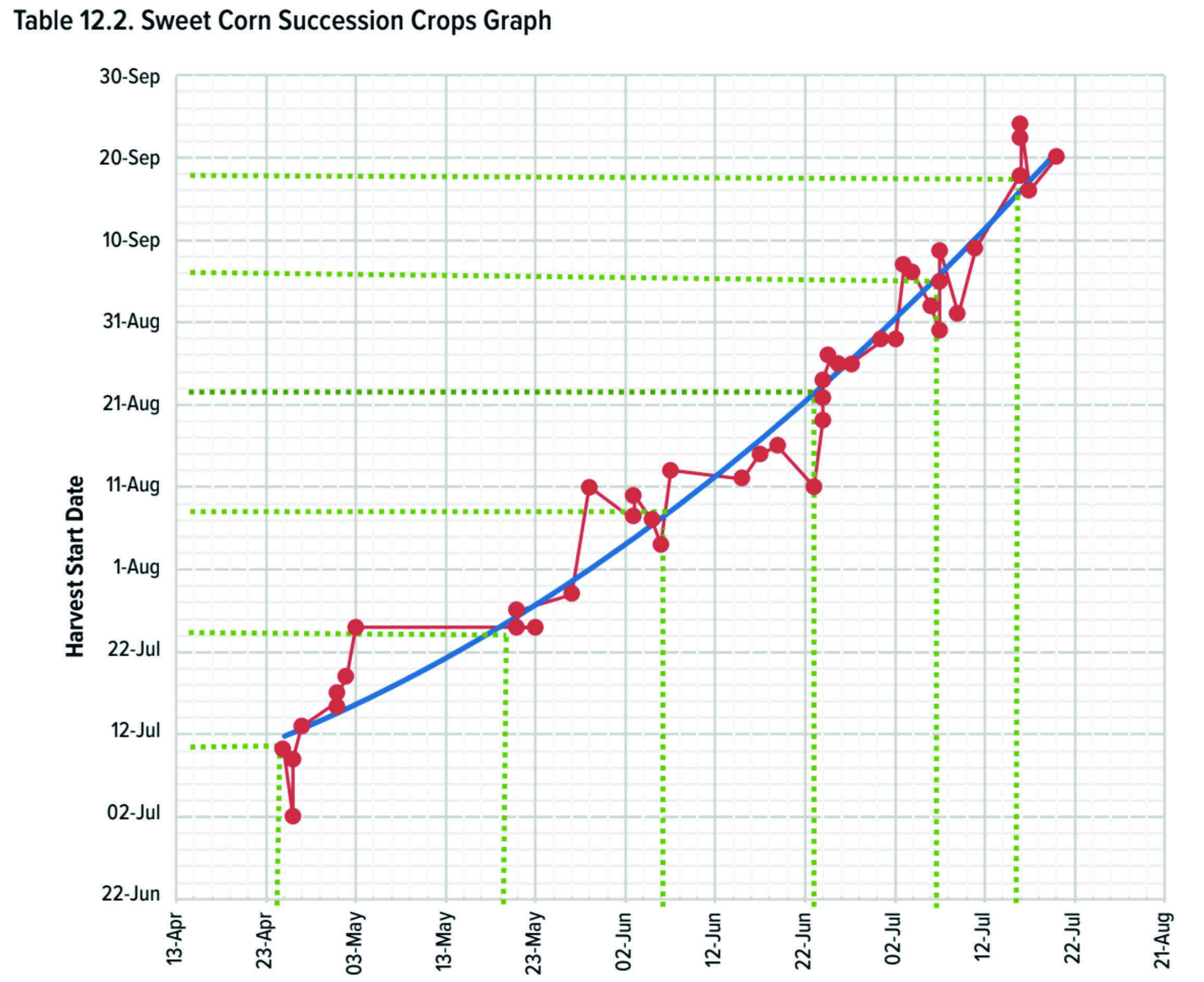
This graph shows how the author used planting dates and duration of harvest to time sweet corn plantings for continuous harvest through the season.
But to fine-tune for a really even supply of crops, nothing beats having real information about what actually happened, written at the time it happened! Our system for gathering crop records consists of a pocket notebook I carry all the time and a ring binder with alphabet dividers to store the information until the end of the year. I transfer the field notes from the small notebook to the binder sporadically during the season and then have filing sessions on rainy days in late fall and early winter, storing the information for each crop separately. We take the information learned into account when we do our winter planning (see chapter 2, Create Your Crop Plan and Field Manual).
Make graphs
Having graphs of sowing and harvest dates for each crop has been very useful for planning effective planting dates. Because the number of days to maturity varies through the season, in order to get harvests starting an equal number of days apart, we need to vary the interval between one starting date and the next as the season progresses. Typically, plants mature faster in warmer weather.
Here is a six-step guide to making and using these graphs. You can do this by hand on squared paper or use a spreadsheet program such as Excel, as I do. First I’ll explain the manual method.
1. Gather several years’ worth of planting and harvest start and finish dates for each crop. Set aside the harvest end dates for now. Put the planting dates and harvest start dates in two columns (see the squash example). The date in the Harvest Start column is the first day of harvesting from a planting sown on the Planting Date in the first column. Note that these aren’t all in the same year! But if you only have data from one year, start with that. If you don’t have your own crop records yet, you can use our graphs as a jumping off point. You would need to change the first and last sowing dates to fit your own climate zone.
2. Make a graph for each crop, with the planting date along the horizontal (x) axis and the harvest start date along the vertical (y) axis. Mark in all your data. Draw a curving line joining all your points. This line is often rather uneven, due to differences in weather from year to year and differing maturity dates for varieties. To get a smooth line, which is more useful and more representative of typical reality, leave equal numbers of points above and below the graph line, but try to hit most of them. Sometimes there will be outliers — odd things happen. We once had an April 18 sowing of summer squash that didn’t produce till June 12. I guess the plants got cold and set back. Ignore atypical points. In the graph below, the square “blobs” mark the data points, joined by a zig-zagging line.
3. To use one of these graphs to plan planting dates, start from your first possible planting date along the x axis. Ours is April 21. Draw a line up from this date to the graph line. Draw a horizontal line from the point on the graph line to the y axis. This is your first harvest date. (Yum!) Our first squash harvest is around May 31.
4. Decide the last worthwhile harvest start date of the season and mark that. Draw a line across from this date on the y (harvest start) axis to the graph line. Draw a vertical line from this point on the graph line to the x (planting) axis to show when you need to plant this batch. Ours is sown Aug 6 (70 days before our average first frost), and we harvest from around Sept 20, giving us about 4 weeks of harvest until our first frost, which averages October 15.
5. From May 31 to Sept 20 is 112 days. Use the harvest end dates to see how long a planting lasts (how often you want a new patch coming into production). Divide the period into a whole number of equal segments of that length. If we want fresh squash every 28 days, we’ll need 4 equal intervals between plantings and 5 plantings (112/4=28). The harvest start dates will be May 31, June 28, July 26, Aug 23 and Sept 20.
6. Mark in your chosen harvest start dates and draw horizontal lines from the y axis from those dates to the line of the graph. Then draw vertical lines from where these horizontals cut the graph line, down to the x (planting) axis. This will give you the planting dates needed. The harvest start dates in our example lead to planting dates of April 21, May 23, June 22, July 16, and Aug 6. These sowing intervals are 26, 25, 25, and 20 days.
Note that our first squash is transplanted April 21 but sown March 25. Such early plantings grow very slowly. Because we are working with the harvest start dates to calculate the intervals, it does not mess up our comparisons.
The spreadsheet program I use is Microsoft Excel, and graphs are called scatter charts. I start the worksheet by creating columns for Planting Date and Harvest Start. I sometimes include a column for Harvest End as well, to help with choosing how often to have a new patch to harvest. It isn’t used in making the chart. For the dates to appear as needed on the chart, they all must be changed to be in the same year. The computer-generated line will be jagged, and you will want to smooth it out a bit. I used to print out the computer-generated graph and just pencil in a more even line, using that to derive my sowing dates. Now I choose a “trendline” that has a good match. Often this is the polynomial 2 option.
Squash succession crops graph
Information from the graphs may help you find you can plant less often than expected, thereby saving space and work. We used to do 6 plantings of summer squash and cucumbers: March 25 (transplanted April 20), May 14 (transplanted June 7), June 13, July 3, July 19, and Aug 5. The intervals between these sowings were 50, 30, 20, 16, and 17 days. By using the graphs, we have been able to go down to 5 plantings: March 25 (transplanted April 21), May 23, June 22, July 16, and Aug 6, at intervals of 52, 30, 24, and 21 days. The sowing intervals decrease as the season warms up as it takes fewer days for plants to mature. The first planting is very slow to mature — probably we could just start later still and lose nothing. By moving the second planting 9 days later than it used to be, we are able to direct sow rather than transplant, which saves us time. This revised schedule saves us from dumping zucchini on our neighbors’ porches!
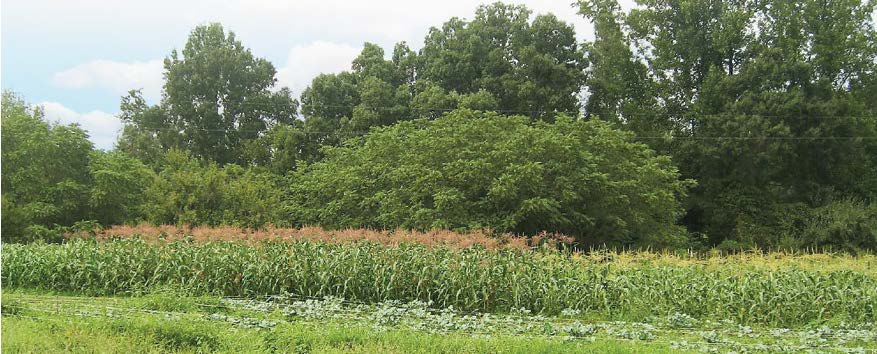
Three sweet corn varieties sown on the same day provide over 2 weeks of harvest. On the right, fast-maturing Bodacious; in the middle, red-flowered Kandy Korn; on the left, Silver Queen still growing to its full height. Credit- Kathryn Simmons
For us, squash plantings can stay productive for up to 40 days, while cucumbers sometimes only last 35 days. Cucumbers also take a little longer to mature than squash. These two features would suggest making more plantings of cucumbers than of squash, but after looking at the graphs, we decided to plant both on the same set of dates, for simplicity. We are often picking from 2 plantings on the same day — the overlap helps even out our supply, as the dwindling old patch augments the newly starting row. If we could be satisfied with a new patch starting production every 36 days, we could sow only 4 times. See chapter 43, Summer Squash and Zucchini, and chapter 45, Cucumbers and Muskmelons, for crop-specific details.
Mexican bean beetles
Other factors can affect sowing dates for succession crops too. We used to be sorely plagued by Mexican bean beetles. This meant that pole beans were a complete waste of time (they didn’t mature before the beetles ravaged them), and we needed a new patch of bush beans every 2 weeks to keep up supplies. We made 7 plantings at 15-day intervals: April 16, May 20, June 9, June 24, July 9, July 22, and Aug 3. After 2 weeks of harvesting each planting, we would need to do “Root Checks,” our euphemism for pulling up the beetle-ridden plants, picking off the last beans and taking the plants to our composting area.
Now we buy the parasitic pedio wasp. Once the parasites are adult, they lay eggs in the bean beetle larvae and kill them. There’s no more need for handpicking beetles, and the second and subsequent plantings will look very healthy. We now plan for a new patch to harvest every 20 days, sowing 6 times rather than 7: on April 16, May 14, June 7, June 29, July 19, and Aug 3. These sowing intervals are 28, 28, 22, 20, and 15 days. We also get more beans than we did previously. Much of the time, we pick from two patches with an overlap period. See chapter 27, Snap Beans, for more about beans.
Hoophouse crops
We now plant our earliest squash and cucumbers in our hoophouse. We sow cucumbers Feb 14 and squash March 1 We like Spacemaster bush cucumber for their compact vines and prolific yield and Zephyr and Golden Glory zucchini for their relative ability to set fruit when pollinators are scarce. We transplant both on April 1 for harvests starting May 19 (squash) and May 21 (cucumbers). I think we could postpone our chancy first outdoor plantings and reduce our stress without losing much yield. So far we haven’t made that leap!
Fast turnaround crops: lettuce
Succession planting of lettuce, because it is such a fast turnaround crop, is a subject in its own right. See chapter 38, Lettuce All Year-Round. The short version is that we sow lettuce indoors in flats, twice in January, twice in February, and every 10 days in March to transplant outdoors. Then in an outdoor nursery bed for bareroot transplants, we sow every 9 days in April, every 8 days in May, every 6 or 7 days in June and July, then every 5 days in early August, moving to every 3 days in late August and every other day until Sept 21. The mid-September starts are transplanted into our glass greenhouse. We sow in an outdoor nursery bed Sept 15 and Sept 24 to transplant into our hoophouse, where they will be harvested as leaves (rather than heads) right through the winter.
Avoid chancy sowings: sweet corn
We had been in the habit of making 7 sweet corn plantings: April 26, May 17, June 2, June 16, June 30, July 14, and July 28. The intervals were 21, 15, and then 14 days. We eliminated the seventh planting because of shortage of space and increased the size of the sixth, sowing a range of three varieties as noted above. The season does finish a bit earlier than previously, but we get no complaints. The seventh sowing has always been risky because of deteriorating weather.
Using the graph of our corn sowing and harvest dates discussed earlier, I found that April 26, May 19, June 6, June 24, July 7, and July 16 are good dates for 6 plantings to provide fresh eating every 2 weeks. The planting intervals are 23, 18, 18, 13, and 9 days. See chapter 57, Sweet Corn.
Spring and fall crops: carrots
We sow carrots mid–late February, starting as early as possible. Then we sow every 4 weeks in March, April, May, and if needed, June and July. We scratch these hot-weather sowings if we still have spring carrots in the cooler as the flavor of hot-weather carrots is not as good and we can get Alternaria blight, which turns the leaves black and reduces growth. We make a huge fall planting in late July or early August, to harvest and store in November. If we miss those dates, we wait till late August to avoid the high numbers of grasshoppers here in mid-August. Late August sowings don’t bring as heavy yields as the earlier ones, unless the winter weather lets us harvest later than usual. We don’t do succession plantings for fall carrots, just one big one, because we are growing bulk carrots to store for use all winter and don’t need multiple harvest dates. With fall crops, even a difference of 2 days in sowing dates can make a difference of 2 or 3 weeks in harvest date, because plants grow more slowly as days get shorter and cooler.
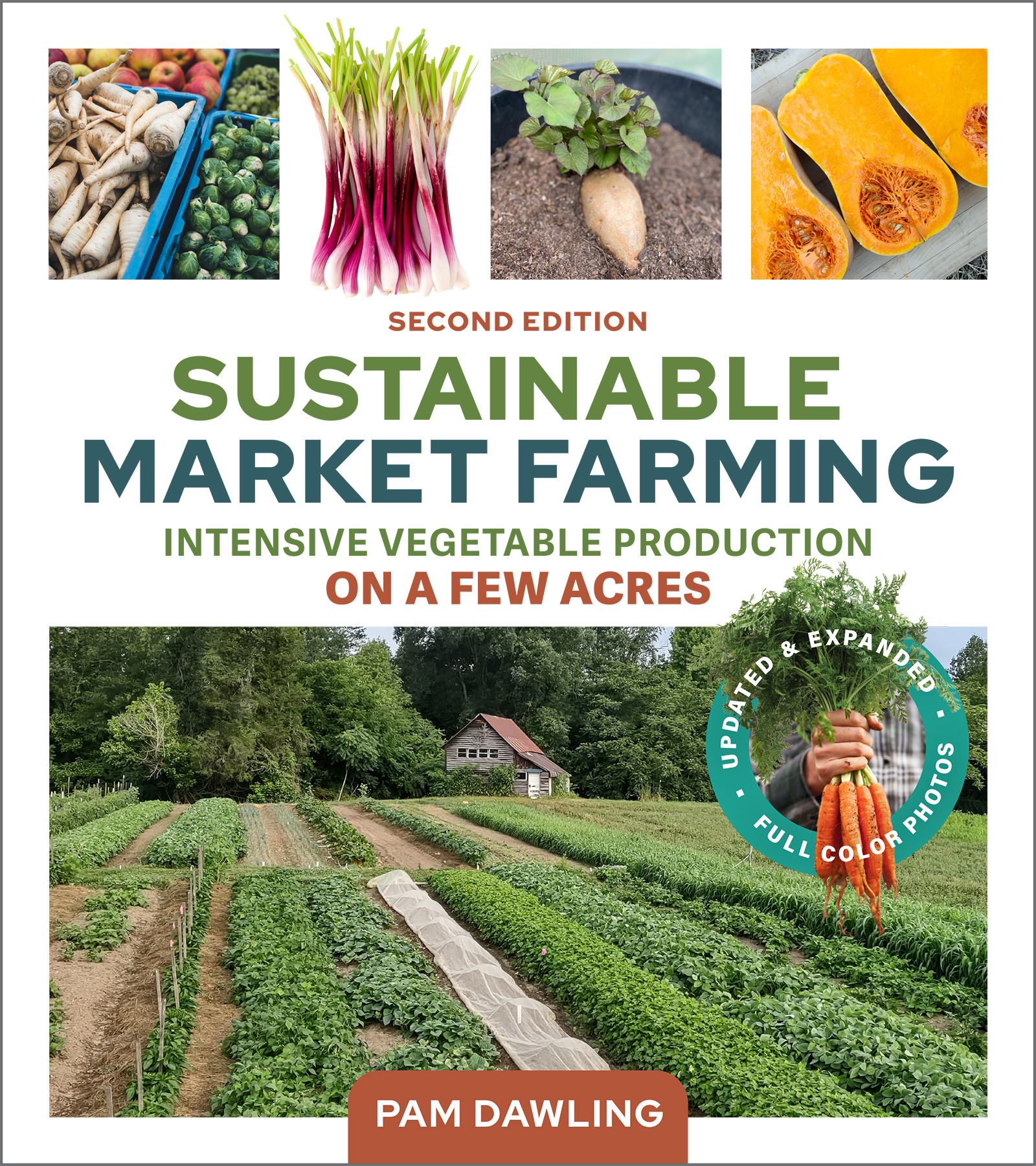
The updated second edition of Sustainable Market Farming by Pam Dawling is available now.
As I have shown, many vegetable crops can be planted several times during the season, to provide a continuous supply. The skill is in aiming for an even supply throughout the season that crop will grow. If you are growing storage crops, the goal is to find suitable dates, grow manageable amounts, and find suitable storage conditions. Chapter 24 of Sustainable Market Farming, Winter Vegetable Storage, has more on that topic.
Pam Dawling works in the 3.5 acres of vegetable gardens at Twin Oaks Community in central Virginia. “Sustainable Market Farming” is a comprehensive manual for small-scale farmers raising organic crops sustainably on a few acres. Her books, “Sustainable Market Farming: Intensive Vegetable Production on a Few Acres,” and “The Year-Round Hoophouse,” are available from Growing for Market.
Copyright Growing For Market Magazine.
All rights reserved. No portion of this article may be copied
in any manner for use other than by the subscriber without
permission from the publisher.