











Our produce farm is diverse in what we grow and diverse in how we market. We have 10 wholesale accounts, a summer CSA of about 400, a 230-family winter CSA, and we sell at two farmers markets. Most of our customers are urban, but we farm in the country. Less than 20% of our income comes from CSA members that pick up on the farm itself. That reality makes me a delivery man, a truck driver, in addition to all the other roles that successful farming demands.
A typical summer delivery day covers 20 stops, split between our CSA and our wholesale accounts. Cases on board the truck are often in excess of 450, with highly fragile goods like tomatoes and blackberries and heavy ones like sweet potatoes and watermelons. Winter deliveries are lighter, with perhaps 270 cases of nice light fluffy greens and much-reduced wholesale obligations. But snow and ice can often add spice to the winter delivery run and can add more fear and adrenalin to my mornings.
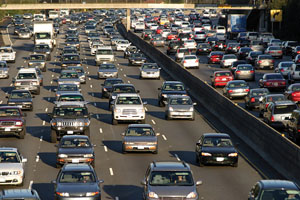
All this would be OK if we delivered in an area with reasonable traffic. We travel an average of 240 miles per delivery run. But the urban center we chose for our marketing –and I love city dwellers, as they appreciate our foods more than do country gardeners—is the Washington, D.C., metro region. I dread annual national surveys of worst traffic. Road congestion in the sprawling Washington area usually ranks #1 or #2 and never below #5. No fun. I do not intend here to make urban delivery runs seem nasty, or to imply that I hate this chore. I have evolved from fearing my delivery days into loving the game and the challenge. I now get a thrill from successfully slipping into the urban jungle, moving a lot of food, and slipping back out again to be back with my fields, my family, and my crew. This is not a complaining or a bleak or a negative article. This is about tools and empowerment.
This article details how we have changed our behaviors to successfully cope with two unstoppable forces: horrid traffic and the financial need to market into The Big City. The tools are timing; clustering delivery sites; driving skills and mental preparation; proper infrastructure; and idiot-proof packaging and loading.
Timing is everything
The first three years of our farm were a steep and sometimes rocky learning curve. One of the errors I made was in 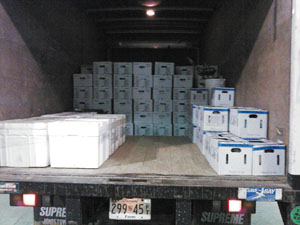 being too willing to please the chefs of the restaurants that back then were our primary income source. The chefs mandated specific hours of deliveries, and our farm should be there then. The problem was that such commitment meant that I began the 2-hour one-way trip precisely when all the countless other commuters were also driving. And the return leg was often cursed with the early part of the evening rush hour. I was exhausted not so much from hauling all the heavy cases of food but mostly from trying to make deliveries when the roads were at their worst. That timing problem had to change.
Above: Loading the truck is art and science. The ultimate goals are twofold: to keep produce safe while traveling, and to make unloading quick and mindless.
Three primary variables of congestion are 1) an ever increasing volume of commuters; 2) roads originally designed for far fewer vehicles, and 3) all these people wanting to travel at about the same times: the morning and evening rush hours. Factor in a fourth and barely predicable variable of accidents, rain, snow, ice, or fog and the product can be horrible: traffic at a standstill. But timing is so important. Setting off in the wee hours can reduce two of the variables –number of cars and the rush hour phenomenon—to really low values. As the farm matured and diversified its customer base, I adjusted my delivery run to start earlier and then still earlier. By now, 17 years into farming at this scale, I start the main wholesale/CSA weekday delivery run no later than 3 a.m.. That means getting out of bed at about 2 a.m., one day a week in the winter and twice weekly in peak summer. That sounds unpleasant to so many friends, but I am cheerful and liberated. I no longer have to make our 20 peak-season stops immersed in congestion. Instead, I am already inside The Big City before most commuters have even awakened. I am liberated because I pass through the problem traffic areas of our region and make most deliveries long before the roads clog. I am liberated because the traffic station is reporting on real troubles on roads already behind me, when I am on the traffic-free ride home. The weekend farmers market plus minor wholesale run can start later, with the truck rolling out by 5 a.m.. But weekends in our region see only some tourist-based traffic congestion but no commuter congestion, so this late start is safe. If you are in a seaside or similar resort area, starting your delivery runs when the tourists are still sleeping would be wise.
The negative side of this is that I am nearly useless after our main Thursday delivery run. I typically get back to Even’ Star around 1 or 2 p.m., but my brain rapidly deteriorates from about 6 p.m. onward after that 3 a.m. start. To cope, I try to complete any work that requires real thinking early, right after my run, when the adrenalin is still high. I know I’ll melt down by 7 p.m.. After completing the brain work, I can still do mindless tasks like making dinner, tractor work, harvesting, or weed whacking. But my idiocy occurs only once weekly in the winter and twice weekly in high summer, and so is a small price to pay for delivering so much food and getting safely back home. My wife and daughter might disagree.
Good timing also means planning the delivery territory. Deliveries for us are mostly clustered; a single far-flung stop has to get an awful lot of produce to be serviced. The goal is to move a lot of cases off the truck once you have left the main highways or arteries. At the epicenter of our turf I’ll make 7 stops within a circle 6 miles in diameter. We do not accept new wholesale accounts or new CSA drop sites that are far from current ones. The freedom to reject potential new customers is a luxury start-up farms may not initially be able to afford. But our farm and delivery turf is already pretty big, and too many new accounts hearing “yes, I can deliver to you” can slowly add up into a delivery run twice as long. To speed up the delivery, I prefer 2-week net for our goods rather than waiting 20 minutes for a check, standing there and fretting about ever-growing traffic. This is feasible now that we are an established farm; cash flow needs for young businesses may require immediate payment. Further, we won’t accept wholesale accounts that mandate that I deliver within a narrow time window. We have kept our produce quality at the very highest level and hence can set the terms for our wholesale accounts. To properly respond to clogged traffic that may abruptly develop, I stay flexible about which clusters of delivery sites I’ll service first. I always deliver earlier than my competitors, but we cannot let any account tie our hands about precisely when. Indeed, for super-early deliveries, I have the door keys to a few of our longstanding stops. Thankfully I don’t have larceny in my blood. I value the trust people have in the beauty of our foods (so I don’t have to checked in by the produce manager or chef) and in our business ethics.
Fuel-efficiency and time-efficient hauling mandate the old trucking maxim of “haul something there and haul something back”. Make both legs of the delivery run do work. Hence we schedule pick-ups of our livestock feed (1.5 to 2 ton loads), of our bulk packaging purchases, and of bulk foods for feeding our crew for return journeys homeward.
Mental preparation and driving skills
Driving without being truly alert is bad. Really bad. A commuter who generally follows the same route to work and the same few places may be able to afford grogginess or a preoccupied mind. But delivery people and truckers cannot afford many mental lapses. We have too many stops and places to be, and must be in the top 5% of all drivers. We have greater exposure per trip to myriad bad drivers. We haul loads that are sometimes fragile, and a spilled case of heirloom tomatoes or of blackberries becomes a mess and lost money. And if we get hurt on the road, our farm will face serious financial trouble. Staying alert, really alert, is vital.
The ways I ensure a sharp mind when I get into the truck at 3 a.m. on delivery days are easy. First, coffee. Second, I gear up and get my adrenalin flowing with total focus. At that hour and for the next 10 I have only one job: make the run a success and get back home. Third, I must sleep really early and adequately the night before. My wife is not thrilled that we have no social life the nights before and after delivery runs, but my fears of bad drivers and traffic congestion force me to invest in a good night’s sleep the night preceding deliveries.
As soon as I am on the road, I am fully engaged. I urge you to find the best radio traffic station or most flexible GPS/traffic scanner and make it your best buddy. Both GPS devices and traffic radio can miss suddenly deteriorating road conditions, but knowledge, even imperfect knowledge, is power. I listen to the traffic reports every 20 minutes on my initial drive through the rural areas, then every ten minutes once I am within 40 miles of The Big City. I start the delivery run with a mental map of that day’s likely route (the 13 CSA neighborhood drops sites being fixed, while the wholesale accounts can vary weekly). Each time the traffic broadcaster lists all the highways and their congestion or problems, I re-create a mental map of alternate routes if the need arises. Road conditions change fast and I must be a path shifter. While we certainly use GPS devices, this is mostly on longer trips and when not on business. I know my delivery territory pretty well, I like the complete data and explanations that the best traffic broadcasters offer, and I do not want a disembodied GPS voice that commands me to one route to distract me from the road right ahead. Indeed, the subtle worried tone I sometimes hear from the radio traffic people usually indicates that certain routes may rapidly descend to chaos. The higher value of a broadcaster’s voice may change as GPS units evolve, use probability functions, and become both more big-picture and more flexible.
As traffic gets worse, the road immediately around the driver becomes everything. No distractions are OK. The cell phone or hand held GPS’s are unimportant. Food, coffee, and writing invoices or to-do lists for self or crew don’t matter. Any distractions need to wait for red lights, for when you are not moving. Whenever possible, scan the roads as far ahead as a mile or two. Other vehicles’ brake lights are the finest indicators of upcoming problems like erratic drivers, road debris, or police activity.
Driving defensively
Defensive driving is an old phrase that encapsulates safe driving. Defensive driving means assuming that a certain percentage of others will act poorly on the road. Bad drivers and the dangers they pose can best be handled by the rest of us, the responsible, anticipating troublesome vehicles and being mentally prepared –beforehand, not in the moment— for compensatory and defensive actions. For example, if I see someone weaving through lanes or someone else clearly not paying attention to the road, I try to carefully accelerate past them to leave the trouble behind. If I encounter people racing, I keep my speed and lane constant but monitor any rapid lane changes in which the bad actor(s) may indulge. The job of defensive drivers is not to be the fastest on the roads. Our job is to be the most responsible and far-seeing. In that theme I’ll be brutally honest: I’ve recorded the tag numbers of at least 6 drivers doing over 90 mph in residential areas. I then speed-dialed our county sheriff’s dispatch office. Informing on the grossly dangerous is never worthy of shame.
Once you stop being an aggressive driver and become the most alert and responsible, your chance of getting home safe and sooner is much greater. Be aware that this advice comes from someone who is aggressive or maybe even pugnacious in nearly all other aspects of the farm business. Let defensive driving take over your road psyche.
Alert driving lets me respond to traffic lights before they are a mile distant. I time the green lights and my speed carefully so that I only infrequently have to fully stop for reds. I am typically rolling in slow speed when the light returns to green, so my fuel and time efficiencies are both maximized. And I most often pull ahead of those who are always accelerating toward intersections and then braking when the light shifts to red. They are abrupt managers of their vehicles; I am smooth.
One other driving skill that deserves mention is backing up. The larger your truck, the bigger your blind spot. After 2 incidents when I was exhausted from the September grind and ever-so-slowly backed into two separate vehicles (parked illegally in two different loading zones), we installed a rear-view camera in our big truck. It has been a dream. A great path to follow is to back up only that distance you need to pull forward again. The axiom is that you cannot back into any other vehicle if you are moving forward.
Problems and traffic flows have patterns, and drivers themselves repeat behaviors. Categorizing different driving behaviors can help you avoid trouble before less alert drivers get stuck in a rapidly deteriorating mess.
A taxonomy of drivers
I offer the following behavioral taxonomy based on my 16 years of Big City delivery runs. By observing and categorizing different driving patterns, I can predict very often how types of drivers will act in the future to endanger or not endanger all the rest of us. The same driver can behave in one or more of the following ways.
Dawdlers are those drivers who go much more slowly than prevailing traffic speeds. Dawdlers are most troublesome when on single-lane roads or in the left lane of multilane highways. Dawdlers are often using their cell phones or seem to believe that the best speed is 1 mph below the posted limit, regardless of which lane they are occupying. The danger to the rest of us is that dawdlers can make otherwise sane drivers frustrated. This can induce reckless driving to pass the blithely ignorant slowpoke.
Darters (aka weavers) are among the most reckless. They change lanes very often, appear to view the highway as a personal playground, and may not realize that the painted white and yellow lines between road lanes exist to guide safe driving. A mile traveled without at least 5 lane changes is viewed by darters/weavers as a path too boring to even contemplate. Most perilous when combined with racing behavior, the problem that darters pose is that they do not care that the rest of us may have to abruptly brake as the darter cuts in front of us with 18” to spare. Weaving from the left-most lane across three more lanes to make their exit ramp only 50 feet ahead is risky but part of their favorite pattern, especially at 70+ mph. Darters/weavers are also really dangerous when they pass to the right of the Distracted, who may be utterly unaware that their path to the exit ramp is now blocked by a fool who wants to win an imaginary computer game.
Racers are utterly reckless. These besotted sub-humans are generally immature, either in real time or in potential intellectual development. Racers appear to view the road as being as safe as their living room or video game. They do not grasp that the distance anyone needs to fully brake is directly proportional to vehicle speed and mass. Driving fastest is the passion of racers. Racers want to be first to get there, and often find new companions in other vehicles that are happy to compete. The rest of us are all simply slow-moving, law abiding cowards who are more obstacles than folks who might deserve to get home safely. Racers are no friend to road crews or to anyone else traveling less than 90 mph, and are major causes of both high-speed, multi-vehicle accidents and of high insurance rates. The only good aspect is that racers can quickly attract the attention of and then experience animated discussions with police officers.
Breakers are those who hate being tied up in a congested pack, with more open lanes so tempting, a few hundred yards or a few miles ahead. This class must break out of the pack to occupy free ground. Being among the traffic-shackled masses is so unacceptable. Breakers both dart and race to leave the knot behind, but many seem more self-retrained than the hard-core racers and darters. Once they have gotten ahead of the pack, breakers frequently slow down to more responsible speeds–until a clot forms again ahead of them. I actually appreciate breakers: they are a nice bait for state and local police, a sure way to draw out the unmarked car or stationary speed trap.
The Distracted are those who go on the road with a multifaceted agenda by intent, by neglect, or by unforeseen circumstances. The distracted often have kids or pets or unstable loads. Or they may have personal grooming, texting, laptops, cell phones, maps, chemically-induced fogginess, or engrossed conversations with present, distant, or imaginary companions as their primary focus. Driving for the distracted is a poor second to their more important activities; the chronically distracted view the art of attentive driving as really unimportant. The dangers to the rest of us are that the distracted often weave within their lanes, and can react too slowly to road conditions and even to their destinations. Often dawdlers become darters by realizing too late that, at 60 mph, they have only 5 feet to cut across traffic and make their exit ramp. Nice touch, buddy.
The Erratic can engage in any of these bad driving behaviors, but to win the erratic label one must change behaviors often. An example is the racer who gets a cell phone call, slows down from his previous 88 mph to 52 mph, stays in the left-most lane, and hence becomes a dawdler. He only returns to racing once the call is over. The danger posed by the erratic is that they are the most unpredictable in this taxonomy.
Smooth operators are the only good category in this list. The above semi-humorous tone aside, if we were all smooth operators the roads would be much safer, insurance premiums would be lower, and road rage would not exist. Smooth operators scan the road ahead –both far and near—for possible troubles, and respect road crews and officers stopped in the shoulder. They know their routes, actually use turn signals, rapidly accelerate or decelerate only to avoid poorly-driven vehicles, and give full attention to driving. Oh that! The task at hand! Smooth operators are boring to racers and darters but definitely drive faster than dawdlers. If the average speed of most vehicles is 72 mph in a 55 zone, smooth operators will be within 10 mph or so of 72, but are rarely in the top 2% of fastest vehicles. That turf is occupied by the racers.
Proper infrastructure
Gone are the early days when we farmed on a shoestring and delivered in a little 4-cylinder pick-up truck. Working so hard has enabled us to invest in good infrastructure and equipment. Trustworthy machines are vital: just as our chainsaws are Stihl and our tractor is a Deere, the third delivery vehicle we bought was a new diesel Isuzu box truck, able to hold about 800 cases or 8 tons when fully loaded. For small local farmers markets, we use our second delivery vehicle, a cargo van. But most delivery vans do not have the perfect rectangular cargo areas of small and large box trucks and tractor trailers. Safe loading is so much more efficient in bigger delivery machines, and even a small farm can make a great delivery choice by graduating away from vans and to a small or medium box truck. The Isuzu is a dream of reliability, fine engineering, and fuel efficiency. We could have bought something used much more cheaply. But to reduce the stress of potential vehicle problems, it seemed wiser to work harder, make bigger payments, and have a machine that always behaves. The only problem is that business vans can often escape USDOT regulations; our box truck must be fully USDOT registered and compliant.
Other delivery tools are less costly. One clipboard carries both the wholesale orders and the number of CSA boxes to be left at each site. A second clipboard has to-do lists (errands) for the return leg. These could be digital, but I have had so many cell phones go down that I value the simple reliability of paper. I carry a cell phone, enough food, water, and caffeine for an 11-hour delivery run, a GPS for longer, less familiar journeys, and a road atlas (rarely used but invaluable when digital devices fail or use up charge). I urge you to keep in your glove compartment the name and number of the best roadside assistance company for truckers in your region; it is really hard to change a heavy truck tire fast without a hydraulic lift and pneumatic wrench. The cargo area in the Isuzu came with a light, but I keep a flashlight, fuel filter wrench, other wrenches, screwdrivers, and back-up bulbs for the running lights in the truck as well. The US Department of Transportation mandates that trucks of our size carry additional items. I believe in their safety program and follow the law.
I am a weather-forecast junkie, especially in the winter. We financially depend on winter vegetable cropping as well as summer, but farming year-round means that I reliably deliver even when snow, ice, or strong storms are forecast. I’ve delivered countless time with ice or snow, and two times our farm has worked farmers markets when a hurricane was just entering the region. I pack my best chainsaw when the weather people warn of impending bad stuff. A strong back and a chainsaw is also a nice way to make urban drivers, also blocked by trees down, appreciate your farm. For imminent ice or snow events, I’ll also load a shovel and a bucket of ice-melt crystals.
Packaging and loading
The way we package our produce has also improved from the early, less financially secure days. Now it is all about time and not making delivery mistakes and much less about saving a few pennies here or there. The main option for our CSA is boxed and delivered to clusters in neighborhoods, and the boxes are all standardized and packed to exactly the same array of items. This makes stacking the CSA boxes mindless, and unloading pretty mindless. Special items that only a subset of members will receive are packed into white Styrofoam coolers. That is very advised for this farmer: I want to be a delivery machine, with nearly all of my brain reserved for the traffic to come. Our wholesale cases are much more diverse: we use everything from ½ bushel to 2-bushel boxes to coolers with squash blossoms to many berry flats. Wholesale cases are amply labeled and most are stacked in one side of the truck cargo area. I assume I’ll easily forget a few oddball wholesale items, and these travel beside me in the passenger seat so their presence will be constant reminders.
Oh, the art of loading a truck. One enemy of cargo is spillage. Many types of produce can withstand a spill, but I’ve caused more than my disastrous share of tipped blackberry flats and heirloom tomato spills. We neither palletize nor squander tons of pallet-wrapping plastic, the tools of so many trucking companies. Instead, the crew and I now load to take full advantage of lateral bracing. The truck is of course loaded from forward-most first to the rear of the vehicle last, but an entire row (perpendicular to the main axis of the truck) must be loaded wall-to-wall. Between stacks of boxes, we leave air gaps of about an inch to ensure that inner cases do not experience high levels of fruit-produced heat, ethylene, or carbon dioxide. Fragile items of course can go on top of cases more resistant to compression. Many are the times we’ve loaded into the passenger seat really fragile flats like figs or blackberries. These are seat-belted in. Only cut flowers in their buckets are not stackable. If it is mid-winter and therefore only a delivery of about 270 cases, then the wall-to-wall bracing requirement of the main cargo area may mean I will walk 8 feet into the cargo area before I can grab a single stack. So be it. What matters most is no spillage, and the front and side walls of the cargo area take care of that. The wall-to-wall bracing is preserved between stops. Finally, if a stack seems slightly precarious to you when you are on the farm, imagine how questionable that it may become after 4 hours of curvy roads. Imagine that speeding idiot in the lovely BMW that cuts in front of you with 3 feet to spare and imagine you braking and the expletives. Correct the precarious stack before you leave the farm.
I wish you the best of fortune in your farming and your deliveries. May you encounter few dawdlers, darters, or the otherwise reckless. May being a smooth careful driver get you home safe before traffic gets nasty. Travel well, farmer and trucker.
Brett Grohsgal is the co-owner with his wife, Dr. Christine Bergmark, of Even Star Organic Farm in southern Maryland.
Copyright Growing For Market Magazine.
All rights reserved. No portion of this article may be copied
in any manner for use other than by the subscriber without
permission from the publisher.