











The farmers market is a likely destination for many new farmers and gardeners who are ready to try selling their vegetables and flowers. And it is a logical one — relationships need to be formed, experience needs to be gathered, lessons need to be learned, and reputations need to be forged as you begin to establish your operation. And a farmers market is an excellent place for this.
Wholesale contracts, restaurant and grocery store connections, CSA shares, these all tend to come later with a few seasons under your belt. Plus, direct-to-consumer sales are famously where the best money is to be found.
Although it is a sales option with few barriers, in order to be successful you (and your farm) need to be prepared. You need modest but crucial infrastructure in place. And you need to be ready to pay attention to the market(s) as well.
Here are a few questions to think about before you head to market. The first few focus on market selection, the next handful on market operations, and the final three deal with farm marketing feedback and its impact on your farming.
1. Will the market be a good fit?
You might think choosing a farmers market to attend is a simple matter of going to the nearest. But not all markets are created equally. If this is to be your operation’s main source of income, it may be worth it to go farther afield for a better fit. Some fundamental questions are whether the market offers more than one day for attendance and if you can take advantage of this. Do you have the time? Will you have the product? What time is the market?
Fresh-cut flowers, strawberries, leafy greens, and other sensitive produce items better retain their tempting appearance if you take them to the crisp air of an early morning market that is over at noon rather than forcing them to withstand the heat of an August afternoon sun. Flowers, greens, and, yes, berries, wilt, and bagged items of all sorts get steamy. How many of these will be part of your offerings?
2. Is the market in a good location?
A farmers market can’t just work well for you, it has to work for the customers, too. If a market you are considering has long been established, the logistics side probably runs smoothly or it wouldn’t have lasted so long. In this case your challenge is carving out a presence in an established market.
However, if you are looking into a new market that has not yet stood the test of time, it might not be so well positioned. For example, how well publicized is the market? Does it do a good job of advertising? Does everyone know its hours? Have they been changing days or hours in recent years? That’s a sign they are looking for something that works because what they are currently doing is not working. This this will inevitably lead to customers confusion.
What is the location like? Is it along a busy road or on a back street? Will it pick up incidental traffic or will people have to go with purpose? Quite importantly, does it have parking space? You might be surprised at how quickly potential customers will become alienated when there is no place to park. It is also worth noting if a particular market is set up so those on food assistance programs like SNAP Bridge Cards, Double Up Food Bucks, WIC Project Fresh, and Senior Project Fresh can use them at that location.
3. What demands will this market place on me?
It can be important to fit in at a market. To put it another way, for their and your ideas of what a market should be to mesh. This includes the very practical, such as the booth rental cost and if the market requires insurance. It also includes the structure of the market. Does it require posted prices, allow wholesalers, or carefully keep an eye on the composition of the market?
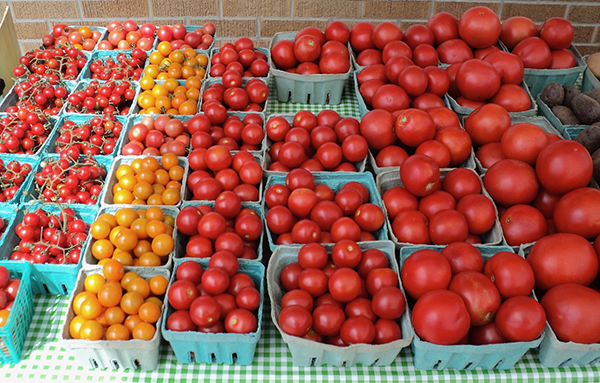
Abundance is always enticing. Pile it high and watch it fly!
In other words, how is competition managed at this market, hands off or hands on? And what about entertainment and social aspects? I have been at markets where all you do is set up and sell to customers (with a little vendor chatting in the down times), and also ones with weekly musical performances, monthly raffles, and the not infrequent need for donations of product for special occasions. Each market had its positives and negatives. Which sounds like your kind of market?
4. Have I sized up the competition?
Though it is not a guarantee that the composition of a market one year will mimic its appearance the next, they are frequently quite similar with many regular market vendors. Therefore it is a good idea (if you can manage it) to visit the market(s) you are considering to see what is being offered.
The more hands-on market managers pay attention to what is being offered, being more inclined to accept new vendors with different products and thereby try to avoid gluts on the market. They want variety for the sake of the customers and also so each vendor has a better chance of selling what they bring, which is achieved by everyone not bringing the same things. Is everything you grow already being offered? Do you think you should specialize with a few items that are in short supply at the market?
You can also regard your potential customer pool as a challenge, in a sense — they have money and you are putting forth an effort to get it from them! Do they look like they will be a good pool for you? What kind of people want to buy what you sell, the older or the younger, the occasional shopper or the regular shopper, the fad follower or the steady home cooker? Who do you see shopping, and will they be receptive to your product, especially in terms of your specific advertising plan?
5. Am I accessorized?
You may be surprised at all of the accoutrement required to set up a market booth (perhaps not all required, some is merely advisable for a successful booth). You will need some manner of tables, chairs, tablecloths, price signage, product signs, farm name signage, baskets, buckets, display tubs, crates. Possibly a pop-up canopy tent for markets without structures. And coolers or crates and boxes for transporting items. And shopping bags, maybe business cards. And, for the portioning of some items, a scale or quart and pint boxes. And maybe plastic bags and twist ties for more perishable or delicate items. And then there is keeping produce cool on warmer days. Ice water, ice cubes, misting bottles, these are all ways to keep produce feeling fresher.
And then, the business side, are you ready for that? In the old days when I started going to market, you had your money apron and had to make sure you brought change along. Maybe you were a Doing Business As (DBA) to accept checks written to your farm name — not necessary if you filed to become an LLC.
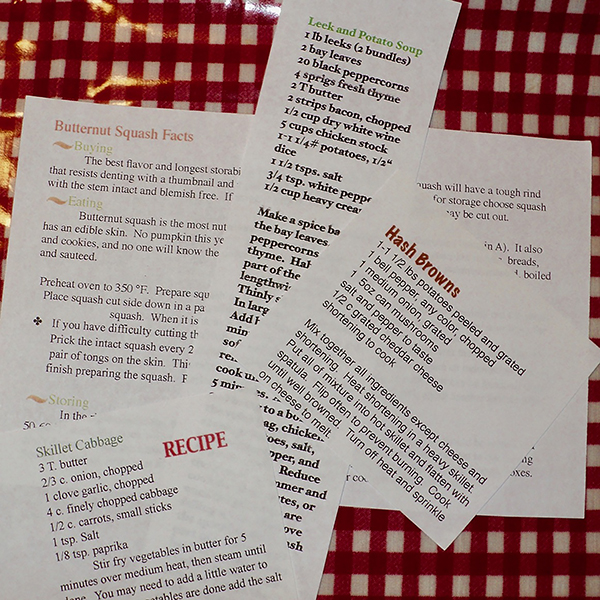 Recipes are one of the best ways to help sell vegetables- especially if it’s an unusual vegetable or something you have an excess of
Some people still deal in cash, but many customers want to use their credit cards. You can accept payments on your mobile device by signing up for an account with a payment processor that offers mobile credit card processing, downloading an app, and purchasing a mobile card reader. The most popular brands are Square, PayPal, and SumUp. Will you sign up for one or stick to cash-and-carry business?
6. Am I ready to advertise my booth?
A well-advertised market is very good, but not good enough. If the market gets customers there, it is your job to then get them to your booth. You must be ready to let customers know what makes you and your products special. Are you Certified Organic or Naturally Grown (or something else)? Are you hyper-specialized in one product, or do you offer variety? Do you like to offer the basics (tomatoes, potatoes, corn, etc.) or specialty items (microgreens, mushrooms, mulberries)?
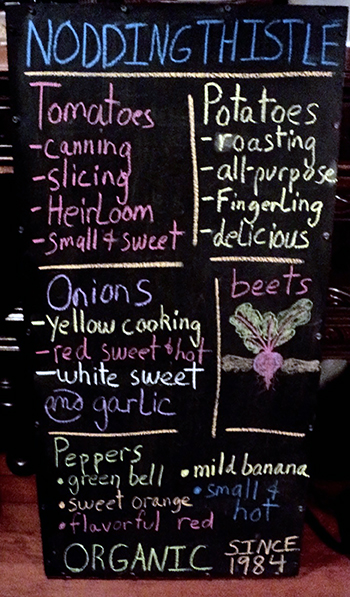 The author’s market sign. Signage is very important- if customers don’t know what something is and what it costs, they won’t buy it
Once you decide how to present what you do in the best terms, get ready with everything from signs, leaflets, and farm albums to electronic newsletters, websites, and a Facebook page, or whatever combination of these methods you wish. An important word on advertising is to stick to what you will do long-term, rather than promising to make facebook posts or send out newsletters or maintain an interactive website and fail to do so. It is better to keep it simple and stick to it rather than to attempt to become more elaborate than you are able to maintain and let people down with poor advertising follow-through.
7. Am I ready with displays and communication?
For good customer interactions, the first thing you have to do is get them into your booth. Appearance is important at the farmers’ market. In addition to good quality, clean produce, an attractive display is important. Whether you go for smart and professional or cosy with character, tablecloths, baskets and tubs, and prices clearly displayed will make your table more approachable. A sign highlighting your produce can help people decide to stop in. It never hurts to have attention grabbers as part of your display — a mass of quart boxes lined up together and full of potatoes, tomatoes, broccoli, etc., or baskets tipped on their sides with produce spilling out (tipped on their sides for better visibility).
Remember that people always respond well to full displays — as your half bushel empties out, switch to a peck, then a half peck, always keeping that full appearance. Play around with individual produce to see if a different display method will help.
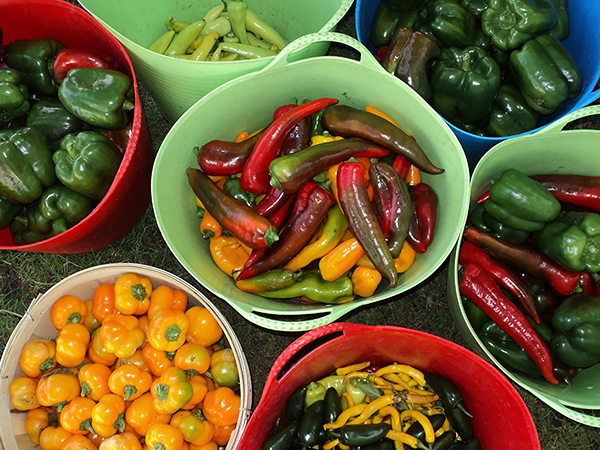
Clean, colorful containers can help highlight their contents.
We had a co-vendor who kept garlic in a basket at the end of his table, and it never sold well. One day he forgot the basket and simply had a nice pile next to his other items, and it never sold better. And our elongated peppers attracted a lot more attention and achieved greater sales when we boxed them blossom end up (“pointing up”). Items like fresh-cut and dried flowers, fruits, and value-added products (from honey or pollen to jars of jam to baked goods) will often entice people into your booth, the important first step.
You have to go to the market ready to talk. It is true that at a busy time on busy days you probably won’t have to say much. But for days when you have to work harder (or you have a chatty customer), you want to be knowledgeable about your offerings. From variety names to prep and cooking advice to farming practices, be ready to share. We frequently offered printed recipes to encourage sales for produce we had in abundance, or that was unusual and required explanation.
Preparing your sales pitch is especially important if you have some unapparent value to convey—if your focus is heirlooms, nutrient-dense foods, organic production, pollinator-friendly methods, humane animal treatment, etc., you will need to be ready with the what and why.
8. Can I sustain an entire market season?
Many markets favor applicants who can attend for greater portions of the season — favored with preferential acceptance and also preferred spots at the market. Also, the greater the frequency of your presence at a market for the season, the quicker and more securely you will acquire regular customers.
Many people have warm-season crops in mind when they first begin market farming — tomatoes, cucumbers, summer squash, bush beans, melons, sweet corn, etc. To have the product ready for both the early- and late-days of the season you must do more. Lettuce, asparagus, rhubarb, spinach (and other greens), scallions, peas, radishes, salad turnips to start the season, and winter squash, globe onions, garlic, fall brassicas, storage potatoes to finish.
You could also build structures for season extension to extend the main summer favorites to the days preceding and succeeding their typical harvest window. Alternatively, you could add some “season-less” products like eggs, honey, pollen, maple syrup, or mushrooms (all of which have some seasonality to them, really, but their supply tends to be fairly constant) to fill out the season.
9. Am I ready to be flexible?
To be successful at a farmers market, it is often helpful to be observant and opportunistic. What are customers looking for? What are vendors selling? Are there too many zucchini or slicing cucumbers at this market? Should you look into patty pans and Armenian cucumbers next year? Should you add a fruit or two? Is anyone having success with unique varieties of any kind of produce, or more so with the familiar varieties? Is it green or red lettuce, green or red cabbage, or green or yellow bush beans, for example, that will sell?
Should you grow some different hot peppers? Would they sell better in a smaller (or larger) quantity? Some of this is observation for the seasons to come, but some can apply to your current season. For example, can you harvest your summer squash or kale leaves or beets at a smaller size to make them unique items that will sell better? So basically: what are people (including you) trying to sell and what are they actually selling? What are customers looking for and what are they buying? Can you alter your harvesting this year or try new varieties next year or make value-added products to create success? Or do you simply need to change unit size? Or presentation?
10. Do I want to go to a market?
Maybe a strange question, but this is important to ask at the end of each season. Everything changes. Demands on your time change. Your agricultural interests may shift a bit. Perhaps you have formed new relationships with local chefs or grocery stores. Maybe what you are growing and producing has shifted and is better suited to a different sales venue. Or you have gained enough experience and built a reputation to allow you do to CSA shares.
Or instead of a weekly market you could attend pop-up markets, or only a few harvest festivals. There is no denying that production, preparation, and attendance at farmers markets takes a great deal of time compared with most other sales options. And if the weather is not very hospitable on any given day, customer attendance may not be very good.
But farmers market selling can also be one of the most rewarding activities in terms of money earned and relationships made. It likely is at least a part of your farm sales plan, as long as you have just that — a plan.
Leah Smith is a freelance writer and home and market gardener. She works on her family’s farm in mid-Michigan called Nodding Thistle (certified organic 1984 to 2009, principally by Organic Growers of Michigan). A graduate of Michigan State University, she can be reached at noddingthistle@gmail.com.
Copyright Growing For Market Magazine.
All rights reserved. No portion of this article may be copied
in any manner for use other than by the subscriber without
permission from the publisher.