








There are amazingly diverse uses for a very cheap tractor implement for those without front-end-loaders or forklifts.
You know those moments when you look at a piece of equipment and wonder why you ever went without it? In just a little over a year, the 3-point pallet fork has become that tool for us. You don’t need a large farm to reap the benefits. We cultivate three acres of vegetables, and this has served our needs and more. If you’ve got a tractor, all you need to make this tool worth the purchase are some used pallets.
When we started our farm, we were in our mid-20s. Eighteen seasons later, we’re in our mid-40s, getting older, and realizing physical limitations. Although it seems obvious now, it has taken us time to realize we can’t always rely on strength to power through difficult tasks. And, even if we can, it’s not healthy for our bodies.
Friends and customers often assume that farming keeps you fit. While it does keep us moving, flexible, and using our bodies, farming is just as likely to wear you out as work you out. Like all farmers, we are constantly in search of the universal goal of working smarter, not harder. As we age, we think more seriously about how to accomplish physically demanding tasks over extended periods of time without exhausting ourselves.
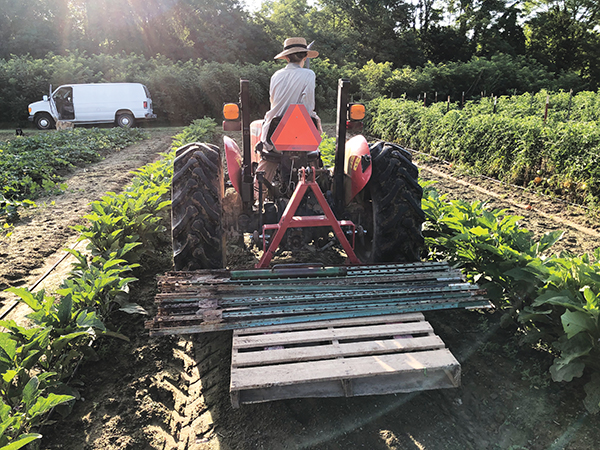
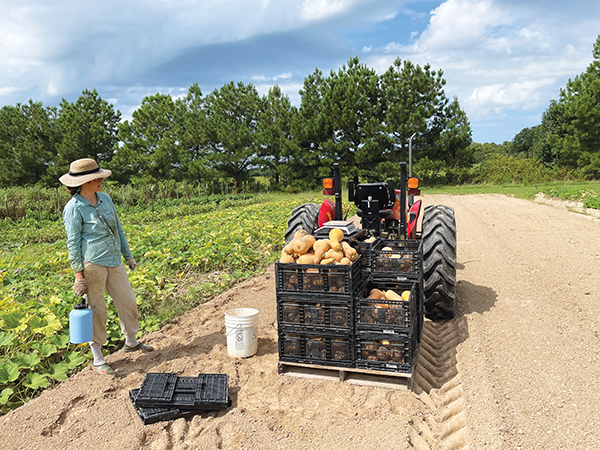 Harvesting butternut squash with 3-point hitch forks. All images courtesy of the author.
Equipment often has been the answer. The right tool allows us to work longer on a job than might otherwise be possible by shifting a significant portion of the workload and effort onto a machine. This is especially important for us as a two-person farm. Without employees or interns to offset our no-longer-25 bodies, equipment can step in to perform tasks we used to push through. And really, there’s never a reason to make your body do something a $300 tool can do instead.
We’ve made a number of changes over our farming careers that have increased efficiency and lessened physical demands, from better layout and ergonomics in our wash and pack station to harvest and marketing vehicles that minimize lifting and stooping. The 3-point pallet fork is one of the most recent and one of the most versatile.
We use the 3-point pallet fork to: lay out and pick up staking T-posts, lay out and pick up sandbags for row cover, unload pallets from our truck, harvest storage crops from the field directly into crates on the forks, spread square bales of mulch, move silage tarps between hoophouses, and general hauling.

I’m sure there are other uses we will figure out with time. In fact, just writing this article helped us come up with another use: carrying our firewood from the shed to the house.
Staking t-posts
Instead of picking up T-posts from the barn, placing them in the truck bed, driving to the field, and carrying them down each row, instead, we can pick up a pallet of T-posts in the field and drive directly down the rows while one of us lays them out. The driver adjusts the height of the pallet to make it easy for the person laying them out to reach. No more bending, no more walking down rows with armfuls of T-posts.
The same is true when it’s time to remove the T-posts at the end of the season. Someone drives the tractor with an empty pallet between two rows while the other person takes the T-posts out of the ground and lays them directly on the pallet. No more pulling out T-posts, laying them on the ground, driving down with the truck, bending down to pick them up again, and laying them in the truck bed. The time and energy to do this job have been reduced by at least 75 percent. Since we stake all of our tomatoes, peppers, and eggplant (which adds up to hundreds of T-posts a season), this tool made an immediate difference.
Sandbags for row cover
We use sandbags to hold down row cover over hoops in our beds. Typically, we only use row cover when the threat of frost or freeze is more than the crops can handle; it’s not something we apply as a regular part of spring crop maintenance. So, when we need to get out row cover, it’s usually pretty hurried. Keeping the sandbags stacked on pallets makes quick work of getting them out to the beds when it counts.
 Staking eggplant without bending over for t-posts.
Unloading pallets
Without a forklift, we’ve struggled with deliveries of palleted orders in the past. Since delivery trucks find it hard to deliver to our property for logistical reasons, we often pick up shipments from a local terminal and have the pallets loaded onto our box truck, cargo van, or pick-up truck. At the farm, we then back up the fork to our vehicle and unload the pallet. For example, the pallet fork lets us purchase totes of potting soil and easily remove the pallet from the truck with the tractor rather than unloading bags by hand. Same goes for pallets of cover crop seed or soybean meal. This saves both labor and money for bulk orders.
Harvesting storage crops
When it’s time to harvest storage crops like beets, potatoes, onions, carrots, and winter squash, we put a pallet on the forks, lay out a row of empty crates on the pallet, straddle the tractor over the bed, and harvest directly into the crates on the pallet. When the bottom row of crates is full, we layer more empty boxes on top, and repeat the process until the pallet is full. We drive the pallet to our barn, unload it in the shade, and clean the veggies when we’re ready. Alternatively, you can buy plastic, wooden, or cardboard pallet crates in varying sizes and capacities that fit directly on the forks.
General hauling
Our tractor doesn’t have a front-end loader, so hauling has always been a challenge. Now, the pallet fork makes quick work of moving and spreading square bales of mulch on asparagus and other beds. It also facilitates moving silage tarps between hoophouses. Anything that can be stacked on a pallet is a perfect candidate. Loading unruly items directly onto the forks is also an option. We’ve used it to move big logs that have come down during storms.
We purchased our 3-point pallet fork from Agri Supply for $290 plus shipping last year. A range of prices and options exist. Ours has a lifting capacity of 2,000 pounds and two-inch thick forks. Our biggest weight limitation is our tractor’s hydraulic pump.
The next upgrade is purchasing a $200 hydraulic top link to adjust the angle of the forks by tilting them up or down, instead of being limited to the range of motion permitted by the 3-point hitch. Its uses wouldn’t be limited to the pallet fork and could be applied to other implements.
Sometimes the simplest tools are the most useful. The 3-point pallet fork reduces lifting and saves time, making dreaded jobs easy and fast. It has already paid for itself many times over and is one of those tools we don’t know why we didn’t buy sooner.
Emily and Mike own Three Springs Farm, a diversified, certified-organic vegetable farm in eastern Oklahoma. They cultivate more than 40 different crops and more than 150 individual varieties on three acres of land and sell primarily through their CSA.
Copyright Growing For Market Magazine.
All rights reserved. No portion of this article may be copied
in any manner for use other than by the subscriber without
permission from the publisher.