











Cut out trips back to the barn for commonly needed supplies: #toolsforgrowingformarket
Post your favorite farm-made tool on social media using #toolsforgrowingformarket or email it to us at admin@growingformarket.com. If Josh picks your tool, you win a $50 tool gift certificate and a Full Access sub to GFM!
At the end of February Little Wings Farm in Eugene, Oregon, posted a couple of photos of “the field boxes” they stash in various locations around their farm. The boxes hold items that at one point or another they’ve found themselves in the field without, and the idea was to save themselves trips back to the barn for small items that are easily duplicated and stashed in a box. The boxes aren’t for everyday use, just for little emergencies.
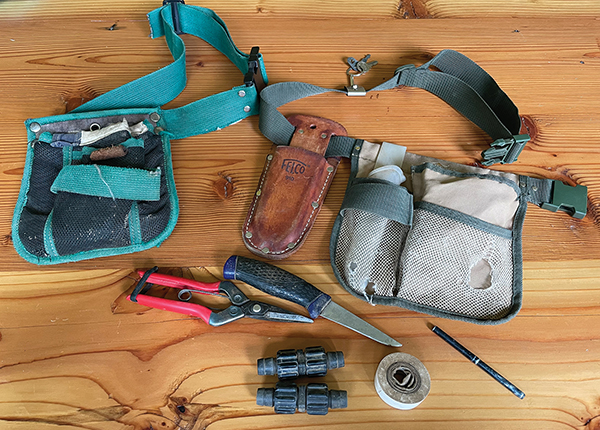 Some of the author’s tool belts with commonly needed items to save trips back to the shed: harvest knife, clippers, travel space pen and sharpie (great for popping troublesome starts out of trays as well as writing notes and labels), couplers and electrical tape for drip tape repairs, and light weight work gloves. Photo courtesy of the author.
The boxes themselves are small Rubbermaid totes and on the inside lid there’s an inventory list of the contents of the box to make it easier to restock them at the end of the season. In each box are spare harvest supplies for last minute orders (twist ties, a harvest knife, clippers, rubber bands…), irrigation supplies (drip couplers, barb fittings, a wire for unclogging sprinkler heads), a file for sharpening hoes, flagging tape, twine, pens and markers for labeling, zip ties and band aids. Their farm is 8 acres, with two fields spread out a bit and divided by a road. Two boxes are stashed in each of their two fields at opposite ends so a box is never far away if needed.
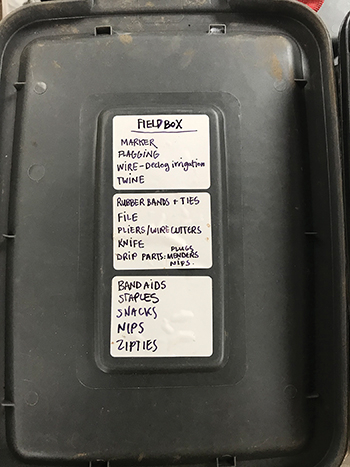 A label on the inside of the lid makes it easy to check the contents and restock when needed.
Little Wings’ boxes remind me of variations on this theme, one being the harvest toolbox I used to send out to the field with the crew when my farm was a little larger. That tote wasn’t just for emergencies, but it was a stocked with similar items, as well as a clipboard with the harvest list for the day. At the beginning of the day the harvest crew would load up the empty harvest totes, into a truck or onto the harvest cart, and also take the tote with all of the harvest tools. The truck, or cart would act like a mobile supply shed and office in the field.
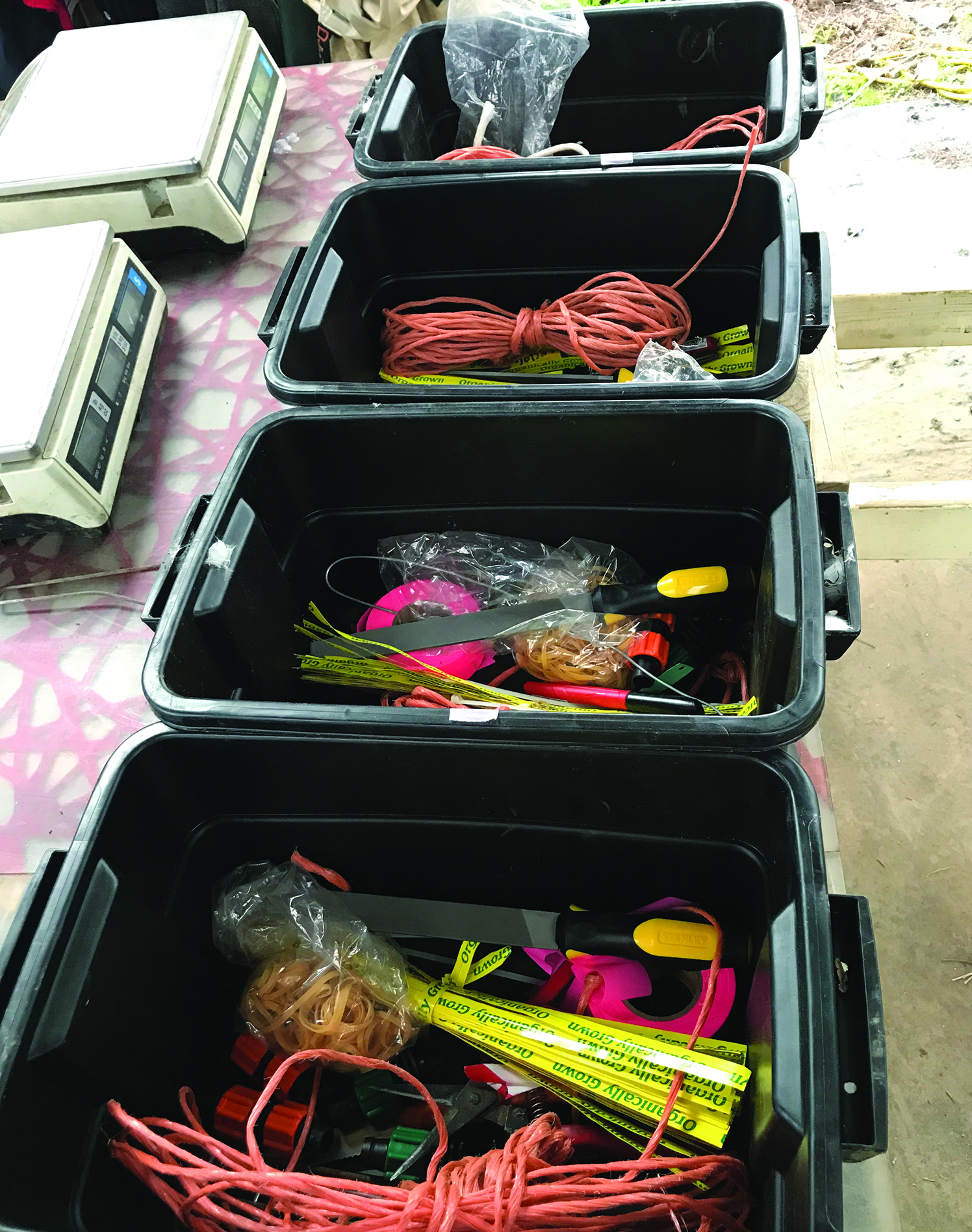 Freshly restocked field boxes at the beginning of the year, ready to be stashed in the field. Photos courtesy of Little Wings Farm except where otherwise noted.
These days I outfit the crew on my tiny farm with garden tool belts, and encourage them to stock their tool belts with the commonly needed items to save trips back to the shed: harvest knife, clippers, travel space pen and sharpie (great for popping troublesome starts out of trays as well as writing notes and labels), couplers and electrical tape for drip tape repairs, and light weight work gloves.
It’s not always easy to find good garden tool belts, but what I look for are ones made with heavy mesh pockets (mesh doesn’t collect dirt or water) and webbing belts that are easy to adjust for layered clothing in the winter. I used to carry all of that in the pockets of my pants, but I like the ability to take the tool belt off during breaks and my pants don’t wear out at the pockets nearly as quickly these days. The tool belt also saves me the work of constantly emptying my pockets whenever I change my pants.
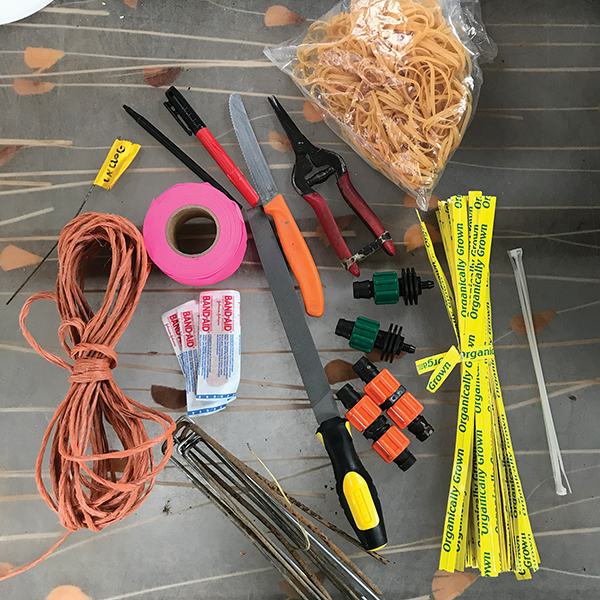 In the box are a mix of irrigation, harvest and miscellaneous supplies that at least one point in the past would have been handy to have in the field.
Like Little Wings’ “field boxes” our tool belts tell the stories of past needs and frustrations and are stocked with things we’ve found we need, not things we think we might need at some point.
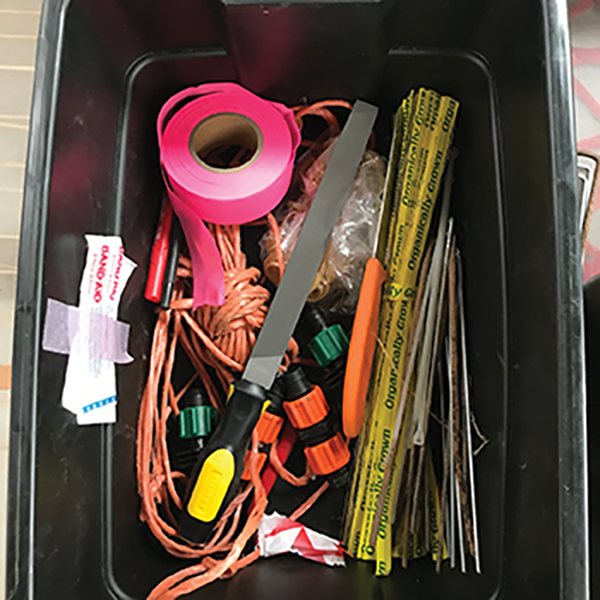 In the box are a mix of irrigation, harvest and miscellaneous supplies that at least one point in the past would have been handy to have in the field.
I’d love to see your versions of field boxes and tool belts, and their contents. If you want to share, please tag photos on social media with the hashtag #toolsforgrowingformarket.
Josh Volk farms in Portland, Oregon, and does consulting and education under the name Slow Hand Farm. He is the author of the book Build Your Own Farm Tools and Compact Farms: 15 Proven Plans for Market Farms on 5 Acres or Less, both available from Growing for Market. He can be found at slowhandfarm.com.
Copyright Growing For Market Magazine.
All rights reserved. No portion of this article may be copied
in any manner for use other than by the subscriber without
permission from the publisher.