











#toolsforgrowingformarket
Post your favorite farm-made tool on social media using #toolsforgrowingformarket or email it to us at admin@growingformarket.com. If Josh picks your tool, you win a $50 tool gift certificate and a Full Access sub to GFM!
Last month I pulled our old Earthway “Precision Garden Seeder” out of the back of our tool shed, searched for the bag of seed plates and renewed my appreciation for this very basic and versatile seed drill. These days I mostly use a Jang JP1 with disk openers for direct seeding and it’s a great seeder, but in a very different way from the Earthway, and it’s a little less versatile.
The Earthway Precision seeder is not particularly precise, but despite that, it’s an incredible seeder for the small farm. It’s much less expensive than any other decent push seeder out there, it’s easy to handle and carry, it comes with enough plates that you can seed pretty much anything, it’s easy to empty the hopper (with a little practice and technique), and it can be modified in useful ways.
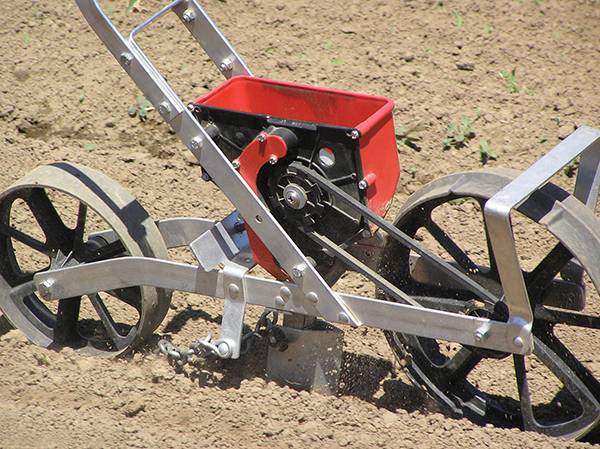 This Earthway seeded many miles of salad mix and other crops for more than two decades with only one or two changes of the drive belt.
I wouldn’t buy it if you’re just seeding 10’, but if you’re seeding 10’ on a regular basis I might go for it. If you’re seeding 10,000’ of one crop on a regular basis I wouldn’t buy it either, but it will do the job, and do it decently well if you’re only doing that much once a year. Where this thing is great is in the 50’-500’ range, especially if you’re making several seed and seed plate changes during a seeding session. It’s especially suited to lighter soil. It is very light weight, which makes it great for carrying around and easier to get the seed out of, but it doesn’t make it great for plowing through heavy clods or rocks in the soil.
In the years since we got the Jang JP1, what I’ve mostly used the Earthway for is seeding cover crops: for rye/vetch or buckwheat mixes going into just a section of a bed, or a few beds at a time as they come out of production. Seeding four rows on a 30” bed top using the “beet” plate puts down a nice thick cover crop stand with good germination and because the seeder is pretty much always set up for cover crop it’s super easy to pull it out of the shed and quickly put down the seed.
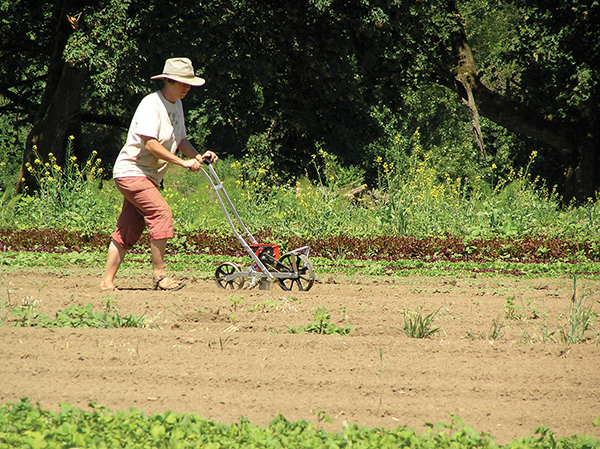 Pre-forming little furrows using a ring roller behind the tractor made it much faster to seed salad mix with the Earthway and always improved germination. All photos courtesy of the author.
I was searching through the plates the other day because I needed to seed salsify and scorzonera and the Jang just isn’t flexible enough to handle such odd-shaped seeds. I had luck in the past using the cucumber plate with parsnip seed so I thought that might be the ticket, but it turned out that the beet plate did the job better.
Here are some notes from my review of the Earthway:
• It says precision, and the different plates do give you a bit of a range of seeding rates and kind of a bit of variation in seed spacing, but not so much. The good news is that you can play with the different plates, even modify plates or order custom plates and get a bit more variation. The most common modification I see is putting a bit of scotch tape behind every other or even every two of three holes on the beet plate to give 1/2 to 1/3 the seeding rate and reduce or eliminate the need for thinning.
• With small seeds, especially small round ones like turnips and arugula, there’s a tendency for the seed to get stuck behind the plate and cause a terrible grinding noise, not to mention it doesn’t really seed right while the seed is back there. There’s a modification that helps with this. You can take a 4” abs pipe cap (I think that’s the size), drill a hole in the center, replace the screw for the top pulley with a long one that extends into the seed hopper and then tighten that cap against the seed plate with a wing nut to keep it from flexing as much. This works pretty well, but it does make changing the seed plates a pain. The trick is getting the tension on the screw just right so that the plate still spins, but so that it doesn’t flex.
• In wet conditions the wheels collect soil (at least in most soils). This can be somewhat remedied by taking a wire (landscape flags are perfect) and bending it so that it scrapes the wheel as the wheel comes off the ground. The wire can be attached to the axle if you loosen the bolt slightly to bend it around the axle and then retighten the bolt.
• In trash or wet conditions the opening shoe will clog. It’s not a disk opener, and it’s not as bad as the old extra wide Planet Jr. Shoes. It’s very easy to clear, you just have to pay attention.
• The belt might start to slip as it gets old and worn. This can be easily fixed by replacing the belt, which is not expensive. Parts are relatively easy to get from the manufacturer.
• The chain that’s there to help cover the furrow is relatively useless, but it doesn’t seem to matter much.
• The depth markings are not very accurate – but who cares, you’ll just figure out what numbers you need for what seeds. I use 1/4”-1/2” for small seed, 3/4” for medium seed, and 1” for everything else.
While the Jang is definitely better at handling small seeds, and in particular round seeds, the stock Earthway does a wider range of seed types with more ease. The only thing I haven’t been able to seed with it are our large-seeded favas, which we basically seed by hand.
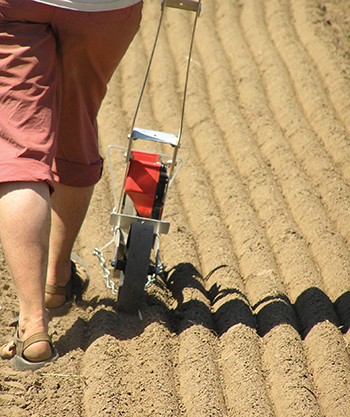 Pre-forming little furrows using a ring roller behind the tractor made it much faster to seed salad mix with the Earthway and always improved germination. All photos courtesy of the author.
The Earthway is also much lighter than other seeders, and this makes it easier to handle when it’s not seeding. On heavy ground and with rocks it will tend to jump around and not penetrate the soil well, so it doesn’t work for every farm. When I’ve wanted to seed peas deeply in early spring, when conditions are terrible for running a seeder, I’ve pre-opened a furrow with a hoe and then just pulled the furrower all the way up so that the seeder is just metering out the seed, not opening or closing the furrow at all. Even with small seed I’ve found that pre-forming a small furrow can help the seeder run more cleanly.
The Earthway is far from perfect, but for the price it’s very hard to beat.
Josh Volk farms in Portland, Oregon, and does consulting and education under the name Slow Hand Farm. He is the author of the book Build Your Own Farm Tools and Compact Farms: 15 Proven Plans for Market Farms on 5 Acres or Less, both available from Growing for Market. He can be found at SlowHandFarm.com.
Copyright Growing For Market Magazine.
All rights reserved. No portion of this article may be copied
in any manner for use other than by the subscriber without
permission from the publisher.