











As farmers have known for years, honeybees and native pollinators are experiencing catastrophic declines from a host of factors including pesticides, parasites, pathogens, and habitat loss. Now, the public has awakened to the issue, thanks to increasing media coverage of the plight of pollinators.
Time magazine drew attention to the issue with an Aug. 19 cover story, “A World Without Bees.” In June, there was widespread media coverage of the largest native bee kill ever recorded, when more than 50,000 bumble bees died of pesticide poisoning in a parking lot in Wilsonville, Oregon (see page 3). The European Union’s decision this summer to limit the use of neonicotinoid pesticides for two years also was widely covered.
In short, pollinator conservation is becoming one of the top environmental causes attracting public sympathy.
Sustainable farmers are singularly well-equipped to help with pollinator conservation efforts. By creating pollinator habitat and food sources, allowing beekeepers to place hives on our land, limiting pesticide use, and educating our customers about the issue, we can support pollinators.
The benefits of a pollinator conservation program on a farm may be direct: As the number of pollinators increases, so do crop yields and quality. There may also be market rewards from the increasing number of customers who understand and appreciate bee stewardship. And much of the work of habitat restoration involves growing flowers — and what could be more personally rewarding than beautifying your farm while helping beneficial species?
Increasing public interest
Pollinator conservation is a part of life at Broadfork Farm in Stewart, Minnesota. The farm is a patchwork of woodlands, native prairie, and cultivated fields, and farmers Kelli Tennyson and Tim Sutton intend to keep it that way.
“The woodlands provide many undisturbed areas and dead logs that native bees use as habitat and the native prairies are full of flowering native perennials,” Kelli said. “Our vegetable production is about one and a half acres, and the woodlands and prairie flowers border the veggie growing area.”
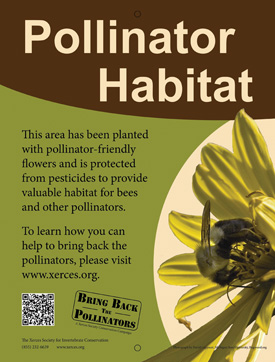
Broadfork Farm grows vegetables and fruits organically, although it is not USDA Certified. The farm has received a “Bee Friendly Farm” designation from Partners for Sustainable Pollination, a nonprofit based in Santa Rosa, California. Kelli and Tim use the logo which generates interest from customers.
“Our Bee Friendly Farm status is often a good starting point for sharing our growing methods and practices on the farm,” Kelli said. “We’ve even had customers ask us what they could do in their own yard to support bees and beneficial insects. It’s a good conversation starter and in my mind it seems people really understand pesticides are bad for people and bad for bees. By showing our farm supports bee habitat and produces vegetables in a way that encourages rather than threatens bees, they make the connection that our food, while not Certified Organic, is pesticide-free, organically grown, etc.”
Kelli said that this summer, a Minneapolis media outlet ran a story about systemic pesticides used by some greenhouses and nurseries for their landscape and garden plants.
“They were making a good case for gardeners to buy local transplants and to seek out growers and farmers who grow plants organically with no pesticides,” Kelli said. “Consumers were told to ask at their nurseries about how the plants were grown and products used in their production. So I think on many levels consumers are more informed and are willing to ask questions and know the questions to ask.”
Broadfork Farm is planning a prairie restoration project next year with an eye to improving pollinator habitat. And on the marketing side, Kelli said, they plan to have hands-on, bee-friendly activities for kids at the farmers market such as building mason bee houses, and educational resources for customers about what they can do at home to support pollinators.
Magnitude of the threat
Pollinators are responsible for the reproduction of nearly 75 percent of the world’s flowering plants, including one-third of the world’s food. Among the fruits and vegetables that depend on pollinators for fruit or seed production: apples, blueberries, broccoli, carrots, celery, cole crops, cucumbers, melons, parsley, pumpkins, squash, strawberries. Tomatoes and peppers, though they are self-fertile, need to be vibrated for pollination. According to the Xerces Society, studies show that visitation by native bees increases fruit set of Sungold cherry tomatoes by about 45 percent.
For the past 10 years, beekeepers have been reporting honeybee hive losses of up to 30 percent annually, as high as 50 percent last winter, in the syndrome known as colony collapse disorder. The cause has not been definitively explained, but is attributed to multiple factors including Varroa mites, pesticides, malnutrition and habitat loss.
The status of native pollinators is less clear because they aren’t managed, as honeybees are. A 2006 study by the National Academy of Sciences warned of downward trends of native pollinators and called for more research. More than 4,000 species of native bees are found throughout North America. The largest family is the Apidae, which includes bumble bees, carpenter bees, squash bees, southeastern blueberry bees, and cuckoo bees. Other important bees include mason bees, leaf-cutter bees, sweat bees, and miner bees.
Conservation on the farm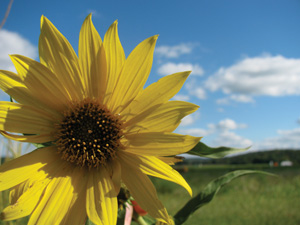
The Xerces Society for Invertebrate Conservation has great resources for farmers on its website, www.xerces.org. It also has published a beautiful, important book on native pollinators — see page 6. Pollinator conservation for farmers involves three facets: recognizing existing pollinator habitat; increasing the food supply for pollinators; and understanding how farming practices may affect bees.
None of these tasks are overly difficult or expensive, and most farms already have important bee-conservation features. Here are some tips from the Xerces Society:
Grow flowers! Wildflower meadows of native species are best but patches of non-native cultivars can also be helpful. Among cultivated varieties, grow singles rather than doubles because their pollen is more accessible to foraging bees. Aim for the longest possible period of bloom, from early spring until hard freeze. Fall bloom is especially important, to help bees get ready for winter. Asters, goldenrods, and Maximilian sunflowers are good fall bloomers across most of the U.S.
Group plants so that the bees can spot them; some research says a 3-foot patch of the same flower in bloom is more visible to bees than a single plant.
Patches of flowering plants can be scattered in multiple spots across a farm. The idea is to get them close to crops for maximum benefit. Native bees typically forage from 500 feet to a half mile, depending on their size. Ideally, plant a flowering crop every 500 feet or so within crop fields. 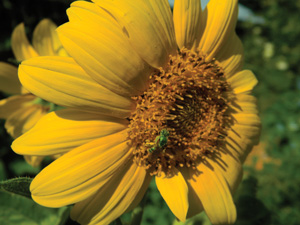
Leave bolting crops such as basil, lettuce, fennel, and radishes in the field as long as possible. The flowers will add to the diversity of native bees’ diet. Ditto for weeds that aren’t competing with crops — weedy field margins, if they aren’t supporting pest insects, can be food and habitat for beneficials.
Herb gardens can be part of the insectary plan as most will go to flower when they mature.
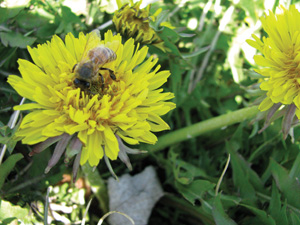
Don’t stress about the lawn. Dandelions, violets, wild strawberry and other low-growing plants are valuable food sources.
Cover crops that flower such as vetch, clovers, buckwheat and alfalfa are an inexpensive and multi-purpose way to provide food for pollinators.
Strips of native shrubs and trees can be planted adjacent to vegetable fields or fruit orchards. Pond margins, grassed waterways and utility easements provide opportunities for establishing bee pastures.
Nesting and overwintering
Most native bees are ground nesters, so they need direct access to the soil. Bumble bees need a shoebox-size cavity, such as under piles of brush or tall grasses that have fallen over. Other bees nest in abandoned beetle tunnels in stumps and snags.
Areas around the farm that are not overly groomed provide good nesting sites. Leave some dead trees and fallen branches in the woods. Maintain patches of bare ground.
Most bees that overwinter use the same nests. Bumble bees die at the end of the summer, except for the queens, which hibernate by burrowing a couple of inches into soil or leaf litter.
Grant funds available
USDA’s Natural Resources Conservation Service provides assistance for pollinator conservation. Several cost-share programs can be used to establish pollinator plantings. Farms that are selected will be paid 50-90 percent of the cost of their projects. Mace Vaugh, pollinator conservation program director at Xerces Society, provided this information:
“Most funds to support pollinator conservation on-the-ground are through the EQIP program, where a landowner can apply for cost-share funding to offset the expense of putting in hedgerows, permanent meadows (conservation cover), field borders, cover crops, or improved IPM practices to support pollinators. However, EQIP is not the only program. There is still a pollinator or a beneficial insect conservation enhancement through the Conservation Stewardship Program (CSP). And, if a landowner is in a state with a lot of Conservation Reserve Program (CRP) land, there are financial incentives to create pollinator habitat through CRP.
“The amount of money available is very dependent upon the state. As a ballpark, if contracts are approved, landowners may be able to get between $600 and $1100 per acre to create a pollinator meadow (depending upon the state). This reflects the range of cost for plant materials in a region. If you wanted to create a hedgerow and your contract was approved, the costs vary between $2 and $4 per linear foot (the more expensive practices usually involve a hedgerow with multiple rows of woody plants and herbaceous plants). To find out how much a state NRCS office can cost-share with landowners, you would need to get in touch with a local NRCS field office (or a state biologist or plant materials specialist) and ask about the cost-share rates for the conservation practices used to create pollinator habitat. Some commonly used practices for pollinator habitat include Conservation Cover, Hedgerow, Field Border, or Cover Cropping.”
Contact your local NRCS office to find out what is available. Get started at www.nrcs.usda.gov.
Copyright Growing For Market Magazine.
All rights reserved. No portion of this article may be copied
in any manner for use other than by the subscriber without
permission from the publisher.