









Wherever water comes into contact with produce, it has the potential to violate the most fundamental of food safety tenets: keep the poop off of the food. Whether it originates from a pond, a stream, or a well, water has the potential to carry and spread the foodborne pathogens that can make people sick.
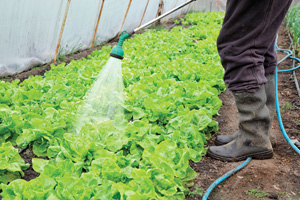
For food safety purposes, it is useful to think of the water used in agriculture as having two distinct purposes: water used in growing produce, such as that used for irrigation and the preparation of crop sprays; and water used as part of harvesting, packing, and holding produce.
As with everything else in food safety, assessing risk is a fundamental part of decision-making. For example, using water conveyed by a furrow or drip system to an apple tree is so unlikely to contact the produce that any potential contamination is of very little concern. Water used to spray those trees, or to irrigate them with a sprinkler system, is likely to contact the produce, but any microbes in the water will be exposed to UV radiation and drying winds before the apples are harvested; the quality of this water matters, but it doesn’t have to meet drinking water standards.
The quality of the water used to wash those same apples matters a great deal, since that water contacts the produce closer to the time they are eaten, and any microbial pathogens that do get on the produce aren’t exposed to environmental conditions that are likely to kill the bacteria.
The source of the water matters. In general, ground water from a well is microbiologically safer than surface water. A properly constructed well will normally provide a safer source of water than a creek or a pond. Wells aren’t perfect: some older wells can have cracks in their casing that can provide a means for contamination to enter the water supply, and you should take steps to keep livestock and surface runoff away from wellheads.
If you irrigate with water from a source of potable water, you don’t have much to worry about from a food safety standpoint. But if you irrigate with surface water, you’ll want to assess the likelihood that it is contaminated with pathogenic bacteria such as Salmonella and Listeria moncytogenes. You can make an initial assessment without fancy instruments or testing – your eyes will tell you a lot.
If you irrigate from a stream, look at the area upstream from your pump; for a pond, evaluate the land surfaces that drain into it. If livestock are grazing in the drainage area, are they standing in the stream, or are they fenced away from it? Does the body of water have vegetation along its edges? A 2006 University of California study showed that grass strips can filter up to 99.995% of E. coli in just four inches, with even greater reductions over additional distances.
If farms in the watershed are spreading manure on their fields, grassed waterways and hedgerows can reduce the movement of manure and contaminated soil in your water sources.
In clear, shallow water, pathogenic bacteria are killed by sunlight and a lack of nutrients. Turbulent conditions that stir up mud from the bottom of the stream are more conducive to the survival of bacteria, providing food sources and shade; and E. coli can survive for months in stream sediments, and has been shown to overwinter in streambeds when embedded in the underwater sediments. Unfortunately, these bacteria can be stirred up into the water by something as simple as deer or livestock hooves in a stream or pond.
In addition to bacteria that get stirred up from the bottom, manure-based bacteria get swept into surface water during rain events. Most of the bacterial load dies off in a very short time, and rain events are usually associate with a lack of irrigation needs.
Many food safety audits, as well as the FDA’s proposed Rule for Produce Safety as part of the Food Safety Modernization Act, require testing of water used for irrigation. Cornell University recommends that growers in northern climates test their irrigation water three times during the growing season: at planting, during peak use, and near harvest. They recommend that growers in warmer climates test quarterly. For surface water, the FSMA’s proposed produce rule would require testing at least every seven days, while well water would need to be tested at the beginning of each growing season, and every three months thereafter during the growing season.
Whether you test your water or not, if you use surface water for irrigation you should take steps to mitigate the risk of produce contamination when you apply it.
Drip and furrow irrigation dramatically reduce contamination risks for crops that grow above ground, because water contact with the harvested portion of the crop is minimized. When crops are irrigated with sprinklers, water contacts the produce directly, as well as splashing potentially contaminated soil onto the produce.
The above-ground environment is not conducive to bacteria survival and growth, so Cornell University recommends waiting seven days from overhead irrigation to the harvest of an irrigated crop, if you are irrigating with surface water.
Some crops are more likely than others to harbor bacteria if water does contact the produce. Crops like lettuce are more susceptible to contamination because of the large surface area of the edible portion. Others with rough surfaces, like cantaloupe, can foster bacterial attachment and entrapment, allowing pathogens to survive despite the damaging effects of UV radiation, drying winds, and sanitizers. A 2009 study found that the semi-savoy Tyee spinach harbored more E. coli 0157:H7 after two weeks than smooth-leaf Space and Bordeaux varieties.
Applying overhead irrigation in the morning reduces pathogen load because the more efficient water use means that less water, and therefore less potential bacteria, are applied to the field and crops. The rapid drying and long period of UV light that happens after morning irrigation also reduces pathogen survival.
Injuries to leaves and fruits can also increase pathogen attachment and survival. Broken, cut, and diseased surfaces increase access by bacteria to the nutrients inside the plant, increasing their chance for survival and growth; they also provide a site for bacteria to infiltrate the plant tissues, where they are protected from the sun’s sterilizing UV rays as well as sanitizers that may be applied through the wash water. In one study, just bending the waxy cuticle surface of a leaf was shown to increase the survival of E. coli on that leaf; another study demonstrated increased human pathogen survival after leaves were squeezed between a thumb and forefinger. A 2009 Australian study indicated that waiting three days to overhead irrigate after an injury occurs reduces bacterial survival to the same levels that occur on an uninjured plant, suggesting that you can reduce risk by irrigating or harvesting three days after close cultivation, severe weather, or other events that cause minor damage to crops. This is another reason to handle crops gently at harvest.
Water used for wash water, post-harvest handling, hand-washing, and that touches food-contact surfaces should meet the same bacterial standards as drinking water. You should also take steps to ensure and maintain that quality.
To keep water in the packing shed safe, these are the most important considerations: surfaces in water tanks and wash lines should meet food-grade standards, and should be cleaned and sanitized on a daily basis, at minimum; water held in tanks should be changed when it gets dirty; and water used for cooling and washing should be treated with a wash-water sanitizer.
Wash-water sanitizers can reduce pathogens on the surface of produce, as well as keeping any bacteria from surviving the journey from one piece of produce to another. Wash-water sanitizers can’t eliminate pathogens on contaminated produce, because plant surfaces are full of crevices and cracks where bacteria can avoid contact with the sanitizer.
Many growers use Ecolab’s Tsunami 100 for a wash-water sanitizer; BioSafe’s SaniDate 5.0 is also labeled for this use. Both are based on peracetic acid, a hydrogen peroxide – acetic acid blend, and approved by OMRI for use in organic production. Chlorine bleach can also be used, but it is not approved for organic production and is far from benign in the environment.
Ideally, any time water comes in contact with harvested produce, you would use a wash-water sanitizer, whether the water is being used to cool the produce or to clean it. A sanitizer is almost mandatory in a dunk tank to prevent pathogens from spreading from a piece of contaminated produce to another, but using a sanitizer in a brush washer or wash line can also reduce the pathogen load on produce; in fact, the criminal charges brought against the Jensen brothers as a result of the 2011 listeria-cantaloupe outbreak includes the charge that they didn’t use a sanitizing spray to clean the fruit.
Sanitizers must be used in accordance with the instructions on the label. Concentrations that are too high can damage hard surfaces, and may persist on the produce, while concentrations that are too low won’t be effective against pathogens. And while you can simply do the math to determine appropriate concentrations, it’s important to monitor actual concentrations, especially over time as water is added and sanitizers break down. The test strips available for both peracetic acid and chlorine make an easy and inexpensive way to monitor sanitizer concentrations.
As soil, organic materials, and microbial load increases in a tank of water, the efficacy of a sanitizer decreases. Net out debris, and change water frequently.
Washing crops such as tomatoes, apples, and peppers in water colder than the produce temperature can cause water and bacteria to be sucked right into the fruit. The air spaces in the fruit contract, producing a negative pressure differential that causes water to move through the blossom scar. If you choose to immerse fruiting crops, be certain that they have been cooled to within ten degrees of the water temperature, and use a wash water sanitizer to reduce the likelihood that any internalized water doesn’t contain live bacteria.
Infiltration of pathogens does not necessarily require a negative temperature differential. Soaking lettuce in a concentrated E. coli 0157:H7 solution allowed pathogen cells to penetrate into leaves from the cut edges; the higher the concentration of E. coli 0157:H7, the more bacterial attachment that occurred. Also, the longer the lettuce was allowed to soak in the solution, the more cells penetrated into the lettuce. Reducing the pathogen load of the water with a sanitizer reduced the quantity of E. coli 0157:H7 that attached to and penetrated the lettuce. A later experiment with Italian parsley yielded similar results. This would suggest that minimizing the time that produce remains in a dunk tank would reduce the opportunity for pathogenic bacteria to contaminate produce.
Chris Blanchard provides consulting and education for farming, food, and business through Flying Rutabaga Works. He has worked in farming for the past 24 years, managing farms and operations around the country. He is the owner and operator of Rock Spring Farm.
Copyright Growing For Market Magazine.
All rights reserved. No portion of this article may be copied
in any manner for use other than by the subscriber without
permission from the publisher.