











Do you need a justification for having some weeds visible among your crops? Do you crave a system to help you get a grip on your to-do list, so you’re not overwhelmed? Sustainable (or Ecological) Weed Management does it all! In the earlier days of organic farming, maximum use was made of frequent cultivation to kill weeds. Now we know that too-frequent cultivation risks causing soil erosion, and that each tilling or deep hoeing stirs air into the soil and leads to a burning-up of organic matter. The practice of sustainable weed management is about effectiveness — removing weeds at their most vulnerable stage, or at the last minute before the seed pods explode, and ignoring weeds while they are doing little damage. Work smarter, not harder!
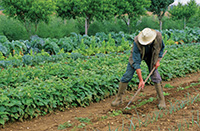
A holistic approach
Start with restoring and maintaining balance in the ecosystem. Develop strategies for preventing weeds and for controlling the ones that pop up anyway. An obvious point is to avoid adding new kinds of weeds to any part of your fields. Remove the hitchhikers from your socks out on the driveway instead of when you notice them as you squat to transplant onions. We use our driveway as a convenient place to “roadkill” particularly bad weeds by letting them die in the sun. Beware of Trojan plant swaps!
Weeds are not a monolithic enemy, but a diverse cast of characters. Applying biological principles is not an attitude of war, but more like ju-jitsu, using the weaknesses of the weeds to contribute to their downfall. Develop an understanding of weeds and the different types: annual, perennial, stationary perennials, invasive perennials, cool weather or warm weather, quick-maturing or slow-maturing.
One factor to consider is how vulnerable the crop is to damage from that weed at that time. Weeds that germinate at the same time as a vegetable crop usually do not really affect the crop’s growth until they become large enough to begin competing for moisture and nutrients. These early weeds have the greatest potential for reducing crop yields if allowed to grow unchecked. We need to cultivate or otherwise control weeds before this 2-3 week grace period is over.
The critical period for weed control for the crop is the interval from the end of the initial grace period until the end of the minimum weed-free period, which is approximately the first third to one half of the crop’s life. For vigorous crops like tomato, squash and transplanted brassicas this is four to six weeks. Less vigorous crops like onion or carrot need weed-free conditions for eight weeks or more. During that time it is essential to control weeds to prevent loss of yield.
Weeds that emerge later have less effect, and ones that emerge quite late in the crop cycle no longer affect the yield of that crop, although there are long-term reasons for removing weeds to improve future crops.
Know your weeds
Learn to identify the major weeds on your farm, and any minor ones that suggest trouble later. Observe and research. Start a Weed Log with a page for each weed. Add information about your quarry’s likes and dislikes, habits and possible weak spots. Find out how long the seeds can remain viable under various conditions, and whether there are any dormancy requirements. Note when it emerges. If it’s an annual, how soon does it form viable seed? If it’s perennial, when are the roots easiest or hardest to remove from the soil? What time of year does it predominate? Which plots and which crops have the worst trouble with this weed? Monitor regularly throughout the year, each year. Look back over your records and see if anything you did or didn’t do seems to have made the problem worse or better.
Next, think about any vulnerable points in the weed’s growth habit, life cycle, and responses to crops or weather that could provide opportunities for prevention or control. List some promising management options. Try them, record your results, decide what to continue or what to try next. Most weeds respond well to nutrients, especially nitrogen. If you give corn too much nitrogen, even as compost, the corn productivity will max out and the weeds will use the remaining nutrients. Some crops, like carrots and onions, never cast much shade at any point of their growth, so that sun-loving weeds like purslane are more likely to thrive there, but not be a problem for crops which rapidly form canopies that shade the ground.
A few weeds, such as giant ragweed, emerge only during a three-week interval, while others, such as pigweed and velvetleaf, can germinate during a two-month period, if temperatures are warm enough. Galinsoga seeds are short-lived and germinate only near the soil surface, but velvetleaf seeds can lie dormant for years deep in the subsoil, and germinate whenever they get brought close to the surface. Clearly, different strategies work best with different weeds.
Red Root Pigweed is a “Big Bang” weed. The plant grows for a long time, and then all its seeds ripen at once, as the plant starts to die. Most seeds come from a few large plants. Pigweed-monsters that mature late in summer can shed 400,000 seeds! Pulling the largest 10 percent of the weeds can reduce seed production by 90 percent or better. We used to ignore pigweed growing in our sweet corn, once it escaped two cultivations, believing anything that big must already have done damage. Now we pull while harvesting. Some pigweeds are as tall as the corn, but most don’t have mature seed heads. Since starting to do this a few years ago, we have noticed a considerable drop-off in the number of pigweeds we have to deal with. This is different from the “Seed Dribblers” like galinsoga. Seeds mature on galinsoga while the plants are still quite small, shed some seeds, make some more, and can carry on for a long seed-shedding season.
Another useful piece of information is that a constant percentage of the seeds that are still left from one year’s shedding dies each year. This varies widely among species. For lambsquarters it’s 31 percent per year in cultivated soil (only 8 percent in uncultivated soil). The number of seeds declines rapidly at first, but a few seeds persist for a long time.
While seeds survive better deeper in the soil, they don’t germinate better down there. Larger seeds can germinate at deeper levels than small seeds. If you are trying to bury seeds deep, use inversion tillage, don’t rely on rotavating because seeds somehow manage to stay near the surface with rotary tilling. Chuck Mohler (see resources below) has tested this out with colored beads.
Most of the weeds in cultivated soils are annuals, but some of the worst ones are perennials. They can be either stationary (tap-rooted) perennials like docks and dandelions, or wandering/invasive perennials with tubers, rhizomes or bulbs (Bermuda grass, quackgrass). Stationary perennials in their first year act like biennials. They have leaves and roots, but no flowers or seeds. In annually tilled areas, they get killed in year one and don’t often establish. Wandering perennials are a more difficult problem, and understanding apical dominance is important in tackling them.
Prevention of germination
Preventing seed production is an important strategy. Extreme energy might be needed to apply this across your whole farm. However, in a hoophouse, the improvement is obvious. It is possible to reduce weed seed banks to 5 percent of their original levels when weeds are not allowed to produce seeds for five consecutive years.
Any technique that helps fill the growing space and the growing season continuously with thriving crops will leave less opportunity for weeds. Options include:
• good soil fertility, which helps the plant canopy to close quickly, out-shading and out-competing weeds;
• growing vigorous crops by providing the right soil conditions, row cover or shadecloth if needed;
• choosing locally adapted varieties, with good disease and pest tolerance;
• close crop spacing, leaving less space for weeds;
• using transplants, rather than direct sowing, to give the crop a head start;
• drip irrigation rather than overhead watering, leaving aisles relatively dry and inhospitable;
• interplanting or relay cropping where one crop or cover crop is planted in the spaces between the standing crop before it is finished;
• rapid succession planting where one crop is planted immediately after the previous one is pulled or turned under;
• prompt planting after cultivation, which gives the crop the most advantage over sprouting weeds. Previously, I had not realized how much difference it can make to plant immediately after cultivation rather than two or three days later. With large areas, if we end up needing to wait before planting (sweet corn for example), we’ll scuffle hoe along the planting rows just before planting, knowing that we can till weeds between the rows more easily than we can in the rows.
• the use of Stick Seeders or Easy-Plant Jab Planters to sow large crop seeds into a seedbed that has already had the weeds removed (by flaming or stale seed bed technique) avoids bringing new weed seeds to the surface;
• mulches, especially for slow-growing or vertical crops such as garlic, which have a poorer chance against broad-leaved weeds;
• cover crops filling the space when food crops don’t, and in some cases, exuding compounds which inhibit germination of small-seeded weeds;
• using no-till cover crops, grown to maturity (heading/flowering) then rolled or mowed to create an in-situ mulch. The vegetable crop is planted into this mulch, reducing new weed seed brought close enough to the surface to sprout;
• reduced tillage/strip tillage, which also reduces the new weed seed brought to the surface;
• crop rotations that switch between spring and summer crops, so that cultivation takes place at different times of year.
Reduction of weed seeding
It’s not always possible to prevent weeds from germinating, so the next step with annual weeds is to prevent them from seeding. This can be done by flaming to kill new weeds; mowing weeds before they flower; grazing by cattle, chicken tractors or goslings, (if you are not prevented by Organic rules). Timely cultivation, when the soil is dry enough, and the weather warm and/or breezy, can kill weeds by the millions. Additionally, the loosened soil is not conducive to more seed germinating.
Precision cultivation and close in-row spacing means that most of the weeds will be between the rows, easily wiped out by cultivation, rather than between plants in the row, where they are harder to remove.
Reducing weed seed viability
Most weed emergence happens within two years of the seeds being shed. Not all seeds that are produced will ever get to germinate (I was very pleased to learn that seeds have many ways of not succeeding!) You can help reduce their chances with these strategies:
• Farmscaping: plant habitat areas to encourage seed eating birds, insects, earthworms, mice;
• Grow a healthy soil, with abundant soil micro-organisms to keep the biological activity high. This can give vegetable crops which benefit from mycorrhizal fungi (legumes, alliums, and nightshades), an advantage over some of the weeds, (such as lambsquarters, pigweeds, smartweeds, nutsedges).
• Mow the crop immediately after harvest, (to prevent more weed seed formation), then wait before tilling to allow time for seed predators to eat weed seeds that already produced. Seeds lying on or near the soil surface are more likely to deteriorate or become food for seed predators than buried seeds, so delaying tillage generally reduces the number of seeds added to the long-term seed bank. (Short-term, they may germinate!)
• If they do not get eaten, dry out or rot, seeds on top of the soil are more likely to germinate than are most buried seeds, but longer-lived seeds like pigweed, lambsquarters, and velvetleaf, if buried, may remain viable and dormant in cold dark storage for years, and any tillage during that time can bring them back to the surface, where they rapidly germinate and grow. On the other hand, small, short-lived seeds of weeds which have no dormancy period, such as galinsoga, will almost all die within a year or two if they are buried a few inches.
• Stale seed bed techniques draw down the “wealth” of the seed bank in the soil. Beds are prepared ahead of time, and watered, perhaps even rowcovered, to germinate a flush of weeds, which are then removed by shallow cultivation or by flaming.
• Soil solarization can be used in hot weather for particularly difficult weeds: the soil is cultivated, watered, then covered tightly with clear plastic sheeting for one-two months. This kills anything in the top layer of soil that is unable to move out of the way. Solarization can also be combined with certain cover crops, to provide biofumigation. Allelopathic crops, such as brassicas, rye or sorghum–sudan are grown to full size, mowed green, tilled in, then the soil is covered with plastic. The combination of the heat and allelopathic compounds from the rapidly decomposing cover crop can kill weed seeds, pests, and pathogens.
Reducing strength of perennial roots
When a rhizome grows a shoot, chemicals from that shoot prevent other nodes from sending up shoots. This is called apical dominance. These chemical messages get weaker over distance, so that after a certain length of rhizome, the dominance effect is too weak and another node can grow a shoot. When rhizomes are cut into little pieces during tillage, the apical dominance is lost, and each piece can grow a shoot. This is not necessarily as disastrous as it sounds, because these are small, weak plants, with only a small rhizome piece sending nutrients up. The danger is in walking away at this point and leaving them to grow. If we cultivate again before the new shoots have grown enough to be sending energy back to the roots, or manually pull out the pieces to dry out on the surface, the depleted pieces of root may die. Even simply removing top growth, whenever the weeds reach the three to four leaf stage can be quite effective in further weakening invasive perennial weeds. This may need to be done several times at three or four week intervals to knock out a bad infestation. For quackgrass the three leaf stage is the time to act. It’s more effective to wait each time until the new top growth has drawn down the reserves in the roots, before hoeing or pulling, than to go almost daily after every sprig. Thickly planting buckwheat or other smothering cover crops immediately after tilling helps put extra pressure on the weed, and can reduce tilling passes.
Putting it together: two examples
Galinsoga can be a troublesome weed for vegetable growers, as it can produce seeds in as few as 30–40 days after emergence, and the seed has no dormancy period – it sprouts after the next cultivation. Fortunately, the seeds are short-lived, and have to be in the top 0.25”of the soil to germinate. Strategies for controlling galinsoga include:
• Inversion tillage such as moldboard plowing. The seeds will die off deep in the soil within a year or so.
• Mulching – the seeds will not germinate or be able to grow through the mulch, and will be dead by next year. Be sure to rotate the mulched crops around the farm.
• No-till cover crops, with summer crops transplanted into the dying mulch;
• Stale seed bed techniques, including flaming.
Nutsedge is a wandering perennial. Most of the seeds are sterile, so they are a distraction, not the main threat. Those seeds which are viable can persist for 3-4 years deep in the soil, but if they are near the surface they germinate or die within three years. The tubers or the rhizomes in late summer are the main source of new plants. Tubers need a month of cold dormancy before they start spring growth. Strategies include:
• Tillage in late spring and early summer after the tubers have sprouted but before new tubers (or daughter plants from rhizomes) have formed. Repeated cultivations are needed, and this can work with a late spring/early summer crop that needs frequent cultivation, such as sweet corn.
• Plant crops which finish in early summer, and follow by deep tillage to disrupt tuber formation, which mostly occurs in late summer.
• Good soil fertility and dense plantings of crops which can over-shadow and out-compete the nutsedge may work. Nutsedge is not very responsive to soil fertility.
• Sweet potatoes can suppress the growth of nutsedge, by releasing of growth-inhibiting substances (allelopathy). Allelopathic cover crops such as rye and sorghum-sudangrass could be used if the area can be (needs to be?) taken out of crop production.
• Ducks or pigs are the action of last resort for organic growers.
Resources
Information about Sustainable Weed Management is springing up like you-know-what:
• eOrganic, www.eXtension.org Weed management is at http://www.extension.org/article/19642.
• ATTRA has a 2003 publication, Principles of Sustainable Weed Management for Croplands, http://www.attra.org/attra-pub/weed.html Why weeds grow, how to take a proactive approach (prevention) rather than reacting after the arrival of the weeds.
• The University of Maine has started work on a series of fact sheets about specific weeds. The first is Quackgrass. http://www.umaine.edu/weedecology/weed-management/
• Center For Environmental Farming Systems (CEFS) Weed Management on Organic Farms: Cultivation Practices for Organic Crops (34 pages) http://www.cefs.ncsu.edu/resources/organicproductionguide/weedmgmtjan808accessible.pdf
• Manage Weeds on Your Farm: A Guide to Ecological Strategies by Charles Mohler. and A. Ditommaso, to be published by Sustainable Agriculture Research and Education (SARE). This book will likely become the classic go-to book on the subject. I went to a workshop by Chuck Mohler, and found it very inspiring and informative. He includes profiles of many, many weeds.
•http://www.mosesorganic.org/attachments/research/10forum_weeds.pdf A wonderful 55 page document based on pictures and charts (see the earthworm snag the weed seed on page 52!)
Pam Dawling is garden manager at Twin Oaks Community in Louisa, Virginia.
Copyright Growing For Market Magazine.
All rights reserved. No portion of this article may be copied
in any manner for use other than by the subscriber without
permission from the publisher.