











Two Wisconsin cheeseheads visit veg farms part two
You’re back again for part two of our tale of Japanese vegetables! Seeing as how it’s the ragged end of the growing season, I’ve got to imagine your patience is wearing thin — so I’ll jump right in.
Paul and I left the Osaka area headed by bullet train to the south island of Kyushu. Because of its milder climate and expanses of flat land (at a premium in mountainous Japan), Kyushu is a hub of vegetable production. On the way, we stopped in Hiroshima to pay our respects at the site of the atomic bombing. I won’t linger on our experience there since it is not farming-related, except to say that visiting the exact place where the bomb detonated, hearing from survivors, and learning at the museum was a solemn experience that gave Paul and me a fuller experience of our identity as Americans and humans.
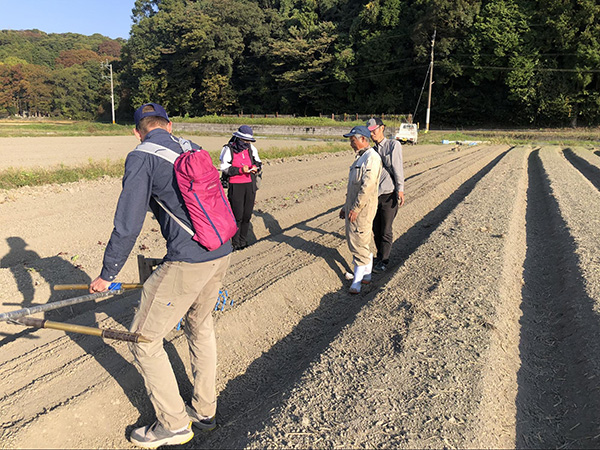
Paul using the Hawking tool on raised beds of newly planted spinach (which has not yet emerged) under the tutelage of Faruno-san, with Shinya behind him and a reporter taking notes.
The bullet train took us Southward to Kyushu. Outside the city of Kagoshima we rented a mini camper van that would be our home for the next week. I will take just a moment to note the joys of traveling with a good friend. In the months leading up to our trip, Paul and I wondered if we would get into a fight in Japan. Though after ten years of friendship we had not, surely three weeks in a foreign country would bring out the worst in us.
We never did end up in words of anger. We tended to laugh at difficult situations rather than getting riled up. I did get close though. We were driving on the narrow, winding mountain roads of volcano-studded Kyushu Island, with sheer drop-offs here and there, when Paul asked if we could take a detour past a sign that as best we could tell said “No turn-around, Do Not Enter.” I wanted to be the cool and flexible traveling companion, so I said sure. Ahead we went and the road got windier and as we got higher into the clouds the GPS faded away.
Recall that Japanese people drive on the left side of the road, so we were not in our element. I was very worried about tumbling over the side, but Paul was relishing the ‘fun’ driving experience. As we got more lost with each turn Paul could sense my temper rising, but his reaction was to laugh at my frustration — what a guy.
Boy, it was hard to remain an adult, but I held it together … barely. We ended up being rewarded for our circuitous route by finding a mushroom farm hidden in the forest and a mountain Onsen (a natural hot spring, and associated bathing facilities and inns surrounding them). It was so secluded and classy that we felt like James Bond celebrating at the end of an escapade.
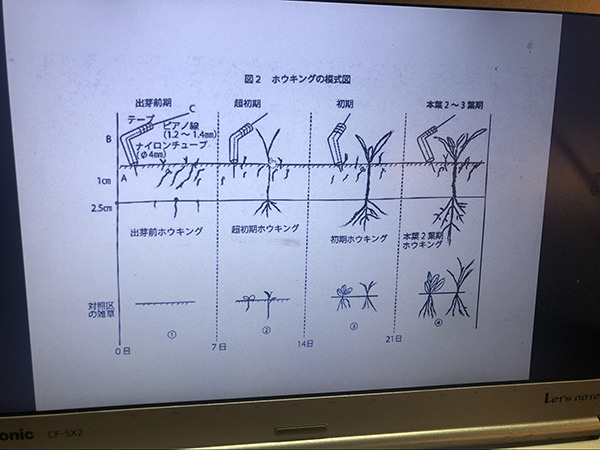
Screenshot from a presentation Faruno-san showed us in his kitchen, showing the relationship between crop canopy size, crop root size, weed seed depth in the soil profile, weed size, and time. You can see the importance of killing weeds that have germinated but not yet emerged.
Outside of Kagoshima city we met with Shinya Mimura. An American farmer had introduced us to him. Shinya was passionate about sustainable agriculture, knew many farmers on the island, and spoke English thanks to attending the University of Missouri. He would be our guide through most of the island, introducing us to many farmers, explaining Japanese agriculture, and having fun. First, we went to visit the Duck-Rice King.
Have you ever met a rockstar farmer? Fame brings a high profile, but it is grounding to meet these people in person and get to know them and their farming methods. Takao Faruno, or Faruno-san, is known as the originator of duck-rice farming, a method whereby ducks are raised along with transplanted rice. Through many synergies the rice is kept weeded and fertilized by the ducks, and the farmer reaps a harvest of both rice and ducks. Although Faruno-san is famous all over the world for this technique that he has perfected and has served as an apostle, we were not visiting him to learn about duck-rice.
Like most Japanese farmers Faruno-san grows rice, and like many rice farmers he grows vegetables in rotation with his rice. He cultivates the 32 acres on which he was raised with his wife and son’s families. Faruno-san sells his rice, ducks, and vegetables to a consumer buyers-club, but more on that later.
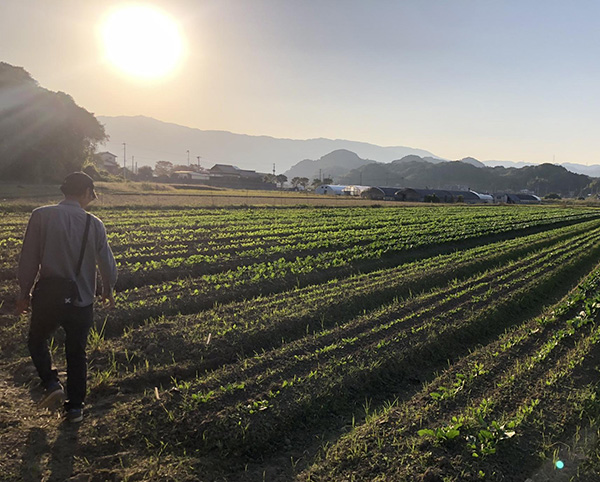
Shinya walking past raised beds of Faruno-san’s spinach. A good reminder that weeds aren’t problematic unless they compete with harvest, hinder harvest, or drop seed. This bed-height and spacing of raised beds was ubiquitous for vegetables in Japan.
As an organic farmer, weeds have always bedeviled Faruno-san, and because of this he was inspired to invent a weeding tool, which he calls “Hawking” in reference to the Japanese word for sweeping. His Hawking tool is a hand-drawn tine weeder. We have this type of weeding tool available in America, sold by companies like Two Bad Cats and Johnny’s, but Faruno-san’s tool takes tine-weeding by hand to another level.
The Hawking tool has five to eight rows of tines depending on the model, so that much more disturbance happens in a single pass. Each gang of tines is turned at a slight angle away from the row in order to be more aggressive. And the tine tips are sheathed in plastic tubing or just blue painter’s tape so that the tines do not damage the crop stem.
Faruno-san has three models or sizes of Hawking tools: small (with small diameter tines for the earliest growth stages); medium (with medium diameter tines for more established crops); and large (for larger crops and larger weeds). Faruno-san is a joyous man and our time with him was both serious, because farming is his life-long profession, and fun, because he loves farming. He named the largest model of his Hawking tool ‘Hitman’ — “Because no weed escapes the hit man!”
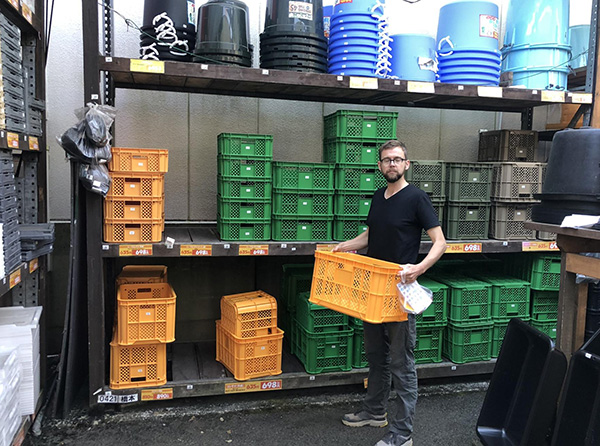
Paul inspecting the harvest totes at Handsman – the Home Depot equivalent in Japan.
Faruno-san loves farming and spends a great deal of his time helping other farmers all around Asia. He very much wants to share his Hawking tool and insisted that we share it with farmers in the United States. Paul and I took detailed measurements and made simple sketches – if you want more information about making your own Hawking tool please write me.
Faruno-san spent a few hours in his vegetable fields with us showing us his Hawking tools, asking for our experience of weeding, and sharing his insights of a lifetime spent organic farming. He also invited us into his home, where his wife treated us to an incredible dinner, and the beer he poured us seemed to help our communication.
Over a dinner in the farmhouse kitchen that stretched long into the night, Faruno-san shared many interesting perspectives. In describing the small weeds that tine-weeding can kill, he said: “The problem is our human perspective. We need to focus on the weeds we cannot see and not on the weeds we can see. The critical matter of weeding is the first weed.”
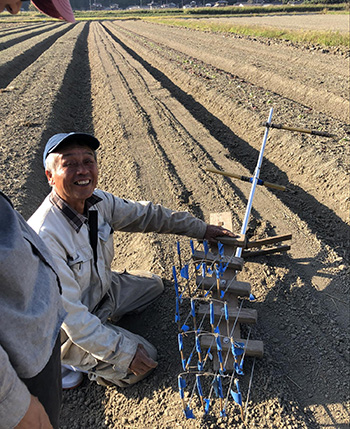
Faruno-san radiated so much joy in farming! Note the five rows of tines.
When I asked him about mounting his Hawking tool on a tractor for faster weeding, he replied, “It is important to start all cultivation with hand tools so that you have a feeling for what should happen, then later you can apply the machine to weeding.” He then followed that up with a wry smile and added: “I enjoy farming, I don’t need ‘smart ag’ to shorten the time that I can farm. We don’t have robots play our sports for us because we enjoy playing sports.”
In the morning Faruno-san spoke with us over breakfast, but then abruptly took his leave as there were more fields that needed Hawking. “I like Hawking so much that sometimes I stay out in the fields Hawking and don’t come home for dinner,” he said. “I think my wife may be jealous of my Hawking!” His wife smiled. She must be well-accustomed to his shenanigans.
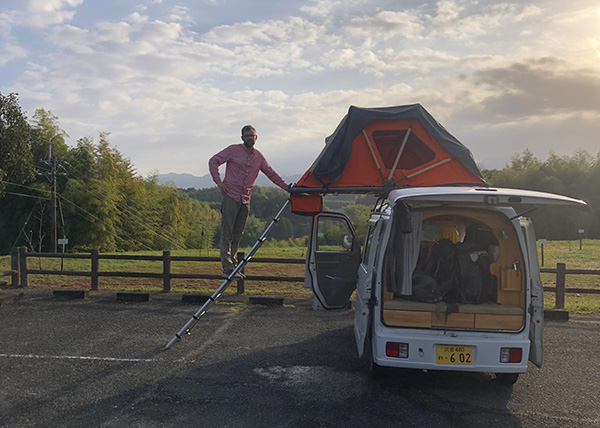
Paul getting ready to pack up our camper-van in the morning.
We thanked Faruno-san profusely and headed off in our mini camper van farther into the Japanese countryside. As we drove along we saw a level of community-commercial horticulture unknown to us in the United States. In many front yards and scraps of land between roads and buildings, people were growing food. No mere home gardens — they used intensive spacing, intercropping, row cover, black plastic, raised beds, trellis, and other cultural practices that denoted horticultural skill.
In addition, whereas in the United States, most of us need to order horticulture supplies from specialist companies, supplies are easily available in Japan. The Home Depot-type stores sold myriad supplies for small-scale commercial production: things like plastic harvest totes, black-plastic with pre-punched holes, hardware for high-tunnels, packaging, etc.
The retail availability of horticulture growing and packaging supplies was coupled with a wide proliferation of farmers-market stores to sell to. Called ‘michi-noiki’ these are independently owned farm markets, open and staffed for regular business hours. Part-time farmers can sell their produce to these markets, usually at a price of the farmer’s choosing. The grading standards are not too stringent.
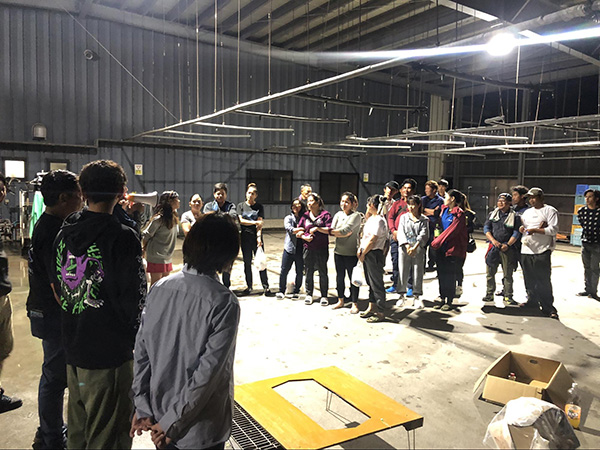
The farm crew at Osaki farm saying goodnight after the barbeque. All photos courtesy of the author.
The michi-noiki store takes a 15 to 20 percent cut of the selling price. We stopped at several michi-noiki. They were well-trafficked, and it was fun to buy the special cultivars of each region. It was clear from the consumers there that they valued high-quality fresh produce of regional-favorite cultivars.
Each night we would find a mostly legal place to park our van, and in the morning we would find a gas station to have a breakfast of coffee, rice, and steam buns. A few days after leaving Faruno-san, Shinya took the train and met us farther south near the city of Kagoshima at the tip of the island. Here we met Fukunaga-san, another duck-rice farmer who had grown up on the land that had been in his family for 250 years. Shinya and Fukunaga-san had met in Japan’s duck-rice farming group. While Shinya was young, Fukunaga-san was older, and we learned that their relationship highlighted Japan’s rural and agricultural situation.
Japan is seeing the rural areas empty as young people flock to the mega-cities. This is very hard on rural society, as shown in the abandoned fields and houses we saw. Many younger farmers come from the city, and in addition to learning agriculture they also need to become enmeshed in a new rural culture.
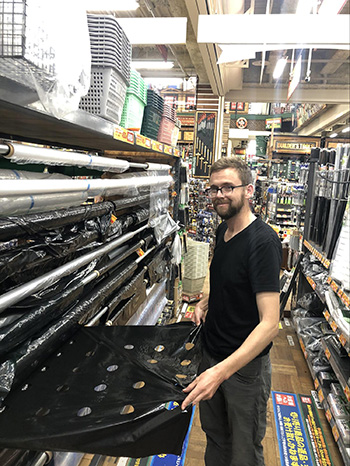
Paul inspecting the plastic section at the hardware store.
Shinya showed us how the situation presented obvious problems and some opportunities; on the one hand he was the youngest helper in his neighborhood’s persimmon-drying cooperative by 30 years, but on the other hand older farmers like Fukunaga-san were excited to mentor him. Also, older residents are willing to rent land for free and sell machinery cheaply so that the agricultural landscape continues to be cultivated.
Although we could only communicate through Shinya’s interpretation, Fukunaga-san was very kind. In the evening we enjoyed dinner, beer, and then onsen. He invited us to park our van at his homestead for the night, and in the morning he accompanied us to visit other farmers.
With him and Shinya we visited another duck-rice farmer, Hachiguchi-san. He grows 11 acres of rice and 2.5 acres of vegetables, and had been doing so for 50 years. While we appreciated learning about his production (he has his own cultivar of carrot that he developed through seed saving), we were more interested in his marketing. He markets through two types of direct-to-consumer groups, similar to our CSA, called Teikei. Later we would visit the Teikei packaging hub and meet the founder and manager (and a local politician who left after taking photos with us).
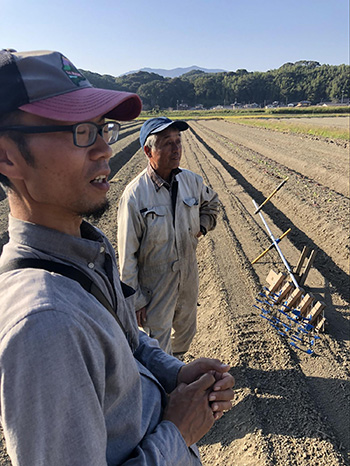
Shinya and Faruno-san (in coveralls) with the Hawking tool in beds of newly planted spinach.
The Teikei group consists of two parts: the farmer group and the consumer group. You’ll see how the consumer group plays a much more active role than in our CSA’s. The farmers are responsible for delivering their bulk product to the Teikei hub. Farmers arrive on packing day to deliver and package all of the produce together with the manager prior to delivery, and they usually share a meal after.
The manager also writes the newsletter to communicate with consumers, takes payment, and promotes the Teikei to find new members. The Teikei charges consumers a one-time membership fee and a monthly processing fee. Members can pause purchases anytime and start up again anytime. The manager writes two newsletters per week with the offerings, recipes, and farm updates.
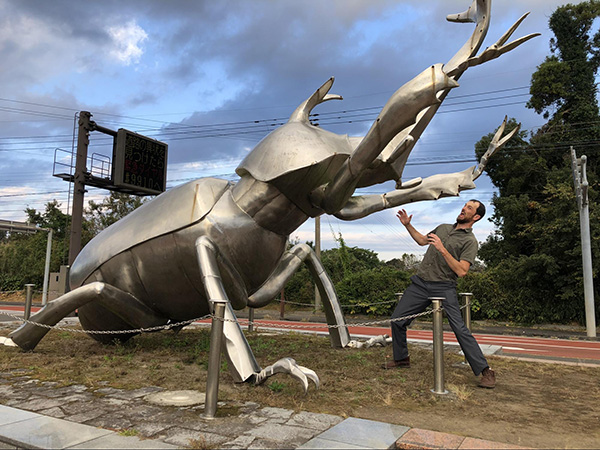
Japan presented new types of megafauna.
In their bag members receive five to seven vegetables with other add-ons like rice. Members come to the Teikei building to pick up their bags, and some also distribute the shares to others in their own cars, and are paid a small fee for delivering. The Teikei that we visited is 30 years old and has 250 members. The manager works two-days per week. The Teikei takes 20 percent of sales for its costs (building, cooler, computer, manager wages, etc.). The Teikei sources from ten farmers.
In addition to selling to the Teikei group in nearby Kagoshima city, Hachiguchi-san also runs a Teikei group from his farm with sixteen area farmers. Members pick-up on his farm or get a home delivery. Once per year the 16 farmers in his Teikei meet with the representatives of the consumer group to decide what produce they want from the farmers as well as other details like quantities and deliveries.
Twice per year the farmer group meets to decide who will grow what quantities of the crops requested by the Teikei. “How do you communicate quality standards to the growers?” I asked. I loved his answer: “At our meetings farmers bring samples of their crops and we all judge who has the best quality. You know, some person’s soil is better suited to clean carrots or someone else grows tastier tomatoes. We have a saying: you see the vegetable, you set the standard.”
You can see that even though we traveled to Japan in search of advanced machinery, the people we met made the biggest impact on us. We did make sure to see machinery though. In southern Kyushu we connected with Osaki farm, a large grower (several hundred acres) of mainly daikon radish. Owner-manager Nakayama-san was kind enough to give us a tour, and again somehow we were able to communicate through bits of English, hand gestures, Google Translate, and our shared love of agriculture.
Osaki farm was very much a conventional farm with large machines to cover lots of acres, and a large foreign-born workforce for field work and the packing shed. Notable equipment was a plastic layer that was synced with an attached seeder so that daikon radish seeds were planted to line-up with the holes pre-punched in the plastic.
Nakayama-san preferred rotary-harrows to rototillers because they could be run at faster speeds and required less fuel. But again, the people made a bigger impression. After touring the farm he invited us to return in the evening as he was hosting a barbecue for the entire 70-person farm crew to kick off the busy season.
We left to do laundry and take an onsen, and when we returned the docking area was full of hibachi grills, each one surrounded with groups of people grilling stacks of meat. We also were insistently invited to dip into the barrels full of ice and beer. Many of the Filipino workers spoke more English, and we enjoyed talking with them. They were taking turns singing karaoke. We found out that Nakayama-san’s favorite song is “Hotel California,” and because Americans are generally thought to be cool in Japan, our rendition was greeted with a lot more enthusiasm than we deserved.
Paul and I did try hard to connect with the Kubota company to convince them to sell their technologically-advanced vegetable machines in the United States. But they were not interested for a variety of agronomic and cultural reasons. We would like to continue working with them to achieve that goal, and generally to make appropriate Japanese vegetable machinery available here.
But we understand that this will be a longer process, best involving Japanese companies, US machinery suppliers, and government support and research. We have begun these conversations, but if you are interested in helping, trialing tools, applying for grants, and moving this forward, Paul and I would be happy to hear from you. Thank you for letting us share our fun and special trip with you. I wish you a nice end to your growing season.
Sam Oschwald Tilton helps farmers improve their weed management and machinery systems and works with technical support groups to develop educational resources, through his business Glacial Drift Enterprises. Sam lives in Minneapolis and enjoys gardening with the neighborhood. If you want to talk to Sam about Japanese agriculture or anything else please email him glacialdrift@protonmail.com.
Paul Huber is the Farm Director at Troy Farm in Madison, Wisconsin, where he trains new farmers, fosters community connections and collaborations, and helps grow food for the surrounding community.
Copyright Growing For Market Magazine.
All rights reserved. No portion of this article may be copied
in any manner for use other than by the subscriber without
permission from the publisher.