











Managing soil health and fertility organically is one of the most challenging and exciting aspects of organic farming. There is no single right method, and our process has evolved over time. How we each approach this depends on our climate, soil type, labor, philosophy, and available resources.
We are an organic vegetable farm in the Ozarks of eastern Oklahoma with approximately two acres in cultivation and two fallow in a cover crop each season. We get some much-loved help for harvesting, but we are primarily a two-person farm and have built our systems to accommodate that.
When we bought our own land in 2006, the field soil test showed six pounds of nitrogen to the acre. Our fertility options were limited. There was no source of compost within an hour and a half haul. The only manure was from the region’s poultry houses.
We had always cover cropped with a goal of minimizing use of extractive inputs, but we needed to plant our first veggies in five months. So, since it was available and effective, we applied chicken manure to our entire field for the first two years. Then, we divided the field into two plots and alternated applying litter to every other field the next seven years.
During that time, we worked to develop our cover crop program and examined soil test results on the field not receiving litter each year. As our fertility increased through litter and cover cropping, we began thinking about how our farm could manage without the chicken manure.
Although it helped build our fertility, we always had reservations about using chicken litter. By its nature, almost any off-farm manure in truckload quantities comes from Confined Animal Feeding Operations (CAFOs). CAFOs produce industrial levels of manure, a waste product for them.
Chicken litter in particular has high levels of phosphorus, more than plants need. Over time, phosphorus build-up and leaching in the soil can become a problem for crops and watersheds. We also have concerns over residues in manure from feed additives and pharmaceuticals.
We decided to stop applying chicken litter altogether in 2016. Since then, we have gone through six successful growing seasons with no manure of any kind. Chicken litter served as a one-stop-shop for liming, NPK, and to some extent, micronutrients. When we stopped using litter, we looked at our soil test results with new eyes for what might be missing.
We started applying lime (to adjust pH since we have naturally acidic soil), sea minerals (for micronutrients), and organic fertilizer mixes (for N and K, P was already adequate to high from the chicken litter). Yet, we were back to depending on CAFO production for the feather, blood, and or bone meals found in the fertilizer mixes, and still importing nitrogen to the farm.
Focusing on on-farm fertility took on a new meaning during the 2018 growing season when our region was invaded by a new wave of chicken CAFOs. The latest chicken “barns” were enormous, raising 1.5 million birds per farm per year. Dozens of these farms emerged nearby.
In our involvement with the fight to protect our local communities and environment, we realized we no longer wanted any of our fertility to come from the CAFO industry. That means no manure, no compost with CAFO manure, and no feather, bone, or blood meals as CAFO byproducts.
We previously used kelp and fish meal at transplanting or occasionally in the field or high tunnels during cold snaps. We have also stopped using this input because just as we don’t want to utilize CAFO byproducts, we don’t want to tap marine resources for our fertility. Not all fish fertilizers are byproducts of human consumption, and seaweed and kelp are foundation species for marine ecology. We see no impact on transplanting or early growth success.
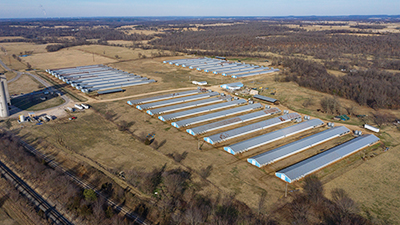 A photo of one of the enormous chicken facilities in the author’s area whose manure they are trying to avoid using. Photo by Midwest Drone Productions.
We are now starting our fourth season of no animal fertilizers of any kind. Since 2019, aside from potting soil, municipal food waste compost for our two high tunnels, and cover crop seed, our only off-farm nitrogen input has been a pelleted organic soybean meal side-dressed on a few long-term crops. This totals a few hundred pounds per year. Every few years we add lime or gypsum, as indicated by our soil test results.
Using cover crops for the majority of our farm’s fertility has been a long-term project and is still a work in progress. Cover crops provide soil cover, nitrogen, biomass, and disease and pest control. They are equally effective as smother crops, eliminating perennial grasses and preventing annual broadleaf weed germination. We plant them with the tractor, so they are a good fit for our labor situation. We can plant our fields in an afternoon.
We have two different cover crop programs: fall/winter and summer. Over the past 18 seasons, we have gone from planting single crop rye in fall/winter and cowpea and foxtail millet in summer to planting as many different species as we can in each mix to increase soil biodiversity.
Fall and winter cover crop mix
The fall/winter mix is planted over our entire four acre growing area. It includes oats, clover, hairy vetch, tillage radish, and Kodiak mustard. We end our marketing season early in September to have time to get a good cover crop established.
Ideally, we plant it in mid-September, though some years it doesn’t get planted until early October. But every week in planting delay represents a substantial decrease in growth. We want as much growth before cold temperatures and reduced daylight retard plant development.
Typically, we start seeing winter die-off when temperatures are below 15°F. However, if we have had plenty of nights in the 20s, the plants are properly hardened off and can often stay green below 15°F.
The oats provide quick growing biomass, winter kill, and are easy to incorporate in spring. We don’t want a stubborn grain that becomes a problem when trying to plant in the spring or that could potentially go to seed. Tillage radish aerates soil and scavenges nutrients. Kodiak mustard shows promise for wire worm control and is also fast growing for early establishment.
We find vetch the best legume to survive our winters. It is slow growing in the fall but quickly takes off in the spring. It is an excellent smother crop and is our main source of nitrogen. The clover understory does well in spring and grows once the vetch is done; it can handle hotter temperatures.
Summer cover crop mix
The summer cover crop is planted on the spring vegetable field once those crops are finished, usually the beginning of July. We are trying to harvest as much heat and sun as possible at that time of year, so we have selected the mix for maximum biomass. It includes sorghum Sudan grass, sunn hemp, sunflowers, soybeans, cowpeas, and safflower. It rotates with our cash crop rotations.
Sorghum Sudan grass is extremely tall, produces amazing biomass, and is good at smothering out weeds. Sunn hemp fixes nitrogen and adds biomass. Sunflower is heat tolerant, native, and adds to the plant architecture. Soybeans and cowpeas are quick growing, drought tolerant, and fix nitrogen. The safflower provides diversity. Every plant brings more biodiversity of soil bacteria and fosters unique biological activity.
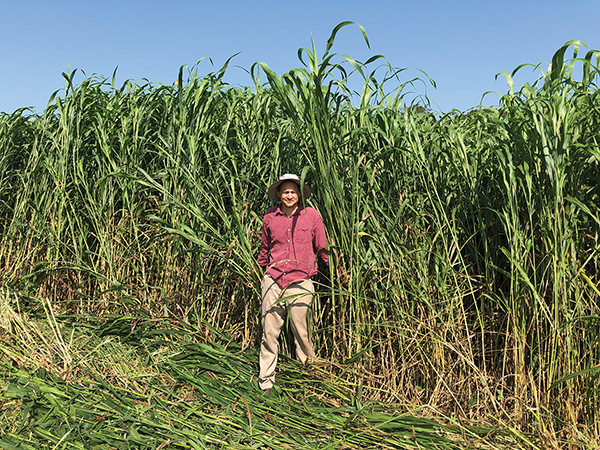 The author’s summer cover crop including sorghum Sudan grass, sunn hemp, sunflowers, soybeans, cowpeas, and safflower. Image courtesy of the author.
To plant the cover crop, we use a 1940s John Deere grain drill purchased for $400. We highly recommend drills over broadcasting as the drill allows planting into moisture. When drilling into moisture, the soil doesn’t need to be tilled as aggressively to incorporate the previous cash or cover crop, and we can worry less about rain forecasts.
We like to use a flail mower to terminate the cover crop, though we have used a brush hog when the summer cover crop becomes a vegetative jungle. If mowed strategically before flowering or tillering, cover crops can be cut high to get a second or even third flush of growth.
After the summer cover crop is done, we mow it and then disc or rototill it in, depending upon soil moisture, heat, and the decomposition of the cover crop after mowing. We can generally plant the fall cover crop right into the summer cover crop residue.
For spring planting, we mow passes and incorporate the winter cover crop as we need planting beds. So, we only till the area we will be immediately seeding or transplanting and leave the remainder in cover. In early spring it takes two to three weeks before the winter cover crop has dried down enough after mowing to plant the cash crops. Later in spring when soil temperatures warm, it can take as little as a day or two.
The tradeoff with cover crops is they require tillage to incorporate their organic matter. There is so much biomass from our often 8-to-10-foot-tall summer cover crops that it is impossible for us to seed the winter cover crop without tillage first. A no-till drill would remedy that and is something we are exploring.
Cover crops have given us major improvements in productivity, soil tilth, and weed and disease pressure. The jury is still out about the feasibility of using them for the majority of a farm’s fertility needs, but conservatively, we can grow 10,000 pounds of dry matter per acre through summer and winter cover crops. By growing it, we aren’t trying to haul that in as compost. And, we have seen soil test results demonstrate the high levels of nitrogen fixation we are achieving through the legumes in the mix.
Dropping use of chicken litter was, in some respects, a leap of faith. We already knew that applying litter only every other year on a field was working just fine in terms of crop health and yield. But when we stopped the use of manure entirely, we initially relied on organic fertilizer mixes with nitrogen supplements out of concern for losing our manure nitrogen. When we decided to stop using any animal fertilizer products (like the feather meal in the organic fertilizer mix), we applied pelleted organic soybean meal to the entire field, again as a means of “weaning” off supplemental nitrogen sources.
At that point, we were still trying to use annual soil test results to tell us how much nitrogen we needed to add through outside sources. Last year was our first season to depend exclusively on the cover crops for nitrogen. We only rarely and lightly side-dressed a few select crops with pelleted soybean meal.
This transition took time, mostly to build our confidence in the process. With each step- removing manure, removing fertilizer mixes, and finally removing pelleted soybeans- we have watched our fields and harvests carefully to gauge the impact. Every year continues to be as or more profitable on the same amount of land (or less), and our crops are robust.
Now, when we look at our soil tests, we take the nitrogen results with a grain of salt. The time of year in which we take our soil test plays a huge role in the nitrogen numbers. For example, the lowest nitrogen is often associated with the field that has just come out of a year of fallow and cover crops, most likely because nitrogen is tied up in the cover crop residue.
Likewise, our fields coming right out of cash crops can sometimes show the highest levels of nitrogen- in the optimum to high range. All of this is to say that while we continue to look at soil test nitrogen as a general reference point, we find crop health and yields a more robust indicator of how the soil is faring.
We didn’t start out with a goal of growing our own fertility, but it has become as important to us as farming organically. In limiting our use of off-farm inputs, we hope to reduce our farm’s carbon footprint, build organic matter, and create fertility independence from CAFO manure and byproducts.
Emily and Mike own Three Springs Farm, a diversified, certified-organic vegetable farm in eastern Oklahoma. They cultivate over 40 different crops and more than 150 individual varieties on three acres of land and sell primarily through their CSA.
Copyright Growing For Market Magazine.
All rights reserved. No portion of this article may be copied
in any manner for use other than by the subscriber without
permission from the publisher.