











Ornamental curcuma and gloriosa lilies
We’ve invested in a lot of heated greenhouse infrastructure on our cut flower farm, Moonshot Farm in East Windsor, New Jersey. These greenhouses provide the conditions needed for deep winter production, enabling us to have fresh cut blooms from November through February, the coldest months of the year. They also provide a unique frost-free growing space to explore crops not hardy to our zone.
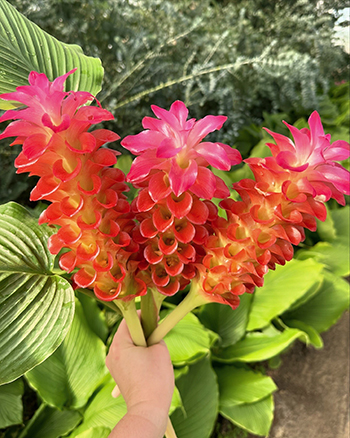
Bold red dragon curcuma sell for a high price point at our markets and offer something new compared to the sunflowers and zinnias that dominate most local summer flowers. All images courtesy of the author.
We’ve been experimenting with a few different tropical crops that would be difficult to grow as annuals without a little added heat. Exploring tropical crops is one of the ways our farm is building climate resilience. Vegetable growers have been doing this for a while, with ginger and turmeric now fairly common sights at farmers markets across the country.
In the flower world, we’re finding that cool-weather crops like tulips seem to peter out earlier each year. Summers are getting hotter. Our region was even recently reclassified as having a humid subtropical climate. So rather than stress out plants that struggle with hot temps (like dahlias), we’ve been looking for plants that won’t just survive, but thrive through extremely hot summers. Here are two we have been trying out.
Ornamental curcuma
Curcuma alismatifolia is native to tropical Thailand and a close relative of edible turmeric. Vegetable growers who have planted turmeric may occasionally see some flowers on their plants. Ornamental curcuma looks similar to these but comes in a range of bright and pastel colors. It has an excellent vase life.
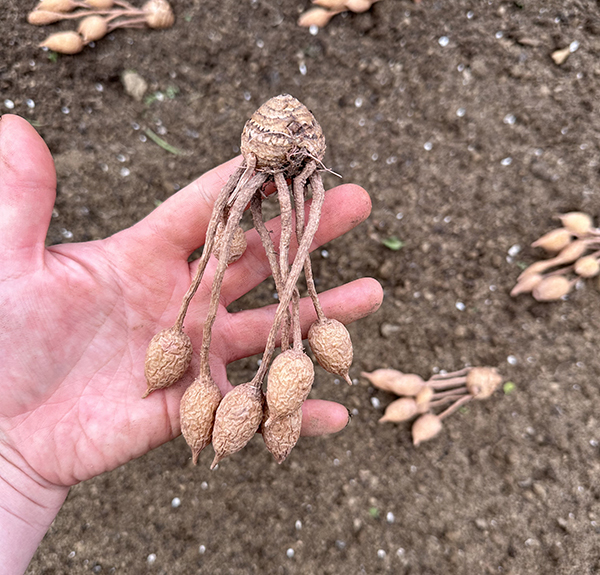
Curcuma is grown from rhizomes. We plant them around 9” apart with the dangly “balls” facing down. All photos courtesy of the author.
We started growing curcuma last year in our geothermal greenhouse where we’re really able to crank up the heat. The rhizomes proved difficult to source but have since become more readily available from a handful of U.S. suppliers. We actually imported our own directly from Thailand in a relatively complicated process (recently made more complicated by tariffs and other regulatory changes). I hope to cover this topic in a future article.
We plant the curcuma bulbs as soon as they arrive, ideally by early March. We aim to get our greenhouse pretty hot for them, at least 60°F nights and warmer during the day. Southern growers may be able to get these conditions naturally or in an unheated high tunnel space. I wouldn’t recommend curcuma for growers much north of me, as the heating costs would be substantial.
The rhizomes are a funky shape with one central root with a bunch of dangly balls. We plant the rhizomes 9 to 12 inches apart and around 1-inch deep. We have found that the soil needs to stay warm and deeply, consistently moist for the curcuma to sprout. They take a while to finally sprout, around four to five weeks.
I know some vegetable growers pre-sprout ginger and turmeric in the greenhouse with heat mats. I think this might be a good approach for ornamental curcuma, especially for growers in cooler climates. We need to weed several times before the plants are large enough to shade out any weeds, but eventually the curcuma completely take over the beds with their enormous leaves.
In Holland, curcuma is often grown in soilless mix in containers, so, that is also an option especially if a greenhouse with in-ground beds is not available. However, we get higher yields in the ground compared to containers or bulb crates.
Curcuma is a long-day blooming plant and typically starts blooming for us in early July. While we put shade cloth onto most of our high tunnels in the summer, we grow the curcuma without shade. Given plenty of water, it thrives in the heat and cranks out stems for several months. For most varieties, we get around four to six stems per plant.
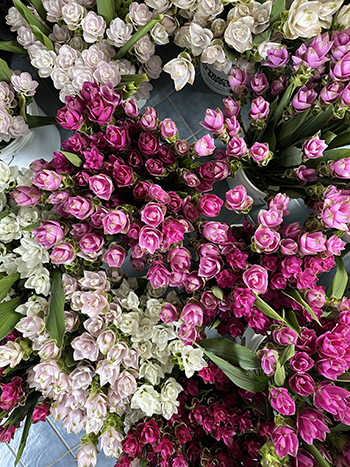
Our customers love curcuma for its bold colors and long vase life. It comes in a range of pinks, whites, greens and reds.
Knock on wood, but so far we have had zero pest or disease issues on the curcuma. It has extremely sturdy flowers and leaves that seem to resist most of our common insect pests like thrips and aphids.
We harvest curcuma when they are fully open, with one or two of the small inner flowers in bloom. We pull the stems rather than cut them (similar to how daffodils or callas are harvested). As a heat-loving plant, curcuma should never go into the flower cooler, where it will literally turn black. Yet, we also found that stems would have a short vase life if left in the hot barn in July and August.
As a compromise, we bring the buckets of curcuma into our air-conditioned house where it’s around 70°F. It has a long harvest window. We only harvest the plants once a week, a nice relief compared to other summer crops that need daily (sometimes twice daily) harvesting. Curcuma has an excellent vase life, lasting 10 days to three weeks depending on the variety. Green-colored curcuma seems to last the longest for us. Because it can’t go into the cooler, we don’t use it in mixed bouquets and sell it in straight bunches.
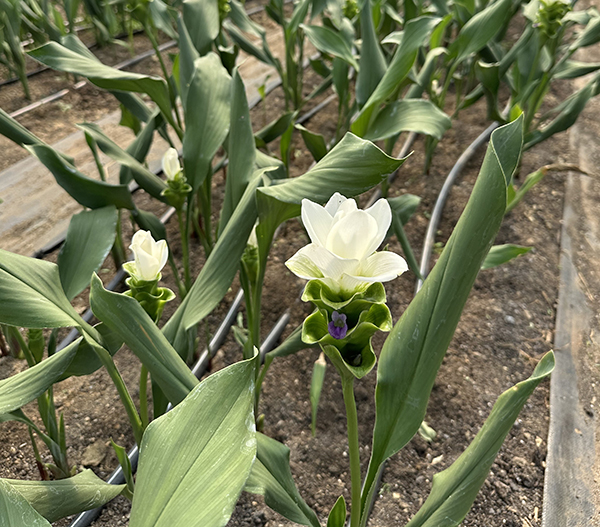
Curcuma is a great fit for our geothermal greenhouse, where we can provide hot nights early in the season. Southern growers may be able to get these conditions naturally or in unheated high tunnels.
As a rare, unique, and long-lasting flower, it demands a very high price point at $6-plus per stem in our urban farmers market, where it sells out every week. Customers marvel at its unique shape and vibrant colors. They’re delighted when it lasts so long in the vase.
As the days start to shorten in September and October, the curcuma plants stop producing flowers. The rhizomes can be dug and stored somewhere around 60°F, but we haven’t had much luck storing them — around 80 percent of last year’s bulbs either rotted or desiccated in storage over the winter. Despite buying fresh bulbs each year, we are finding the plants to be quite profitable. When I analyzed our numbers last year, I was shocked that it was our fifth best-selling flower, tied with chrysanthemums which are a huge crop for us.
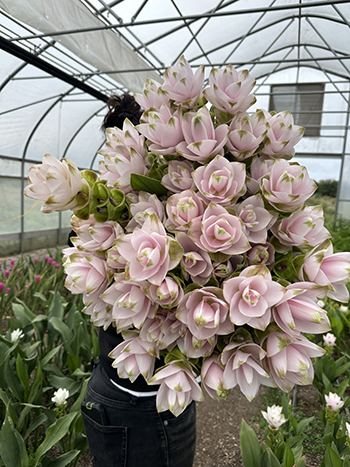
Wedding florists also like to use curcuma as it comes in a variety of soft pastels.
With flower buyers tiring of everyday sunflowers and zinnias in the summer, it is so fun to have something new and tropical to share with our customers. Curcuma will definitely stay on our “must grow” list and I’m eager to add even more colors and varieties.
Gloriosa lilies
I was so excited to trial Gloriosa (aka Flame Lilies) this year, after drooling over them for a long time on Instagram, where I follow several farms in Japan specializing in these flowers. I thought that, like curcuma, they’d be a great tropical addition to our farm. A few domestic grower friends tried to warn me away from this crop after experiencing trouble with them, but I was determined to give it a try. Spoiler alert: It didn’t go quite as well as I had hoped.
Like curcuma, gloriosa is grown from bulb-like rhizomes. It’s native to tropical regions in Africa and Asia. We sourced rhizomes from a West Coast grower and planted them upon arrival in March in the same hot greenhouse as our curcuma.
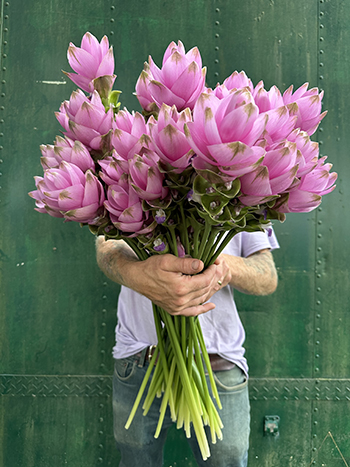
As a tropical plant, curcuma flowers can’t go into the flower cooler. We store them in a cool air-conditioned room of our farmhouse.
We tried out a few different pre-sprouting methods. We planted some gloriosa in moist peat in trays in the greenhouse, some in trays in our germination chamber, and some directly into the ground. We had the best results with the directly planted rhizomes.
The gloriosa sprouted and grew very quickly. It’s a vining plant so we trellised it onto hortanova netting attached to the ceiling of the tunnel. It did not require any training or pruning, and quickly grew up the trellis.
We have 4-foot beds in our tunnels, and we planted the gloriosa at 6-inch spacing in two beds down the center of the row. This is similar to the setup we use for a different vining crop, sweet pea. The result is around 18 inches of dead space on both sides of the plants. While this is great for airflow and ease of harvest, it feels like a lot of wasted space in an expensive greenhouse. While it might be possible to grow a companion crop in that empty bed space (we do this for sweet peas), the gloriosa is so tangly that I don’t think it would work well.
The gloriosa climbed the trellis fast and started to bloom in just around 75 days from planting — a fast crop time. Harvesting gloriosa is a kind of “choose your own adventure.” Each vine makes one to two stems with multiple flowers. Some growers harvest individual flowers with the short 5-to-6-inch stems. You can also harvest the whole vine at once.
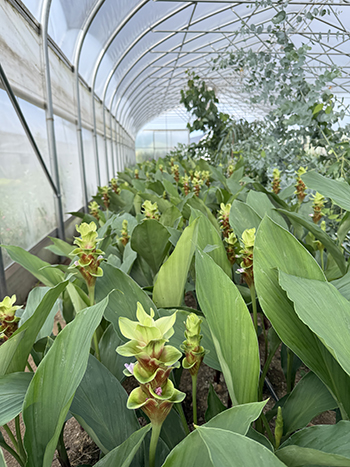
We find that green curcuma has the best vase life, lasting 2-3 weeks. In the greenhouse it makes a great companion to eucalyptus, which also loves hot temps.
We compromised and harvested medium sections of stem with multiple flowers, meaning each rhizome produced around two stems each. This translated to a yield of around one stem per square foot of bed space, which is one of the lowest yielding flowers I’ve grown.
Unfortunately, we did experience some pest and disease issues with the gloriosa. Thrips were problematic, causing telltale streaking and mottling on the blooms. Then, we lost around 30 percent of the flowers due to tip burning during a particularly hot stretch of weather.
Chatting with our supplier, we think the burning was sun scorch caused by the extreme heat and sunshine. I think if we grow gloriosa again, it would benefit from some shade cloth. We’ve also found that foliar calcium applications can strengthen cell walls and minimize this type of sun damage.
Our biggest issue with the gloriosa really surprised me — they just didn’t sell very well. We sell in some very hip New York City markets. Wholesalers in NYC are selling gloriosa for a whopping $9 to $11 a stem, and it’s showing up in all kinds of trendy florists’ designs. So I figured locally grown gloriosa would be a slam dunk.
However, the gloriosa was tricky to display and didn’t make super impressive bunches on its own. The flowers are downward facing and hidden by foliage. Also, red and yellow flowers are never our biggest sellers while purples and pinks reign supreme. While they look great as accent flowers in beautiful arrangements, the gloriosa were tougher to sell solo at market. The rhizomes and labor of this crop were expensive, so it was a bummer when it didn’t all sell out.
So, will we try gloriosa again? Probably not for a while. Between market demand, sun scorch, and low yields per square foot, I’m sad to say it just wasn’t a winner for us. In its place, I’ll probably grow more curcuma.
There are also some other tropicals I’m interested in experimenting with including anthurium and ginger flowers. Plenty of more common annuals are heat-loving tropicals, too, like celosia and amaranth. As our climate warms, I’m embracing these crops that thrive in the heat and won’t be scorched by the sun.
Rebecca Kutzer-Rice owns Moonshot Farm, a specialty cut flower farm in East Windsor, NJ. She grows flowers year-round including in a geothermal greenhouse, for retail markets in and around NYC.
Copyright Growing For Market Magazine.
All rights reserved. No portion of this article may be copied
in any manner for use other than by the subscriber without
permission from the publisher.