











#toolsforgrowingformarket
Here’s a little tool that we primarily use for transplanting on our little farm, but it’s actually more intended to be a hand weeding tool – and it works very well for that purpose, too. The tool is a small Japanese made “scraper”, labeled Sankaku Hoe and sold by Terrebonne although I’ve seen the same or similar ones from many suppliers.
Transplanting
Over the years I’ve used a lot of different tools for transplanting from transplanting trowels and bare hands to variations on stand’n’plant planters and paper-pot transplanters. In my current farming situation, we’re planting relatively smaller quantities of a wide variety of crops at a similarly wide variety of spacings. This is often less than 100 row feet at a time and rarely more than a few hundred of any one particular variety.
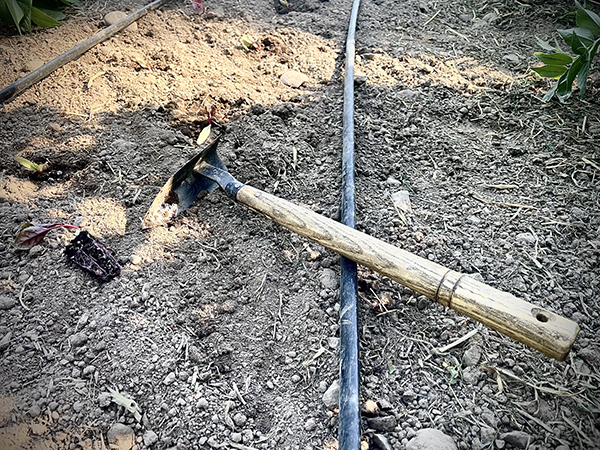
The Sankaku Hoe we primarily use for transplanting seedlings.
We’ve reduced our tillage, and our soils have a lot of rocks which means the soil conditions we’re planting into can often be quite firm and uneven, even though it’s well drained and not compacted. We’re also often planting into wetter soils than we’d like in the early spring, and occasionally the soil is drier than we’d like in the summer. This tool tends to work as well or better than other tools I’ve used in both prime and challenging soil conditions.
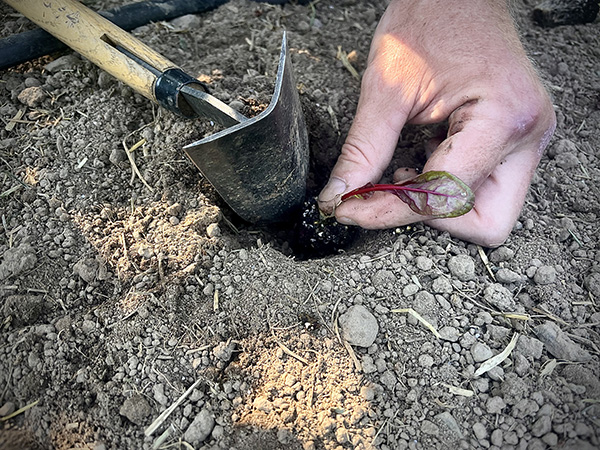
Transplanting is one quick motion when everything goes right. To plant seedlings we open a hole with a quick swing, drop the seedling plug in while the hoe is holding the hole open, then let the soil fall back into the hole to cover the potting soil as the hoe is removed. Sometimes a second little push is needed to get the soil to completely cover and surround the plug.
The Japanese hand hoe with the pointed V shape is light enough to be easy to carry, but is just heavy enough to penetrate firm soil to our seedling plug depth with a quick swing from the wrist. The motion for planting is relatively simple: a quick swing from the wrist to bury the tool while holding the leaves/stem of the seedling plug, then as the hoe is being pulled back to open up a hole the seedling plug is dropped into the hole, and as the hoe is pulled out the soil either falls back into the hole and around the seedling plug, or sometimes it needs a little push to fully cover the potting soil to the correct depth. This is similar to the way I transplant with a trowel, or fingers, in looser soil, but the motion is more ergonomic and it definitely takes far less effort and is faster when the soil is firm. Getting the motion right does take a little practice.
Typically, we’re using plugs that are from a 144 cell 1020 tray. We use the same tool with seedlings up to 50 cell trays, and above that size the tool can still work, but it takes a few swings to excavate a larger hole so it’s not always the best. For our farm which has limited greenhouse space, in recent years we’ve started growing pretty much everything in 144 cell trays, even winter squash and tomatoes.
Hand weeding
I’m not a huge fan of hand weeding and we do pretty much everything we can to avoid it on our farm – including choosing to turn under some crops if they get to the point where hand weeding would be necessary. By hand weeding, I mean getting down to the plant level and using a short-handled hoe, as opposed to standing with a long handled hoe. If I am going to do any hand weeding Japanese scrapers are definitely tools that make it work, and what makes them so good is their light weight and the sharp, quality steel they’re often made from.
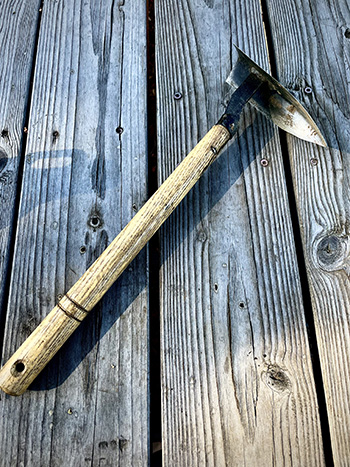
This scraper is a bit different than others that I’ve used because it’s a little heavier, allowing it to be used for chopping and excavating shallow roots without bending or breaking the handle. The typical Japanese scrapers I choose for weeding have a flat blade with a single sharp edge, but on this one both edges come sharp and hold a sharp edge well. They can be resharpened with a stone as needed. Because it’s both V shaped at the tip, and the blade is bent into a V when viewed from the top it tends to want to move soil, which isn’t usually ideal but is why it works well for planting.
Josh Volk farms in Portland, Oregon, and does consulting and education under the name Slow Hand Farm. He is the author of the books Compact Farms: 15 Proven Plans for Market Farms on 5 Acres or Less, and Build Your Own Farm Tools, Equipment & Systems for the Small-Scale Farm & Market Garden, both available from Growing for Market. He can be found at SlowHandFarm.com.
Copyright Growing For Market Magazine.
All rights reserved. No portion of this article may be copied
in any manner for use other than by the subscriber without
permission from the publisher.