











“Do you have cilantro?” is probably the reason I launched my farm six years ago. It still is the most frequent question I get. Then, I would say, “I only grow herbs.” I realized this might sound like a regret. It is not.
So now I say I’m a specialty crop farmer. Since 2018, I grow all kinds of herbs, all year long. This market positioning was a really good choice. Things are going well for my farm and for me. In France we say that you’ll know after five years if your business was the right one or not. For farms, it is even more true.
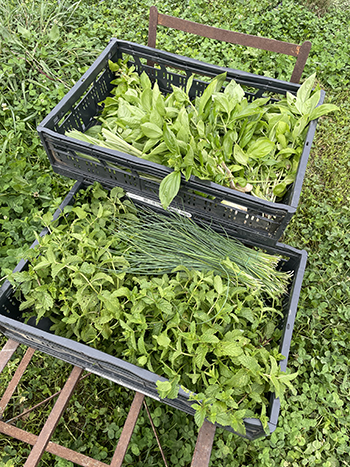
Mint, chives, basil and lemongrass ready to be delivered.
After a few years as a journalist in Marseille, I decided in 2017 to work at a farm for experience to later start my own business. I fell in love with farming, and I wanted to work mostly on my own. That meant I needed to choose carefully what to grow on a one-person farm.
Customers at market were always asking for herbs. The farmer next to us was selling piles of herbs from Morocco that he was buying at a wholesale market. It was in Aix-en-Provence in the South of France with 140,000 inhabitants.
I found a small piece of land to rent next to my house. I asked an organic shop nearby how many bunches of herbs they would buy weekly. Then, I started my own small farm while working part-time at another. Soon, I decided to buy my own place and found land 40 minutes from my first clients.
Today, I grow on just under an acre, including two, 8,600-square-foot unheated tunnels filled with herbs, salad crops and ginger. I sell parsley all year, harvesting six days a week, and sell cilantro nine months of the year.
The crops are grown in 164-foot long, 3.2-foot-wide beds. The plants are watered with drip irrigation, but I use a sprinkler during the first weeks. My crops are certified organic so I only use natural fertilizer, mostly manure. I only use my micro-tractor once in a while.
Cheap to grow, beautiful and popular
Whether you grow for a CSA or farmers market, herbs are super interesting for several reasons. First, they are cheap to grow, especially if you produce your own seedlings. Seeds are not expensive and most herbs are quite easy to grow from seed. I’ll explain later how and when I plant them to be able to sell all year. Most herbs also can be harvested multiple times which means more money out of a small space. My parsley can be harvested so many times I cannot count. In summer it can grow back in less than 15 days.
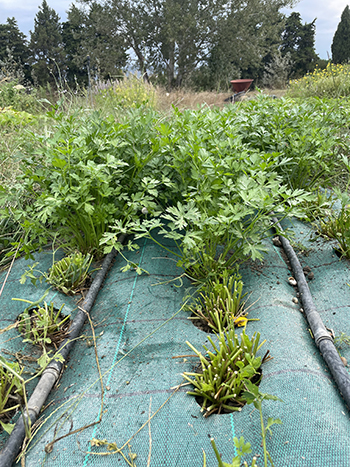
Don’t be scared to cut parsley super short. All photos courtesy of the author.
Secondly, herbs bring a significant amount of money and regular income. As for salad crops, you will quickly know how many bunches you need to harvest for a market or a shop.
Herbs are quite cheap in France. Here there is a big gap between farmer prices and supermarket prices. They cost the same price as greens, 1.20 Euros ($1.33) a bunch. I have decided, for many reasons, to sell them as cheaply as possible. I don’t use any packaging, but 3.5 ounce bunches with just an elastic. Prices of organic veggies have dropped in Europe these last years and to me it is very important that they don’t cost twice the price of others on the market. It just makes it even crucial to grow as efficiently as possible.
Depending on the size of the customer’s shop (and if it is in a big city or not), here in Europe you can expect to sell from 20 to 60 bunches a day of each herb. Once you start growing them, people will get used to their weekly cilantro or parsley.
The last thing is that they are very popular and many customers don’t find them elsewhere. If you need fresh mint for a recipe then you need it and nothing else. They also look great at market stalls, specially in winter when we need more greens.
Favor classics over specialty herbs
Here at our farmers market I often see parsley on its own or with a few bunches of chives. Instead, think of herbs like any other essential veggie: with regularity, a large diverse offering and freshness. Parsley, chives and mint can be grown all year. Cilantro nine months a year. The key, to me, is to always offer several herbs at the same time.
During my first season, I made a very common mistake, which is planting as many specialty herbs as classics. The thing is, you will sell 10 bunches of cilantro for one lemon basil. It is exactly the same with tomatoes: you sell more beef tomatoes than specialty ones. So now I plan 80 percent classic, 10 percent specialty and 10 percent very special.
There are crazy and strong herbs like geranium rosa or pineapple sage, but these are not the ones that will bring you money. Parsley and cilantro will. Still some clients are going to love the special or weird, so it’s always nice to have a few of them. As a side note, after years of trying, I’ve decided to not grow dill and tarragon anymore because they doesn’t work well in my soil.
Treat them well
I have seen many farms growing herbs a bit randomly, thinking mint would grow without proper care. Then, they never harvest or not often. Herbs should be treated well: daily drip irrigation, planted into landscape fabric to avoid weeding, and fertilization like other greens. Ideally, herbs have to be tall, bright green and quick to harvest. A good rate to me is 150 bunches an hour. None tolerates being surrounded by weeds, this is why I use landscape fabric for all of them except mint. As a one-person farm with a toddler I have to be super efficient.
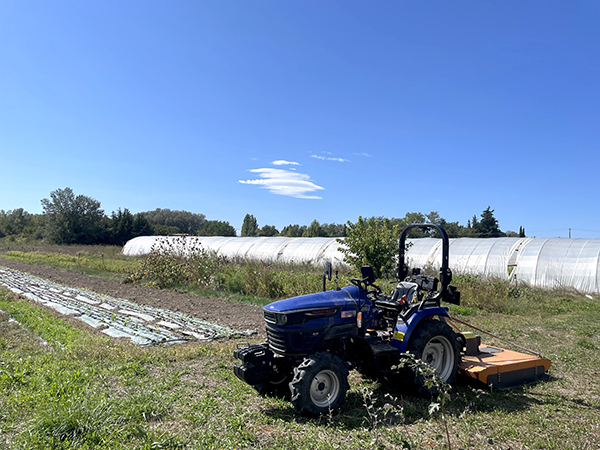
My beloved tiny tractor with the last outdoor cilantro of the season, planted mid-September.
Mint, chives, lemongrass, sage and rosemary stay for years. Lemon verbena, which people love to buy for tea, grows nicely in a tunnel but it takes a lot of space. Parsley lasts at least a year. I plant some three times a year to be sure to have it in winter — first in March in the unheated tunnels, outside in May, and inside again in September.
How many times can it be cut? When it’s happy, many! Parsley, mint and chives grow back very quickly. If you don’t harvest in time, mow it so it grows again fresh and nice.
What about cold ? Most of them, except basil, tolerate cold well with row cover and grow well in low-light conditions. Problems start when a frost lasts more than three days in a row, without any sun. Then, the leaves might get damaged. Cut them back, protect them and they will grow back. To be able to harvest all winter I plant at least 1,000 of each. If the weather is grey for weeks, then parsley will be a bit shorter than usual but people still like it.
Cilantro and basil, touchy best sellers
As for cilantro, things can be a bit more complicated: it goes to seed at the first little stress. The answer is daily irrigation in autumn and spring, shading nets if the temperature gets over 86°F and most of all rotation. In any case, cilantro leaves are not good when they get old.
I plant at least one bed of cilantro per month. If the weather cooperates, you can have three beautiful cuts in winter. Don’t expect too much the rest of the year. I quit growing it in June, July and August because even with shading it’s too hot here for cilantro in summer. I’m planning a special tunnel with automation and strong shade to grow cilantro and arugula better and longer.
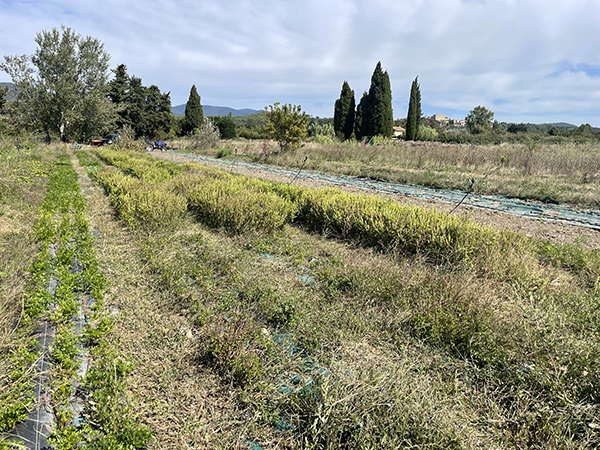
At the end of the season, the basil went to seed and parsley will be harvested until the end of October, then we start harvesting parsley from the greenhouse.
Basil is a best seller in mid-summer, but can also be a bit touchy. I plant the first ones in March with row cover. The first harvest is in May when I also plant them outside. Basil can get sick very quickly if the leaves get wet or the weather is too humid, so I always keep some in the tunnel until October. If it flowers, cut it or you will lose it. If the year is rainy, I add a rotation in July. Once again, go classic: Genovese basil with large leaves and strong smell is the best. Thai and lemon basil are also nice but don’t plant too many.
During the first three years, I bought plug plants from a nursery because I felt too insecure to start from seed. Now, I seed my own except parsley. In order to save time and avoid weeding, I transplant almost everything, even cilantro. I use 240-cell trays that are very efficient and take so little space.
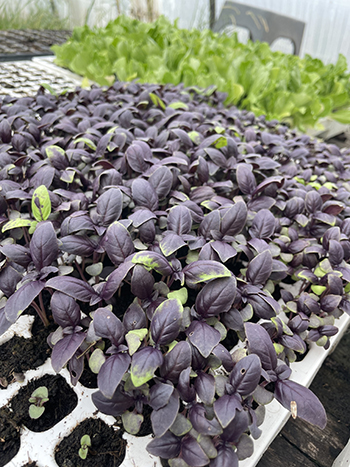
240 cell trays work well for basil and cilantro (here purple basil).
The only hitch is that you have to plant quite quickly. I’ve noticed that the herbs grow stronger when transplanted as soon as possible. Direct seeding was not a good experience here; as a one-person farm I have to avoid weeding as much as possible. Also density, closely spaced, is very important for cilantro to grow well. I know that the paperpot works very well with cilantro, I might try it later if I have fewer weeds. I seed cilantro even in January, every two weeks, and it works well. Spring is when it is the most beautiful. It’s very popular when veggies tend to be scarce in March or April. If you want to plant mint and chives, early spring is the best.
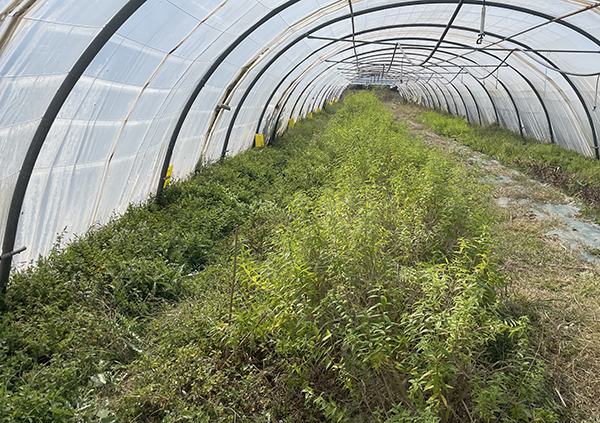
Mint and verbena stay for several years so they need to be planted on the edges of the hoophouse.
I choose to plant all herbs quite densely: 24 plants every square meter (10.7 square feet). To me this is the best way to shade the ground in summer and optimize space. If the plants get too tight, I harvest one of every two.
Last thing but you probably know it, herbs need to be harvested as early as possible in the day in summer and cooled down quickly, but gently. I don’t have a refrigerated room here so every thing is harvested and delivered in the same day. It cannot be fresher. This is exactly what will make the difference, a bit of freshness during winter and some new flavors to season the squash, cabbage and potatoes.
Clémentine Vaysse grows herbs and greens since 2017 in the South of France. Based in Lauris, near Aix-en-Provence, the farm is called Les herbes de la mésange bleue and is certified organic. A former journalist, Clementine is passionate about small scale farms and low tech in agriculture, especially if they include horses.
Copyright Growing For Market Magazine.
All rights reserved. No portion of this article may be copied
in any manner for use other than by the subscriber without
permission from the publisher.