











Our main reason for wanting a hoophouse was to have a good supply of winter cooking greens and salads, with some root crops and alliums for variety. Naturally, we found good uses for the protected growing space in spring and summer too. In order to get the most food from the space, our winter hoophouse crops are a mixture of direct sowings and transplants brought in from outside (in the fall), or grown inside and transplanted during the winter. We don’t want to pull our summer crops any sooner than we have to, but this has to be balanced by planting the winter crops in good time so they’ll grow big enough before they slow down or stop growing at all. I wrote about Hoophouse crops for winter harvest in the August 2010 issue of Growing for Market. That’s a while ago and we have been merrily planting and harvesting ever since. This time I am going to focus on planning for desired harvest dates.
Our winter hoophouse harvests start in November. Kale and spinach grow whenever it is above 40°F (5°C), which happens a lot more often indoors than out! We harvest spinach by the leaf, using scissors, until the plants start to look just past their peak, then we cut whole plants. We harvest lettuce by the leaf, leaving the center to keep growing, until 2/21, when we start cutting the heads (growth really picks up by then and we can be sure we have enough to see us through). Outdoor lettuce will be ready here in mid-April.
Your choices of crops probably won’t be the same as ours. We don’t grow the small greens like mache, claytonia, Mei Qing Choi (small pak choi), salad burnet and upland cress because our market (people cooking for a hundred hungry workers) isn’t interested in them. We don’t grow short-lived crops like broccoli raab and Hon Tsai Tai/Choy Sum as Virginia weather is highly variable and these crops can switch to bolting in the blink of an eye. We don’t grow chicories and endives because our market doesn’t like bitter crops.
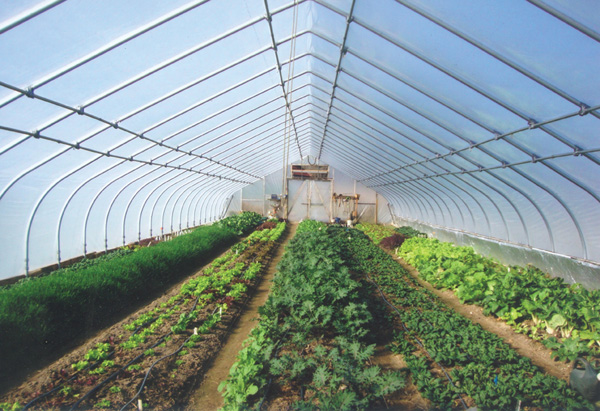
Below is a photo of the hoophouse in December in Virginia zone 7. This is what using the scheduling strategy described in the article for continuous harvest looks like. Photo by Kathleen Slattery.
Winter and spring hoophouse harvests month by month in zone 7
November
Brassica salad mix, Bulls Blood Beet greens, mizuna and frilly mustards, radishes, salad mix, spinach, tatsoi, thinnings of chard, baby turnips and greens for salad mix. We still have leaf lettuce outdoors, and only harvest from the hoophouse lettuce if the weather is bad outdoors.
December
Arugula, brassica salad mix, Bulls Blood Beet greens, chard for salad, Chinese cabbage, kale, leaf lettuce, baby lettuce mix, maruba santoh, mizuna and frilly mustards, pak choy, radishes, salad mix, scallions, senposai, spinach, tatsoi, Tokyo bekana, turnips and greens, yukina savoy.
January
Arugula, brassica salad mix, Bulls Blood Beet greens, chard, Chinese cabbage, kale, leaf lettuce, baby lettuce mix, maruba santoh, mizuna and frilly mustards, pak choy, radishes, salad mix, scallions, senposai, spinach, tatsoi, Tokyo bekana, turnips and greens, yukina savoy.
February
Arugula, brassica salad mix, Bulls Blood Beet greens, chard, kale, leaf lettuce (we cut the whole heads from 2/21), baby lettuce mix, mizuna and frilly mustards, radishes, salad mix, scallions, senposai, spinach, tatsoi, turnips and greens, yukina savoy.
March
Arugula, brassica salad mix, Bulls Blood Beet greens, chard, kale, leaf lettuce, lettuce heads, baby lettuce mix, mizuna and frilly mustards, radishes, salad mix, scallions, senposai, spinach, tatsoi, turnips and greens, yukina savoy.
April
Brassica salad mix, Bulls Blood Beet greens, chard, kale, leaf lettuce (may end in early April), lettuce heads (until late April, then lettuce from outdoors), baby lettuce mix, mizuna and frilly mustards, radishes, salad mix, scallions, spinach.
Fall planting overview
Those in zones 5-6 can find a wealth of information in the collection of slideshow presentations from the Frozen Ground Winter Growing Conference in Vermont in 2014. There’s great information from Eliot Coleman from winter hardiness zone 5, John Biernbaum and Adam Montri from Michigan State University (zone 5a), Ben Hartman in Goshen, Indiana (zone 5b), and Jack Algiere from Tarrytown NY (zone 6b). Each colder climate zone needs sowing dates in the fall about two weeks earlier, and a longer wait before starting again in January. See Eliot Coleman’s Four Season Harvest for a helpful chart of fall planting dates of 45 crops in different climate zones. Using a double-layered hoophouse you can plant as if your first fall frost date is 5 or 6 weeks later than happens outdoors, i.e. as if you are 3 zones further south.
We’re in zone 7, so adjust the dates from our Hoophouse Harvest Schedule for your climate. For example, zone 5 growers start 4 weeks before we do. We make our changeover from summer to fall and winter crops one bed at a time. In early September we start by sprouting some spinach seeds in a jar in the fridge. We clear the summer crop from the designated first bed, add compost, broadfork and rake the bed in time to sow the week-old sprouted spinach seed, Bulls Blood beet greens, radishes, scallions and tatsoi.
If time is your limiting factor, lean towards direct sowing. If space is what currently limits you, go for transplants, and continue harvesting summer crops for several more weeks while your transplants are growing. We do some of each. And we’ve found that using bare root transplants grown outside is much less work than growing in flats in a greenhouse, so we do that. I wrote about this in Don’t be afraid of bare-root transplants in the February 2015 issue of GFM.
On 9/15 and 9/24, we make outdoor sowings of crops to transplant into the hoophouse at 2-4 weeks old. The 9/15 sowing includes about 10 varieties of hardy leaf lettuce and romaines, multi-colored chard, Chinese cabbage, Maruba Santoh, pak choy, Tokyo Bekana and Yukina Savoy. The 9/24 sowing includes another 10 varieties of lettuce, arugula, mizuna and ferny mustards, red and white Russian kales, Senposai, more Yukina Savoy and resows of anything from the previous week that didn’t give a good stand of seedlings. We cover this outdoor bed with hoops and insect mesh, and water it daily.
Toward the end of September we clear at least one more hoophouse bed of summer crops, add compost, broadfork and rake. We transplant the Maruba Santoh and Tokyo Bekana at 2 weeks old, the Chinese cabbage, pak choy, and Yukina Savoy at 3 weeks.
By the middle of October we clear and prepare another bed and transplant about 300 lettuces at 10” apart, and the chard. We also sow turnips, radishes and “filler greens” (more later). In the fourth week of October we transplant the second round of lettuce (300 plants), arugula, kale, mizuna and frilly mustards, Senposai and the second Yukina Savoy at 4 weeks old, after preparing the remaining three or four beds. In the hoophouse, we sow our first baby lettuce mix 10/24, along with our second round of spinach and chard. We also sow some “filler lettuce” and more filler greens to transplant later to fill gaps. We aim to keep all the space occupied, mostly using lettuce and spinach.
On 11/10 we sow our second round of turnips, mizuna, ferny mustards and arugula, more filler lettuce and spinach, and also our first bulb onions for outdoor transplanting as early as possible in the new year – we aim for March 1. From then on, we have a fully planted hoophouse, and as each crop harvest winds down, we replace that crop with another. We use the filler greens and filler lettuce to replace casualties and to fill gaps immediately after any terminal harvest.
Our winter and spring crops finish in late March or early April. Usually we harvest the winter crops from the center rows first, plant the early summer crops of tomatoes, peppers, squash and cucumbers down the center, then harvest the outer rows bit by bit as the new crop needs the space or the light. This overlap allows the new crops to take over gradually.
Days to maturity
For new winter hoophouse growers, be advised that the ‘Days to maturity’ numbers in catalogs are generally for spring planting once conditions have warmed to the usual range for that crop. When growing late in the fall, add about 14 days for the slowdown in growth. When growing in winter, be prepared for a period of almost no growth if your climate is zone 5 or colder.
In The Lean Farm (available from www.growingformarket.com), Ben Hartman (in zone 5b) includes tables from 3 years of growing baby lettuce and spinach. He finds that baby lettuce sown before 10/22 takes 5-6 weeks until harvest. From 10/24 to 11/16 the period till harvest increases from 8 weeks to 17 weeks. With spinach sown before 10/11, it takes 4-6 weeks to harvest, while from 10/20 to 11/1, the time doubles or more (12 to 15 weeks). In zone 5b, if you want baby lettuce mix before December, sow before 10/22. If you want spinach before December, sow before the middle of October. Then sow for new-year harvests every week from 10/15 – 11/1. You can then take December off from planting, before starting a new succession of salad greens and spinach for late winter harvest. In zone 7 we can harvest outdoor lettuce and spinach in December, and we have less urgency about early hoophouse sowings (and no December break!).
Secondly, “days to maturity” usually means ‘Days to First Harvest’ which may not be the same as ‘Days to Full Harvest’. With carrots the exact size doesn’t matter, but an unheaded Chinese cabbage is no good. For a CSA, you can distribute Chinese cabbage to some sharers one week, and others the next, carefully keeping track. If it’s vital to have a plentiful harvest when you do start, add another 7-14 days when counting back to your sowing date.
Persephone period
When day length is shorter than 10 hours not much growth happens. This fact was publicized by Eliot Coleman, who calls this period the Persephone period. (Persephone, in the ancient Greek myth, was obliged to spend some time each year in the Underworld with Hades, who abducted her.) The dates and the length of this period depend on your latitude. The further you are from the equator, the longer this period is. In Central Virginia, latitude 38° North, this period lasts two months, from November 21 to January 21.
Soil temperature also has a big effect on the rate of plant growth. The soil is much warmer on November 21 than on January 21. This time lag in the cooling of the soil keeps crops growing in November and early December. In late January it takes the soil time to warm up again. Adding together the effects of daylight and soil temperature, and observing what happens, we find December 15 – February 15 is the slowest growing period for us.
To harvest in the darkest days of winter you’ll need a good supply of mature crops to take you through. What has already grown before this period will provide most of your harvests. The fact that the plants have their roots in the ground means they will stay fresh and alive (so long as it doesn’t get too cold) even if it is too cold and dark for them to grow.
In our zone 7 winter at 38N, for most of the winter, our hoophouse plants are still actively growing, not merely being stored for harvest (as happens in colder climate zones), so we can continue sowing new hoophouse crops even in December and January. In Vermont, the latest they seed anything in their hoophouses for winter harvest is September 20-October 15, as reported at the Frozen Ground Conference.
A steady supply: filler greens
See my article on Winter hoophouse succession crops in GFM Nov/Dec 2015 if you want details of how to plan a continuous supply of radishes, baby lettuce mix etc.
As well as our scheduled successions, we keep a supply of “filler” lettuce and cooking greens transplants growing and pop a few plants in whenever a gap opens up. Another option for making good use of every scrap of space is to sow small amounts of fast-growing, small-sized crops such as arugula, mizuna, cress and tatsoi. We often fill gaps by mixing our own brassica salad mix from leftover random brassica seeds. For a single cut, almost all brassicas are suitable – just avoid turnips and radishes with prickly leaves. We sow between 10/2 and 11/14 for winter harvest and from 12/4 to 2/12 for March and early April harvests. Pea shoots can be grown as a gap-filling crop if there is unexpected open space in late winter. We have used leftover soaked seed from our spring outdoor planting in early-mid March. We harvested these 4/10-5/5.
Follow-on winter hoophouse crops
Some people use the term “Succession Planting” to refer to a succession of different crops occupying a space. We use the term “Follow-on crops” for this (a series of two or more crops that follow each other well timewise and crop rotation-wise). It’s helpful to have a plan of how all the space will be used, and it’s also important to be ready to change that plan if a better opportunity comes along. For instance if the pak choy you planned to sell over a period of a month is all sold the first week, you can sow a different crop in the space.
We follow our first sowing of radishes with our second scallions on 11/17; our first baby brassica salad mix with our fifth radishes on 12/23; some of our first spinach with our second baby lettuce mix on 12/31; our first tatsoi with our fourth spinach on 1/15; our Tokyo Bekana on 1/16 with spinach for planting outdoors; our pak choy and Chinese cabbage on 1/24 with kale for planting outdoors; our second radishes with more baby brassica salad mix 2/1 and more of our first spinach with dwarf snap peas on 2/1.
Crop rotations
Our winter hoophouse crops fall into three main families: brassicas (turnips and radishes as well as the more obvious leafy types), lettuce (this group would include chicories and endives if we grew them), and chenopods (spinach, chard and beets). When planning we aim to avoid planting any family in the same place as it was the previous winter. We try to do this by whole beds or half beds, rather than smaller areas. Two years isn’t a long rotation, but we rationalize that two years’ worth of summer crops also act to even out the soil nutrients, dispatch pests and diseases and restore the soil to accept that crop family again.
Our three winter crop families are something I keep in mind when making salad mixes too. In order to maximize the nutritional variety, I try for 50% lettuce, 25% spinach/beet greens/baby chard and 25% small brassica leaves.
How to make a coordinated schedule
We do our detailed crop planning in two parts each year. We schedule the few, straightforward, March-September plantings in February, and the many and varied September-March plantings in early-mid August. This allows for some adjustments to take account of anything that happened that we hadn’t planned for. We work from the previous year’s plans and modify them.
We print a map of the bed layout and write in the previous crop and the dates the spaces will become available (above the top of each bed). We take a list of crops we hope to grow and decide which main crops could go in each bed, considering crop rotations, known pest or disease problems, edge beds being narrow and colder, dates of availability, climate change and need for row cover. We pencil in these crops on the map, including how much space they need, then mark the available space left in the bed. Once we know how much of each crop we want to plant, we plan the area each crop will occupy and draw that in on the map, with start and finish dates. We leave the detail planning aside for the time being.
Next we turn to our spreadsheet schedule, decide on the planting dates (tried and trusted, or a bit experimental?), write in expected harvest start and finish dates, and make changes as directed by notes from the previous year. Then we fix the details. As we go along, we make a list of questions to resolve: quantities, succession crop date tweaks, variety changes, what to do if nematodes are found. We record our decisions clearly as we go along.
When we are planning the September to March crops, we figure out the early planting bed (September 7) and the nematode bed first, then the others. We got root-knot nematodes in one bed, and are using a strategy of two years of resistant crops followed by one year of susceptible crops. See my November 2014 article Nematodes in the hoophouse. Following the nematode plan takes priority over our usual crop rotation plan.
We work down the draft schedule ensuring we have a home for each crop in a space that will be available timewise and suitable rotation-wise. We write the location on the schedule and the crop on the map, along with how much space it needs. If we decide to make a change, we make sure to follow through and make those changes both on the map and on the schedule.
We add total row feet of all crops allocated to each bed and make sure they fit. We plan follow-on crops where possible. When the schedule is completed, we sort it in date order. We have two people who did not enter the data proofread for sense and for compatibility with the map. We make any needed corrections, then print, and take copies to all the places we imagine we might ever want to consult them.
Pam Dawling manages 3.5 acres of vegetable gardens at Twin Oaks Community in central Virginia. Her book, Sustainable Market Farming, is widely available, including at www.sustainablemarketfarming.com, or by mail from Sustainable Market Farming, 138 Twin Oaks Road, Louisa, Virginia 23093. Enclose a check (payable to Twin Oaks) for $40.45 including shipping. Pam’s blog is on her website and also on facebook.com/SustainableMarketFarming. Pam also makes presentations on vegetable growing topics at conferences and fairs from September to May each year.
Copyright Growing For Market Magazine.
All rights reserved. No portion of this article may be copied
in any manner for use other than by the subscriber without
permission from the publisher.