











There are all kinds of factors when selecting a single piece of equipment for a farm. Equipment has to fit into the larger farm systems, even if it’s helping to modify those systems in some way. There are lots of other factors as well, such as local equipment availability, soil types, and simple personal preferences. For a second farm equipment profile I talked to Benjamin Shute from Hearty Roots Farm in Tivoli, New York. Benjamin’s farm is similar in size and market to Sauvie Island Organics (profiled in GFM last month). I’ve visited his farm a couple of times in the past few years and any time I visit a farm I’m always looking at what they have in their equipment lineup.
In 2010 Hearty Roots cultivated about 18 acres of mixed vegetables, selling about 85% through their CSA and Just Food’s Local Produce Link Program. The rest of the vegetables are sold to restaurants and through a local farm stand. The farm is on leased ground, mostly sandy loam soil, and they have access to an irrigation pond on the property. During the peak season the farm has nine folks working full time.
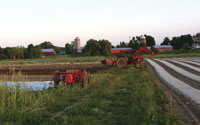
Field equipment
The tractors on the farm shape the way a lot of work gets done. At Hearty Roots, two International tractors, a Hydro 84 and a 784, do the heavy lifting. Both have the same 60 HP motor, but one has a hydrostatic drive, which gives it less power at the drawbar and PTO, but makes it easier to drive slowly, an advantage with a few of their implements.
For preparing fields, a variety of implements are used. For breaking sod or very heavy cover crop incorporation, the farm uses a 3-bottom moldboard plow. That operation is followed several weeks later with a 8’ 3-point mounted disk harrow. The final implement before planting is a 70” Maschio B rototiller with a large rear roller that allows very shallow tilling depth and helps flatten the bed behind.
For fields with winter-killed cover crops or lighter cover crops, the farm also has a 5-shank chisel plow. They’ve bolted an electric MaterMacc dry fertilizer spreader and spring tines behind the chisel which allows them to do both operations in one pass. They also have a John Deere flail mower that can be used for mowing down cover crops or for chopping up crop residue when needed. There is a 4’ rotary mower on a small Kubota L285 that is used for mowing edges. The Kubota was the original farm tractor before the farm grew.
Larger spreading needs are handled by renting a large broadcast spinner from a neighboring farm. The farm doesn’t use any compost or manure in the fields and relies on cover crops for keeping organic matter levels high.
When crops are finished, the disk or rototiller is used to incorporate the residue. The tiller is also used to incorporate cover crop seed, either by tilling shallowly, or by just running over tilled ground that has seed on top without running the PTO, allowing the tines to dig the seed in as it rolls over the ground.
Planting tools
Most transplanting on the farm is done with a Rain Flo water wheel transplanter. The beds on the farm are on 70” centers to match the International’s wheel spacing, and up until this year the transplanter has been set to plant 4 rows with 12” between the rows. Benjamin tells me he’s going to switch it around to run just three rows, 16” apart. The transplanter can be set for marking 6”, 12” or 18” spacing and injects water into each hole which allows more time before irrigation has to be turned on after the field is planted.
For direct seeding, most seeds are put out with a custom-built seeder that belly mounts on an Allis Chalmers G tractor. The seeder uses a Seed Spider sponge seeder to meter out seed for smaller seeded crops, and crops like carrots and parsnips are seeded with pelleted seed to make them work with the seeder. Beans are the one vegetable that is direct seeded with an Earthway Precision seeder, the seeder that used to be used for all seeding on the farm before they bought the seed spider. Cover crop seed is broadcast using a “belly grinder,” also called a shoulder bag broadcast spreader.
Cultivation
The farm has two Allis Chalmers G tractors. One is primarily used for seeding and is run with an electric motor. Whenseeding season is over it joins the second G, which has the original gas motor, as a cultivating tractor. The farm has a variety of cultivating tools for the Gs, including a farm-built Lely tine weeder; a single-row cultivator (a basic set of sweeps on a V shaped frame); a tool bar for the Gs with parallelogram follower sweeps for between row cultivation (they haven’t been able to make this function well so they are reworking that bar with more standard sweeps); and a tool bar with small 12” cultivating disks for light hilling of potatoes, leeks and sweet corn. Once the potatoes get bigger, they move to larger hiller disks mounted on the back of their bigger International tractors. They use another 3-point mounted tool bar on the Internationals for cultivating large cucurbit plants, by mounting a pair of 13” side knives to reach in under the vines.
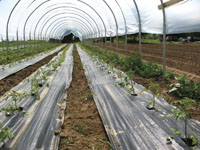
The farm owns a Rain Flo plastic mulch layer with an attachment for laying drip tape. The plastic mulch is used for tomatoes, sweet potatoes, peppers, eggplants, and onions. White dutch clover and perennial rye are planted in pathways and a string trimmer with extra shielding is used to keep the pathways mowed in all but the onions, where a wheel hoe is used.
Spray equipment
Benjamin mentioned that they use a Solo backpack sprayer for a number of organic pest and disease control sprays, as well as foliar feeding. They also bought a Stihl SR420 backpack mist blower with a gas motor to help penetrate the tomato canopy better during the nightmare tomato late blight epidemic year two years ago in New England. He mentioned that Rutgers has an excellent study on backpack sprayers and which work best. (http://snyderfarm.rutgers.edu/html/proj/backpack-sprayer.html)
Harvest
Hearty Roots uses an undercutter bar for lifting carrots and parsnips. Potatoes are dug with a 3-point mounted chain digger from US Small Farm (see GFM classified ads) which they share with two other farms since it is only needed a few days every year. They also have a pallet fork and bucket loader that can be swapped out for a set of forks on one of the Internationals. These are handy for bringing in heavy harvests in farm-built pallet bins.
Irrigation
The farm is irrigated from a pond. For overhead irrigation, they use a combination of 3” and 2” aluminum hand line with Rain Bird heads. A Caprari PTO pump is hooked up to one of the International tractors to feed the lines and they use high pressure lay-flat hose to go from the pond to the aluminum line. No safety switches are in place but Benjamin would like to buy a dedicated pump, or at least install murphy switches to protect against sudden pressure losses, or mechanical failures in the tractor.
The farm also uses T-Tape drip lines in some crops, using a smaller 6.5HP gas pump with pressure regulators. The water is filtered with two Amiad disk filters that he has set up to be able to back flush (details are at www.youngfarmers.org/2010/11/farmhack-tools-back-flushing-irrigation-water-filter/) He has also installed a mechanical sauna timer switch to turn off the pump automatically when the irrigation is finished. For narrow areas that need overhead irrigation, a line of small wobbler sprinklers can also be run off of this pump.
Propagation equipment
The farm doesn’t own a greenhouse but instead rents greenhouse space from a neighboring farm. All watering is done by hand, but the seeding is primarily done with a Berry Hand Seeder vacuum seeder, which is similar to the EZSeeder. The farm uses 1020 plug trays in a variety of sizes: 30, 50, 72, and 128. Their greenhouse table tops sit on sawhorses. When they need to move the flats to the farm they can carry a table top with 14 trays and place the whole thing in their box truck.
The farm also built two 15’ x 150’ three-season high tunnels for tomato production, using steel fencepost tubing and a farm-built jig for bending.
Packing out
Hearty Roots uses Buckhorn flip-top totes and shorter stack-and-nest plastic totes. They have an electric power washer that they use for cleaning bins, no one’s favorite job. For washing vegetables everything is done in Rubbermaid livestock tubs and on simple tables with hoses and spray heads. Salad greens are spun dry in a washing machine.

Because the farm is on leased ground, the farm’s storage spaces are 30’ wide hoophouses covered with opaque plastic. That’s where they have two walk-in coolers, one 12’x20’ and one 8’x8’, built on wooden platforms. The walk ins are built from standard cooler panels and are both cooled with CoolBots. In the winter a heater is added to keep the space from freezing. They have a pallet jack, but mostly prefer to use hand trucks to move bins around, as they are more versatile and nimble.
Deliveries
The farm has a 15’ box truck that is used for deliveries. The truck has an aluminum ramp that stows underneath and makes loading and unloading with a hand truck possible. Lots of ratchet straps keep loads from tipping in the box. The box is not insulated or cooled and deliveries are done in the morning, with the longest run being 5 hours to the last drop.
Wish list
Hearty Roots is continuing to expand slowly and is definitely continuing to acquire equipment. Most of their wish list equipment is in the cultivation arena, including a high clearance cultivating tractor and a basket weeder. A modified field cultivator for shallow stale bedding is also on Benjamin’s list of purchases for the near future.
Several of the farm’s tools have been profiled on FarmHack.net, a DIY-farm tool blog that Benjamin edits. The belly-mounted tine weeder, irrigation filter setup, and electric G plans are all posted there, as well as many other farm inventions.
It’s interesting seeing this farm’s equipment next to Sauvie Island Organics’ selection. Both farms are on similar soil, and have similar markets, but the climates are very different, as are the surrounding farm cultures. In New York the farm planting and harvest seasons are shorter and more condensed, and availability of used, mid-sized equipment seems greater. Distances between small farms also seems more condensed, making equipment sharing easier.
Josh Volk, a regular contributor to GFM on tools and equipment, farms and writes at the edge of Portland, Oregon. He also helps farmers around the country improve their farming systems. Visit www.slowhandfarm.com.
Copyright Growing For Market Magazine.
All rights reserved. No portion of this article may be copied
in any manner for use other than by the subscriber without
permission from the publisher.