











Winter holiday wreaths have been a side venture of our farm for many years. They add color, interest, and value to our late season markets. And, after most of the food crops have been gathered into the cooler or root cellar, making wreaths is an enjoyable way to spend the cold, low light days of November and December.
In 2020 with the onset of the pandemic, our veggie CSA subscriptions doubled. Yet, quickly we lost weekly wedding bookings for the season and suspended all farmers market sales — our two main cut flower outlets.
.png)
We were able to decrease our annual flower plantings somewhat, but with bulbs, biennials, perennials, and our “just-in-case” annuals, we had more blooms than we could move through our CSA and online sales. I started making dried flower wreaths year-round as a way of preserving the value of unsold summer flowers.
All through the winter of 2020 and spring of 2021, we turned our dried product into wreaths that we sold at farmers markets throughout the 2021 season. Customers eagerly bought them for Mother’s Day, housewarming, birthday, and hostess gifts. They enhance the appearance of the market booth, and are a packable, non-perishable option for tourists shopping the market scene.
On our diversified farm we downcycle unsold or blemished produce into feed for our pigs and goats. It’s thrilling to have a way to eliminate waste from our flower production now, too. Drying flowers absorbs over-production in the field, left over product in the design studio, and product that is not sold at market.
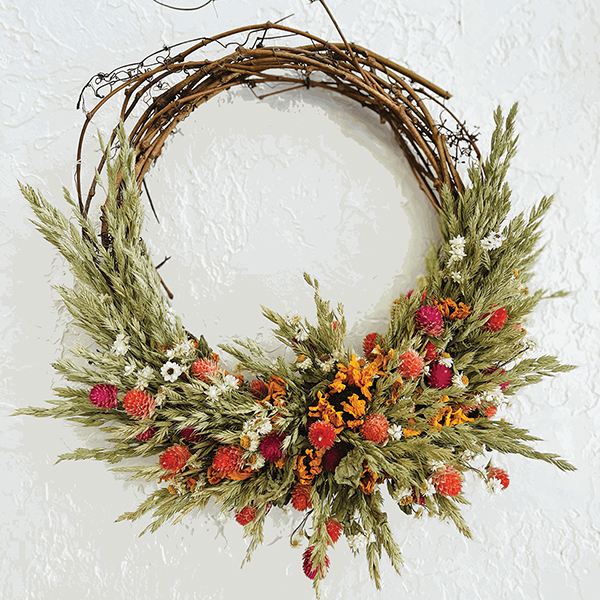 A natural-form wreath featuring dried grasses and gomphrena made by the author. It uses less floral material than the metal ring wreaths because usually just the bottom half of the form is covered.
During the 2021 season, I even found ways to collect and dry flowers I had sold. Guests and bridal parties who visit from out of town for destination weddings can rarely enjoy the flowers after the events. In the past, I’ve collected the vases for reuse the day after the event.
Now, I let the wedding coordinators know that they don’t need to toss the flowers during take-down, but can repack arrangements that guests don’t keep in the original delivery crates. I pick up the used flowers, dump the water, wrap the vase arrangements with rubber bands, and hang them to dry with no additional fiddling. Some of my favorite wreaths made this fall were from re-collected August bridesmaid’s bouquets. The color pallets were conveniently pre-arranged.
When crop planning, I focus my floral and greenery variety selections and quantities to meet my fresh cut demand, then add an additional buffer that can cover poor germination or pest issues. When everything goes smoothly, the overproduction can be absorbed into dried flowers.
Just about everything dries usefully. For line elements, I enjoy working with lavender, grasses, celosia spicata, orach, Russian sage, and larkspur. Safflower, marigold roses, peonies and zinnias all serve as nice round focal elements.
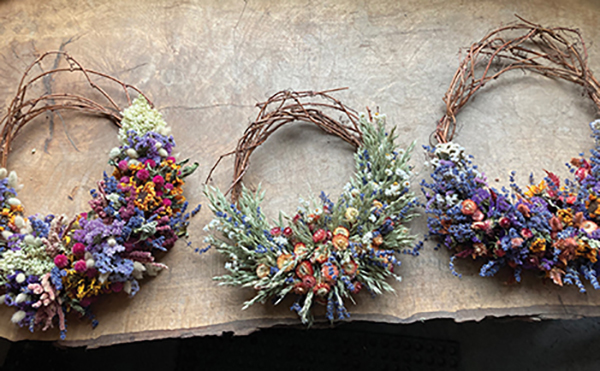 A variety of the author’s natural form wreaths. All images courtesy of the author.
The small size of strawflower, ammobium, and gomphrena make them favored accent elements. If I have time to leave a sunflower succession in the ground following the primary harvest, the smaller, secondary side flowers also dry nicely.
I do grow extra “filler” crops in bulk specifically for wreath making. I get an early spring harvest from overwintered dusty miller and a late season harvest from the spring seeded generation. I seed both bupleurum and nigella in the late summer to overwinter, and in the spring harvest the entire plantings for drying. Statice is my summer harvested workhorse.
In the field, I’ll often take a first heading cut from annuals to encourage longer stems and better branching for subsequent harvests. In the past, those short-stemmed cuts would have been discarded; now they are bunched for drying. Or if I am late to pick and miss the ideal cutting stage for fresh flower sales on a crop, most likely the mature flowers can still be cut, banded, and hung to dry, rejuvenating the bed in the process.
When we make bouquets for our CSA or market, we invariably end up with the floral dregs at the end of the session. Each handful of the picked over blooms can be hung to dry rather than being tossed or cycled back into the cooler. Bouquets that travel to market and don’t sell also get dried upon return. Having a second use option for floral material helps me maintain quality and freshness in the cooler without triggering my aversion to waste.
We’ve had to create many impromptu drying racks in the flower studio to accommodate the volume of material. After all the wires across the ceiling are filled, we hang bunches on nails from the walls. If really pressed for hanging space, I’ll take down dried product and box it for later use. Some longer stemmed items like millet, hydrangea and orach, I dry upright in waterless 5-gallon buckets.
Wreath forms
I use two types of wreath forms. The first is a circular metal ring with clamps that get crimped down. I use this type of form for the evergreen holiday wreaths, but it works nicely for dried flowers as well. I ordered my rings and the Craftmaster Clamp Machine from Mitchell Wreath Rings. The clamp machine attaches to the edge of the table and is easily compressed by hand. Because the wreaths are full circles, they take a lot of product to complete.
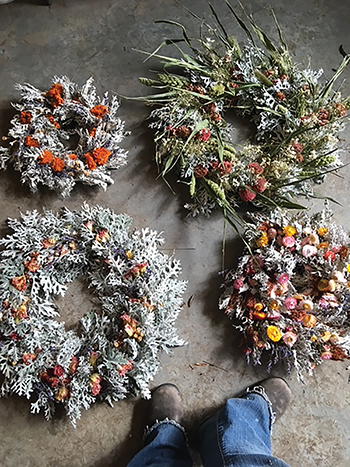 Above are some of the author’s wreaths made with metal ring forms.
I make individual bundles of material for each clamp. I start with a filler backing (like dusty miller), lay down a few line flowers, a focus flower, and a couple of accent blooms on top, then clamp the entire bunch together. I repeat the same bunch pattern each time around the circle. The final clamp is a bit tricky, but with a little fussing you can lift the first bunch up to slide in the final stems.
I also use vines as a natural wreath form. In November 2019 I took a class from wreath designer extraordinaire, Bethany Little, of Charles Little & Company outside Eugene, Oregon. She showed me how to twist vines into forms in the fall after leaf drop. I now make forms from curly willow, Virginia creeper, grape, and kiwi vines — all of which need to be trimmed annually.
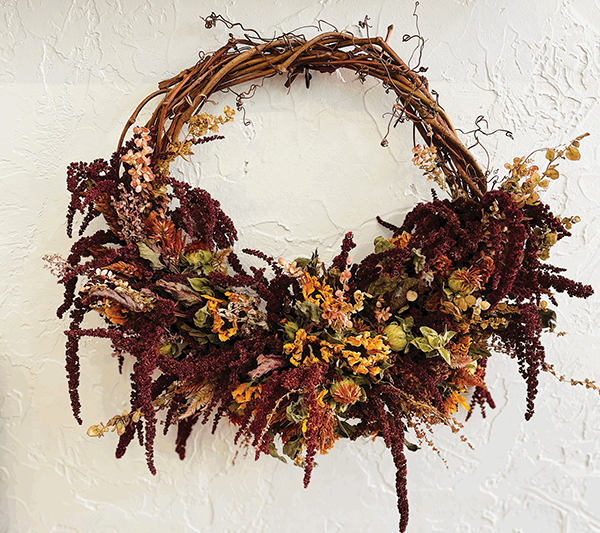
I love the variable shapes possible with the natural form. The irregular, non-circular possibilities of these forms create wreaths with added visual and artistic interest. They also use less dried flower volume as usually just the bottom half of the form is covered.
On the vine form, small bunches of flowers are attached with a flexible floral wire wrap in a repeating pattern along one side, then the other. At the center where the two sections meet up, a hot glue gun can be helpful to affix flowers to cover the meeting point. With hot glue you can also add fun treasures like pinecones, oak galls, and flower heads that broke from stems.
For both types of wreaths I usually work with three or four flower types. I’ll pull down several bunches of each. With a good pair of clippers, I cut through the whole bunch and discard the rubber band end directly into the trash. Then, I make and affix the mini bundles one at a time.
If I find a pattern I like, I’ll try to make several in a row. Creativity is fun, but is much slower than repetition. Also, it’s easier to sell wreaths through an online platform if you can use one picture and a name like “August Sunset” to sell multiple wreaths. The wreaths will last for years on interior walls.
I can make both types of wreaths in 20 to 30 minutes apiece. Small ones currently sell for $35, large for $55 in our small town. I imagine a higher price could be fetched in more urban markets or high-end boutiques. If I were selling the flowers fresh, each of the approximately 20 mini bunches used to make a single wreath could sell as a $3 posy bunch, except these are flowers that can’t be sold fresh for various reasons.
So, by very rough farm math, 15 minutes of harvesting material, five minutes to shape a wreath form, 30 minutes to make the wreath itself, plus some wire, rubber bands and work space can generate $55+ from what otherwise would be compost material. I also appreciate how the time to create the value-added portion of the product can be shifted to the off season and is an indoor, upright task.
Overall, I’m pleased with the quality of the wreaths, customer response, how they absorb potential overproduction from the fields or unsold market product, redistribute work to the winter and early spring, and generate income year-round. This season I encourage you to dry the flowers you don’t sell and see what fun you can have with them next winter. Your customers will love it, too.
Emily Asmus has been farming with her husband, Andy, and kick-ass farm team at Welcome Table Farm in Walla Walla, Washington, since 2007. She is well-occupied in raising vegetables, cut flowers, fruit, livestock, community, and three really awesome kids. Emily can be reached at emily@welcometablefarm.com.
Copyright Growing For Market Magazine.
All rights reserved. No portion of this article may be copied
in any manner for use other than by the subscriber without
permission from the publisher.